
[This is the web version of a paper written by me, Bobby Ulich, Richard Godfrey, and Andrew Banks. The PDF version is available here.]
1 Introduction
Presently, there is no active search to find MH370’s debris field on the seabed of the Southern Indian Ocean (SIO). The last search was conducted by Ocean Infinity, who consulted with official and independent researchers, and subsequently scanned the seabed along the 7th arc as far north as S25° latitude. Since then, independent researchers have continued to analyze the available data to understand what areas of seabed are the most likely, and why previous search efforts have been unsuccessful. The objective is to define a manageable area for conducting a new search of the seabed.
In a previous post [1], we presented an overview of Bobby Ulich’s research [2], aimed at more precisely locating the point of impact (POI) using statistical criteria that requires that random variables (such as the reading errors of the satellite data) are not correlated, i.e., are truly random. A subsequent post [3] describes the work of Richard Godfrey et al. [4] to analytically evaluate a large number of candidate flight paths using these and other criteria. The results of that work suggest that the final hours of the flight were due south in the Indian Ocean along E93.7875° longitude, which matches a great circle between the waypoint BEDAX (about 100 NM west of Banda Aceh, Sumatra) and the South Pole. The POI was estimated to lie close to the 7th arc around S34.4° latitude.
Work continues to evaluate candidate paths using an accurate integrated model that includes satellite data, radar data, flight dynamics, automated navigation, meteorological conditions, fuel consumption, drift models, and aerial search results. That exhaustive work is nearing completion, and documentation of the methods and the results is ongoing. Like the previous work [4], the ongoing work suggests that the final trajectory of MH370 was most likely along a due south path along E93.7875° longitude.
In the interest of providing information in a timely manner, we have chosen to recommend a search area based on this most likely path. A comprehensive paper which expands upon the methods and results presented in previous work [2,4], and provides further justification for the selected path, will be available in the near future.
2 Last Estimated Position (LEP)
Using the results of the analysis presented above, the last estimated position (LEP) is based on a final trajectory of a constant longitude of E93.7875°, which is consistent with the aircraft traveling due south from waypoint BEDAX towards the South Pole. The LEP is based on a location exactly on the 7th arc, and the uncertainty associated with the LEP helps define the limits of the recommended search area.
When the SDU logs onto the Inmarsat network, the SDU begins the log-on sequence by first transmitting a log-on request, which is followed some seconds later by transmitting a log-on acknowledge. For MH370, those were the final two transmissions, transmitted at 00:19:29 (BTO = 23,000 μs) and 00:19:37 (BTO = 49,660 μs), respectively. From past work [6,7], we also know that the BTO values for the log-on request and log-on acknowledge are “anomalous” in that the raw values are outliers that require a correction. Fortunately, the required corrections are repeatable, and can be determined by analyzing prior flights.
Using the Inmarsat transaction logs for MH371 and MH370 [8], the BTO log-on statistics from March 7, 2014, 00:51:00, to March 8, 2014, 16:00:00, were analyzed to determine what offsets might be applied to log-on requests and log-on acknowledges. There were 29 cases in which there was an R-channel burst just after the initial (R600) log-on request and subsequent (R1200) log-on acknowledge. Of those 29 cases, the number of packets in the burst was 3 for 20 bursts, 2 for 6 bursts, and 1 for 3 bursts. The average of each burst was used as the reference for the log-in request and log-on acknowledge. In 4 of the 29 cases, the correction for the log-on request was near zero, i.e., the BTO values were not anomalous, so only 25 cases were included for log-on request statistics.
For the log-on requests, the mean offset from the R-channel burst is 4,578 μs with a standard deviation of 94 μs. The maximum offset was 4,800 μs (+222 μs from the mean) and the minimum was 4,380 μs (-198 μs from the mean).
For the log-on acknowledge, we considered a correction of the form (a + N × W), where a is a constant, N is an integer, and W represents the delay per slot. We found that the standard deviation of the correction error (using the average of the R1200 burst as the reference) to be minimized for W = 7812.0 μs. That’s very close to the 7812.5 μs value suggested by the 128 Hz internal clock of the SDU. By forcing W=7812.5 μs, the mean error to the correction is 23 μs, and the standard deviation is 30 μs. The observed standard deviation is very close to the 29 μs that DSTG recommends to use for “normal” R1200 values [7]. The consistency of the standard deviation of the corrected anomalous values with the standard deviation of the values not requiring a correction is reassuring. The total correction to the BTO for log-on acknowledges is therefore (23 + N × 7812.5) μs.
Using these log-on corrections produces corrected BTO values at 00:19 equal to:
00:19:29: 23000 – 4578 = 18422 μs
00:19:37: 49660 – 23 – 4 × 7812.5 = 18387 μs
We combine these values to determine the BE value of BTO by using the inverse of the variance as weighting, yielding a BE value of BTO = 18,390 μs (σ = 29 μs). Using this BE value of BTO with the longitude of E93.7875° and an assumed geometric altitude of 20,000 ft results in a position of S34.2342° E93.7875° at 00:19:29, which we assign as the LEP.
3 Terrain Near the LEP
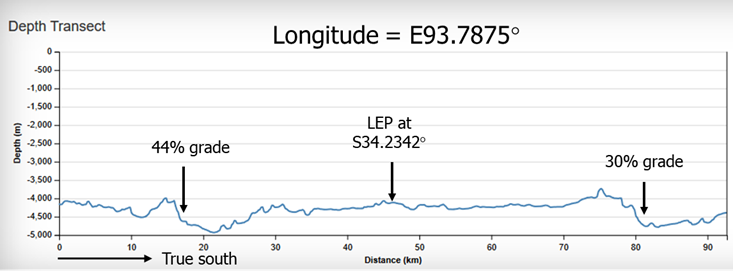
Figure 1 shows the subsea terrain in the vicinity of the LEP using data provided by Geosciences Australia [5]. Some of this area has already been searched by GO Phoenix (managed by the ATSB) using a towfish, and by Ocean Infinity (OI) using Seabed Constructor and its team of AUVs. However, as can be seen in Figure 1, some of the previously searched area has challenging terrain with steep slopes, and the debris field may have been either not detected due to terrain avoidance or shadows, or detected but not properly interpreted by reviewers. In particular, there is a steep slope that lies about 20 NM due south of the LEP that was not scanned by the towfish and appears to have been only partially scanned by the AUVs.

Figure 2 shows the ocean depth along a line of constant longitude in the vicinity of the LEP. The previously identified steep slope to the south of the LEP has a grade of about 30%. To the north, another slope has a grade of 44%. This slope was beyond the limits of the search boundaries of GO Phoenix, but was scanned by Seabed Constructor’s AUVs.
4 No Pilot Inputs after Fuel Exhaustion
In order to define the search area limits, we first consider no pilot inputs after fuel exhaustion. For this case, the search area limits are defined by the uncertainty of the LEP and the uncertainty of the uncontrolled flight path before impacting the ocean.
4.1 Uncertainty Due to BTO Noise
The uncertainty in the BTO produces a corresponding uncertainty in the position of the 7th arc. The calculated sensitivity of the arc position to the BTO is 0.104 NM/µs, i.e., a 1-µs increase in BTO pushes the 7th arc outward (southeast) by 0.104 NM. The 1-σ uncertainty of the arc position due to BTO noise is therefore 0.104 NM/µs × 29 µs = 3.0 NM.
4.2 Uncertainty Due to Altitude at 00:19:29
The LEP is based on an assumed altitude of 20,000 ft that is reached at 00:19:29, i.e., 1.5 to 2 minutes after fuel exhaustion. As the BTO represents the range between the aircraft and the satellite, the position of the 7th arc as projected on the surface of the earth depends on the altitude. As the aircraft would be between 0 and 40,000 ft at this time, we assign this altitude range as the 2-σ limits. The calculated sensitivity of the BTO to altitude is 12.8 µs/10,000 ft. The 1-σ uncertainty of the arc position due to altitude uncertainty is therefore 0.104 NM/µs × 12.8 µs = 1.33 NM.
4.3 Uncertainty of Turn Between Fuel Exhaustion and 00:19:29
Boeing conducted 10 simulations to determine the behavior of MH370 after fuel exhaustion with no pilot inputs [9] using a high-fidelity simulator for the 777-200ER aircraft. The trajectories for these simulations are shown in Figure 3. For each simulation, the autopilot was automatically disengaged after fuel exhaustion, and the aircraft turned slightly either to the right or to the left depending on a number of factors, including the electrical configuration, the initial conditions of the flight parameters, and the meteorological conditions. Within the 2-minute interval between fuel exhaustion and the log-on request at 00:19:29, the slight turn shifted the location that the aircraft crossed the 7th arc relative to where it would have crossed the 7th arc if the autopilot had remained engaged and the course was maintained. For the 10 cases, the lateral shift along the arc varied between 1.1 and 8.8 NM. As we don’t know how well the 10 cases represented the actual conditions, we conservatively assign a 1-σ uncertainty of 8.8 NM along the 7th arc due to the slight turn between fuel exhaustion and crossing the 7th arc.
4.4 Uncertainty of Trajectory Between 00:19:29 and the POI
In all 10 of the Boeing simulations, the aircraft banked after the autopilot was disengaged following fuel exhaustion. The magnitude and direction of the bank that develops is the net effect of a many factors, including thrust asymmetry, rudder inputs from the Thrust Asymmetry Compensation (TAC), rudder trim input, lateral weight imbalance, aerodynamic asymmetry, and turbulence, any of which increases the bank angle. On the other hand, the tendency to bank is opposed by the dihedral effect of the wings and the low center-of-mass. For all the simulations, the POI was within 32 NM from the 7th arc crossing at 00:19:29, as shown in Figure 3.
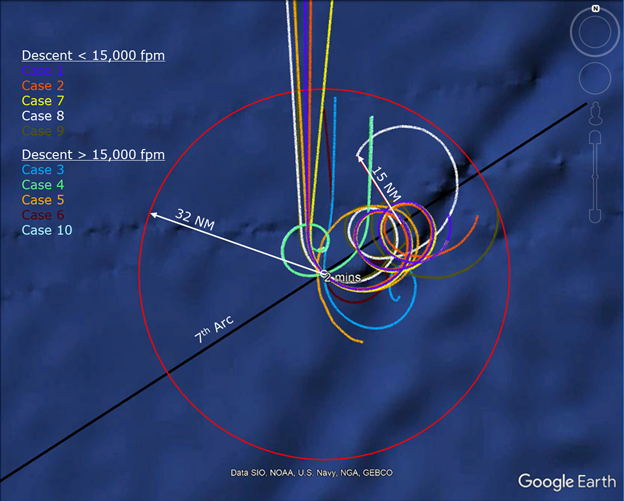
In some of those simulations, the bank was shallow, and phugoids lasting many minutes developed. In only 5 of the simulations did the rate of descent exceed 15,000 fpm while also experiencing a downward acceleration exceeding 0.67 g, which are the values of descent rate and downward acceleration derived from the two final values of the BFO. For these cases, the POI occurred between 4.7 and 7.9 NM from the point where the descent rate first exceeded 15,000 fpm. Other simulations of a banked descent after fuel exhaustion [10] suggest that an uncontrolled Boeing 777 would travel an additional distance of about 5 NM after a downward acceleration of 0.67 g and a rate of descent of 15,000 fpm simultaneously occur.
None of the Boeing simulations predict that the aircraft was in a steep descent as the 7th arc was crossed, so there is an unexplained discrepancy between the Boeing simulations and the descent rates derived from the final BFO values. In light of this discrepancy, we choose to not limit the distance traveled after crossing the 7th arc by only considering the distance traveled after the steep descent. Instead, we assign a 2-σ value of 32 NM for the distance traveled after crossing the 7th arc, based on the farthest distance that was observed in all 10 simulations, irrespective of the magnitude and timing of the descent rates.
4.5 Uncertainty Due to Navigation Error
There are two autopilot modes that could result in a trajectory that nominally follows a great circle between BEDAX and the South Pole. After passing BEDAX, if the autopilot remained in LNAV and the active waypoint was the South Pole (entered as 99SP, S90EXXXXX, or S90WXXXXX), the aircraft would fly along the longitude E93.7875° within the accuracy of the GPS-derived navigation. In this case, the expected navigational error would be much smaller than other sources of error, and can be safely ignored.
The other possibility is that after passing BEDAX, the autopilot was configured to fly along a constant true track (CTT) of 180°. Selecting this mode would require manually changing the heading reference switch from NORM to TRUE, as directions on maps, procedures, and in ATC communications are normally referenced to magnetic north, except in polar regions.
Unlike LNAV mode in which the cross-track error of the target path is continuously calculated and minimized, errors in track (which may be positive or negative) in CTT mode produce error in the due south path that may accumulate without correction. We assume here that that course is nominally 180° True, with a 1-σ uncertainty of 0.1 deg (0.001745 rad). As the distance between BEDAX and the 7th arc along the line of constant longitude is around 2365 NM, the cross-track error has a mean value of zero and a 1-s uncertainty of 4.1 NM. However, since the path crosses the 7th arc at an angle of 46 deg, the 1-σ uncertainty in position along the 7th arc is increased to 5.9 NM.
4.6 Search Area Based on No Pilot Inputs
Assuming there were no pilot inputs after 19:41, the uncertainties in the POI are summarized in Table 1. The 1-σ uncertainty along the 7th arc is 19.2 NM, and 16.3 NM normal to the 7th arc.
Table 1. Summary of POI Uncertainties Assuming No Pilot Inputs
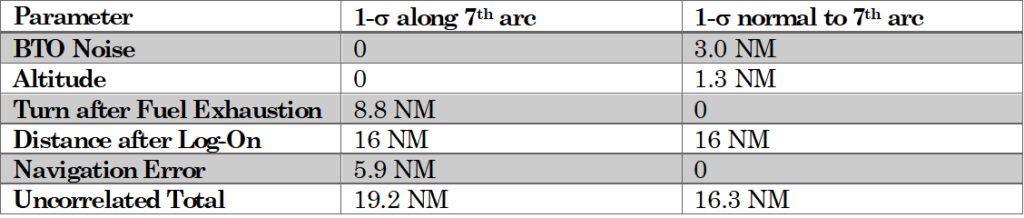
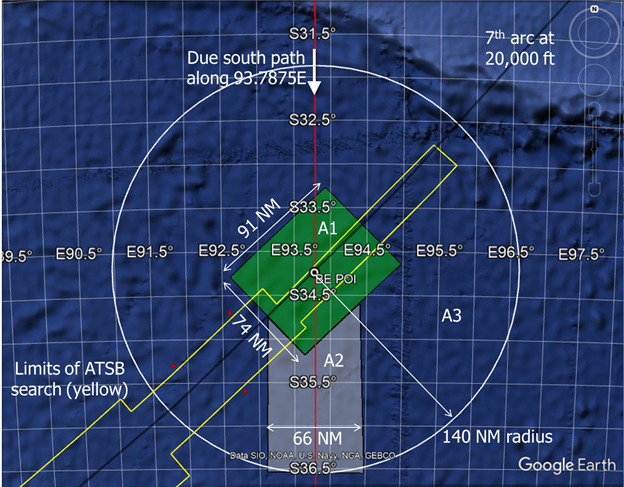
To achieve a confidence level of 98% requires searching an area defined by ±2.3-σ limits, with the LEP at its center. Based on this, the recommended area is 91 NM × 74 NM, and the total area is 6,719 NM2, or 23,050 km2. This area is depicted as A1 in Figure 4.
5 Controlled Glide Due South
We next consider the case in which there was a controlled glide after fuel exhaustion, which would extend the search area beyond the search area based on no pilot inputs. For a Boeing 777 gliding at an optimum speed, a glide ratio of about 20:1 can be achieved. This corresponds to a descent angle of 2.86°, and a continuous reduction in altitude of 1000 ft for every 3.29 NM traversed. Assuming an initial altitude of 42,400 ft (based on a standard altitude of 40,000 ft), the impact could be as far as 140 NM from the point of fuel exhaustion (ignoring the headwind at some altitudes, which would reduce the ground distance of the glide). If the glide started at a lower altitude, or if non-optimum airspeed was flown, the glide distance would be less. The uncertainty associated with the glide distance is much larger than other uncertainties, so we assume that with a glide, the POI might have been as far as 140 NM from the LEP, and use that as the southern limit.
The width of the search area as defined by a controlled glide is more difficult to estimate. If an experienced pilot wished to continue the flight path on a due-south course, that could be accomplished quite precisely. For example, if the autopilot mode was CTT before the fuel exhaustion, then a constant (true) track of 180 deg could be maintained using the indicated track shown in the navigation display. On the other hand, if the autopilot mode was LNAV before fuel exhaustion, then the cross-track error could be minimized by following the “magenta” line defined by the BEDAX-South Pole leg. In either case, the search area width could be limited to less than 10 NM to either side of the projected flight path.
Because we cannot be sure that there was an attempt to precisely follow a due south path, we assign a generous width to this part of the search area, centered on the due south path. A width of +/- 33 NM results in an additional search area of 6,300 NM2 (22,000 km2), and produces an area in similar size to A1. It is depicted as A2 in Figure 4.
6 Controlled Glide in an Arbitrary Direction
If there was a controlled glide that did not continue along the path flown prior to fuel exhaustion, it is nearly impossible to predict the direction. For instance, a path to the west would shield the pilot’s eyes from the rising sun to the east. A path to the northeast would extend the glide due to the tailwind. A path to the west would create more distance to the Australian shoreline. A path towards the northwest would be towards Mecca. Any of these directions is less likely than a continuation of the due south path, but it becomes nearly impossible to prioritize among these or other directions. Instead, we define area A3 as the circle with a radius of 140 NM, excluding the areas already included in A1 and A2. The area is roughly 48,400 NM2 (166,000 km2), and is depicted as A3 in Figure 4.
7 Conclusions
Recent analyses suggest that MH370’s flight path in its final hours followed E93.7875° longitude, corresponding to a great circle path between waypoint BEDAX and the South Pole. Using this result, the last estimated position (LEP) is S34.2342° E93.7875°. Although some of the subsea was previously searched in this vicinity, the terrain is challenging, and the debris field might have been not detected, or detected and misinterpreted. There is also the possibility that there was a controlled glide after fuel exhaustion, and an impact well beyond what was previously searched.
To define the search area near the LEP, three cases were considered, each with an associated search area. The highest priority search area of 6,719 NM2 (23,050 km2) assumes there were no pilot inputs after fuel exhaustion. The search area of next highest priority encompasses 6,300 NM2 (22,000 km2), and assumes there was a glide towards the south after fuel exhaustion. The lowest priority is the controlled glide in an arbitrary direction with an area of around 48,400 NM2 (166,000 km2).
8 References
[1] Iannello, “A New Methodology to Determine MH370’s Path”, May 31, 2019, https://mh370.radiantphysics.com/2019/05/31/a-new-methodology-to-determine-mh370s-path/
[2] Ulich, Technical Note presented in [1].
[3] Iannello, “A Comprehensive Survey of Possible MH370 Paths”, June 30, 2019, https://mh370.radiantphysics.com/2019/06/30/a-comprehensive-survey-of-possible-mh370-paths/, excerpted from [4].
[4] Godfrey, Ulich, Iannello, “Blowin’ In The Wind: Scanning the Southern Indian Ocean for MH370”, June 24, 2019, https://www.dropbox.com/s/9rpcnslz9g4izet/2019-06-30%20Blowing%20in%20the%20Wind%20-%20Scanning%20the%20Southern%20Indian%20Ocean%20for%20MH370.pdf
[5] “MH370 Data Release”, Geosciences Australia, https://www.ga.gov.au/about/projects/marine/mh370-data-release
[6] Ashton, Shuster-Bruce, College, Dickinson, “The Search for MH370”, The Journal of Navigation, Vol 68 (1), January 2015.
[7] Davey, Gordon, Holland, Rutten, Williams, “Bayesian Methods in the Search for MH370”, Defense, Science, and Technology Group, Australia, November 30, 2015.
[8] Iannello, “The Unredacted Satellite Data for MH370”, June 12, 2017, https://mh370.radiantphysics.com/2017/06/12/the-unredacted-inmarsat-satellite-data-for-mh370/
[9] Iannello, “End-of-Flight Simulations of MH370”, August 2018, https://mh370.radiantphysics.com/2018/08/19/end-of-flight-simulations-of-mh370/
[10] Iannello, “MH370 End-of-Flight with Banked Descent and No Pilot”, June 4, 2017, https://mh370.radiantphysics.com/2017/06/04/mh370-end-of-flight-with-banked-descent-and-no-pilot/
Update on March 12, 2020
The best estimate of the point of impact (BE POI) has been renamed the last estimated position (LEP), which is a more accurate description. The location is unchanged.
Thanks for the new post Victor. As discussed off line, I support all of the work you, Richard, Bobby and Andrew have documented in this new paper, except for the assumed max L/D. Regarding the three cases you describe:
• No Pilot Inputs After Fuel Exhaustion
• Controlled Glide Due South After Fuel Exhaustion
• Controlled Glide in an Arbitrary Direction After Fuel Exhaustion
…for the case of “No Pilot Inputs After Fuel Exhaustion”, the estimates are reasonable and well supported by the data and analysis (assuming the path was straight south). However, for the second and third cases (Controlled Glide), the assumed maximum gliding distance (140 nm) is based on the theoretical maximum “clear air” L/D ratio m (~20:1), while practical experience suggests a shorter maximum gliding distance.
My analysis in support of a maximum glide distance of 97-110 nm can be downloaded here: http://bit.ly/2GMxzBo
@airlandseaman
You question the range and L/D ratio regarding the piloted glide scenario.
In our paper, the probability of this worst case estimate of 140 NM actually happening is described as the lowest priority. I agree with you that a glide to 140 NM is a “theoretical maximum”, however I never forget the case of the “Gimli Glider”, which you also mention in your paper. This accident was not theory but a real experience. The Gimli Glider was a B767, that lost pressure in both fuel pumps over Red Lake, Ontario (CYRL) and first diverted at 41,000 feet toward Winnipeg, Manitoba (CYWG), then 120 NM distant. The 39 NM distance from Gimli at the start of the emergency, you mention in your paper is factually incorrect.
“The first signs of trouble appeared shortly after 8:00 p.m. Central Daylight Time when instruments in the cockpit warned of low fuel pressure in the left fuel pump. The Captain at once decided to divert the flight to Winnipeg, then 120 miles away, and commenced a descent from 41,000 feet. Within seconds, warning lights appeared indicating loss of pressure in the right main fuel tank. Within minutes, the left engine failed, followed by failure of the right engine. The aircraft was then at 35,000 feet, 65 miles from Winnipeg and 45 miles from Gimli.” Final Report of the Board of Inquiry into Air Canada Boeing 767 C-GAUN Accident Gimli Manitoba July 23, 1983.
The pilots realised that they might not reach Winnipeg still 65 NM distant and decided to divert to Gimli, Manitoba (CYGM) then only 45NM distant. On approach to Gimli, the pilots realised that they still had too much speed and altitude and performed various glider manoeuvres to slow the aircraft and maintain the glide path including executing a slide-slip. The total distance flown from the start of the emergency over Red Lake to Gimli was over 100 NM and the pilots initially thought they could reach Winnipeg 120 NM away. 140 NM does not seem an unreasonable limit.
We have presented our search recommendation with a clear differentiation between the highest priority areas and the lowest priority areas. I am confident that MH370 will be found in the higher priority areas, but if not, then we cannot exclude the lowest priority areas.
Richard: I’m aware of all that.
RE “The 39 NM distance from Gimli at the start of the emergency, you mention in your paper is factually incorrect.”
I never stated anything about a 39 nm distance. I’m not sure where you read that, but it was not from me. What I wrote was:
“In the case of C-GAUN (the “Gimli Glider”), the captain of the flight was an experienced glider pilot who was aware of the best speed to fly for maximum L/D (~220 kts). Flying at that speed, the FO estimated the glide performance over a 10 nm period during which the aircraft lost 5,000 feet for an effective L/D =12.1.”
I agree the Gimli experience is based on real (767) data.
Mike
I sent the following to Mike in an offline discussion:
“ I agree it’s important to not over estimate the potential gliding range. However, I think we all agree that it’s also important that we don’t cut things too fine and risk missing the debris field altogether, especially given the lack of data on the realistic gliding range of these aircraft and the actual atmospheric conditions at the time. In that light, I think the 140 NM that was proposed is a reasonable upper limit for what might theoretically be achieved under ideal conditions.
I think we also agree that the probability the debris field will not be found within the primary or secondary search areas is somewhat remote. If the aircraft is not found within those areas, I would expect that any search of the tertiary area would start towards the centre (excluding the primary/secondary areas) and work outwards. Perhaps we should recommend that a search of the tertiary area should not proceed outside, say, 100 NM until the entire area inside that range has been searched.”
Andrew: I agree with that characterization.
@Richard
@airlandseaman
RE: “The 39 NM distance from Gimli at the start of the emergency, you mention in your paper is factually incorrect.”
The Canadian accident report only mentions ‘miles’ and does not specify if the distances are statute miles or nautical miles. There is no mention of ‘NM’ anywhere in the report. A distance of 39 NM is the equivalent of 45 statute miles, so perhaps the 39 NM mentioned in the ATSB table that Mike included in his paper is simply a conversion of the ’45 miles’ in the accident report.
@VictorI et al.
Thank you for the new article, which I appreciate for both the timing and the “operational” character of it. It can help the discussion forward.
From a scientific point of view: the question how likely it is that BEDAX-SP (LRC) is the path that was followed, is still on the table. Nevertheless, also based on my own analysis, I feel reasonably comfortable with S34.3 at the 20000 feet 7th arc as a “centerpoint”.
In the operational spirit of your article and taking into account:
– What I know about your analysis of the satellite data
– My own analysis of the satellite data
– The recent article by sk999
– The CSIRO debris drift analysis
– Doubts about the reported “effectiveness” of the “GO Phoenix” / SAS search effort,
I would tend to add an area (say A4) to the recommendation, stretching between S32.5 and S36.0 along the 20000 feet 7th arc, up to a width of about 25 nm at both sides of the arc.
My current recommendation would then be to scan in the order A1, A2, A4, A3 or perhaps even A1, A4, A2, A3.
@Victor. I hope the reception of your collective work is commensurate with the effort put into it.
Thank you for the clear presentation.
Observations:
• 4.3 “….the slight turn shifted the location that the aircraft crossed the 7th arc relative to where it would have crossed the 7th arc if the autopilot had remained engaged and the course was maintained.” I hope this is back-to-front since that would eliminate the “turn after fuel exhaustion” element in search planning.
To me the final transmission is at the arc and that location shift should be applied backwards to the point of fuel exhaustion.
• The first 4.4 Another good reason for not favouring the 4.7 to 7.9 NM is that doing so would imply the aircraft was in an abnormal configuration – and that would need justification.
• Second 4.4. (Presume this should be 4.5, et seq?) Is the CTT route materially less probable? If so that could affect search priorities.
About the effect of the APU on the farthest distance the aircraft could glide unpiloted, based on your home simulations and the manuals that could be expected to tighten left spirals, shortening the throw of those if anything. However for the right spirals, albeit both of the abnormal configuration, it is conceivable these could have been straightened. Still, I would have thought the probability of the spiral being one of those and, if straightened, that the flight would remain that way would be low.
One other effect of APU operation, based on the greatly increased fuel consumption of its in-flight operation, is the appreciable effect its open intake can have on drag. However unpiloted I would expect that would reduce time in the air and so, all else being equal, distance.
In a piloted glide over a distance it would be reasonable to assume that a lack of IFE connection was the result of the APU being unable to access all the residual fuel, the glide also being steepened a little from APU inlet drag. Alternatively it might have taken a while for the pilot to realise the APU had started and had shut it down at that point. (I will not go into what else he might have done.)
• Now your 5. A 42,400ft starting altitude for a glide takes no account of the energy height lost in the descent needed for the final transmissions even though some could have been recovered. APU drag would cost more, that running for say 3½ mins (its inlet door will shut on APU failure).
Regarding the glide search width for A2 you say, “Because we cannot be sure that there was an attempt to precisely follow a due south path, we assign a generous width to this part of the search area….”.
I think it reasonable to suppose that his gliding would be with a distance purpose, that is he would glide in a straight line. In that case the glide area should be an rectangular still but could be of reduced width, that including just the ‘BTO Noise’, ‘Altitude’ and ‘Navigation Error’ from your Table 4.6, plus the 10NM either side that you mention.
Search Priorities: For my part, the unsearched areas should be the priority. The first should be that unsearched part of the 30˚grade to the south, followed by the unsearched glide area, which would be from about 34.9˚S, width as above, to say 100NM from the POI; ie about 36˚S (as per the below to @Richard I agree with ALSM). The third should be your A3 unsearched areas followed by the remaining A3, noting that the simulations suggest little prospect directly under the POI (that’s why I have preferred to call it the Final Transmission Point!)
Thence, review as to what next, depending on the time taken already etc and it may be an ask to seek a commitment to that now.
There might be some search priority fine tuning based on the CTT route probability as above.
@Richard. Re the 100 NM, from your quote the second of the Gimli glider’s engines failed at 35,000 ft, when the glide to Gimli was just 45 miles. The rest was powered: evidently to that point they had hoped the residual fuel on pump failure would last longer….
They decided they may not make Winnipeg, 65 miles (presumably NM) away. Even so, that would have required just a 12:1 glide ratio assuming no headwind, that allowing a couple of thousand feet overhead there.
So they thought they might not achieve even that glide ratio.
To get to Gimli needed just 8:1.
Subtracted from the best L/D clean there is also drag from the RAT to consider and in MH370’s case, the APU inlet drag for part of it.
@Victor. A logical refinement to my above is that assuming a straight glide, instead of the glide area being rectangular it is an isosceles trapezoid, tapering out reach the 10NM either side just at 100Nm from POI.
@Victor Iannello
@DrB
@Richard
@Andrew
Gents, thank you and congratulations on this body work. I think we all understand how much time and effort has gone into it.
From a purely pragmatic perspective, have you presented this work to anyone who can actually do something with it? If so, any initial reaction that you can discuss?
@airlandseaman
You attached a paper that you wrote in your initial comment. In this paper you have a table that clearly states the maximum distance from the start of the emergency for the Gimli Glider was 39 NM.
The emergency started at 41,000 feet over Red Lake and the captain immediately diverted to Winnipeg and started descending. Red Lake waypoint (CYRL) which was en-route between Montreal and Edmonton is 149 NM from Winnipeg Airport. The closest point of the actual lake called Red Lake is 140 NM or 161 statute miles from Winnipeg Airport.
“the aircraft ran out of fuel over Red Lake, Ontario” Final Report of the Board of Inquiry into Air Canada Boeing 767 C-GAUN Accident dated July 23, 1983.
@TBill. Below are tank capacities. From the SIR fuel loads the figures are not much off yours, ullage being 3,112 US Queen Anne gallons (older than the Imperial!). However there is no space much when the main tanks are full (a little in vent channels) unless you count the surge tank (overflow) capacity. I have not found a figure for that. Normally no fuel in there.
I have not yet had a look at your references thanks and how you come by 1700 gals of air dissolved in the fuel. That seems a lot in 16,008 gals of fuel; over 10%!!. More than Coke? Also, what is there takes a fair while to be drawn out by low atmospheric pressure.
I think your scepticism of vapour lock in the gravity feed, “downhill” is justified, based on @Andrew’s advice as to NNC statements about that. As to the effect of a near empty tank I am unsure the NNC addresses that and presume there could be vortices that might cause air entrainment and leave residual fuel on flameout thereby. Then again the engines might just cough a bit, the combustion chambers flash igniting.
Naturally none of that addresses APU “uphill” vulnerability.
https://www.dropbox.com/s/cj81be99g2xfnro/777-200%20tank%20capacities.pdf?dl=0
@Mick Gilbert, @Niels,
Mick asked “From a purely pragmatic perspective, have you presented this work to anyone who can actually do something with it?”
Niels stated “From a scientific point of view: the question how likely it is that BEDAX-SP (LRC) is the path that was followed, is still on the table.”
We received a request from Ocean Infinity to make a search recommendation, if possible by the end of January 2020, and we carved out that section of the upcoming paper and turned it into the self standing paper that Victor has published above. This paper was sent to Ocean Infinity in response to their request, just prior to its publication on this web site.
We continue to finalise the full paper, which is meanwhile 50 pages long excluding appendices. As mentioned, a “comprehensive paper which expands upon the methods and results presented in previous work [2,4], and provides further justification for the selected path, will be available in the near future.” We fully appreciate in releasing the search recommendation without the full paper, that the full justification for our recommendation is missing. I can assure that the comprehensive paper will provide that full justification.
@Richard
Thanks Richard. I have no doubt that you fellows will have the BE POI nailed down six ways to sunset.
I was curious as to whether anything is likely to come of it. And if OI were on the front foot asking for a recommendation then it sounds like there’s a live possibility that something might. That’s heartening.
Richard: Sorry for any confusion about the Gimli Glider glide ratio. The Gimli 12.1:1 glide ratio was not derived from any information in the Table published by ATSB (39 nm distance). It was derived from information contained in the official Canadian Accident Report and other reports that described the procedure used by the crew to estimate the glide ratio in real time. They estimated the glide ratio by noting the altitude (read from the back up cockpit altimeter) at several points along the radar derived path. ATC gave the crew positions and distances. From those positions, they worked out the glide ratio. The numbers they used were: 5000 ft drop in altitude over a 10 nm path.
Andrew and I discussed this off line. We agree that 12:1 is probably very conservative. The crew was under considerable pressure and needed a conservative estimate. The sample space was short (only 10 nm or 2-3 min). So it was probably on the conservative side.
OTOH, in the case of C-GITS, the plane glided from 34,500 feet to 13,000 feet over a distance of 57 nm (effective L/D=16.1) before circling to land at Lajes Air Base in the Azores. This information can be found in the official accident investigation report. The average over a 57 nm stretch will be more accurate than the 10 nm sample in the case of the Gimli Glider.
Thus, 16:1 is probably a very good estimate of the typical, achievable glide ratio, notwithstanding a somewhat higher theoretical L/D ratio.
@airlandseaman
No worries!
If 16:1 L/D ratio is a very good estimate of a typical achievable glide ratio, what is your best estimate of a worst case or conservative value, to be absolutely sure of the maximum range calculation.
Richard: For the purposes of defining the area for a “controlled glide” scenario, either due south or random, I would limit the radius to 100 nm. That is consistent with 16:1 and 38000 feet starting altitude. Obviously, neither is an absolute certain number, but I believe 100 nm would surely cover 99+% of the possible glide scenarios.
Note that people have flown gliders with a 20:1 L/D hundreds of miles, working areas of thermal, ridge or wave lift along the way. It really depends on the atmosphere you are flying through. But given the location and time of day, convection was probably not a significant factor, so realistically, 100 nm is a good number for budgetary purposes. If you don’t find it within 100 nm, go back and search further up and down the 7th arc. That would be a better bet than searching out to 140 nm.
For clarity, I made an illustration of the areas “A4” I wanted to introduce for the discussion
https://www.dropbox.com/s/sfvkpyr9egpw3rn/A4_added_cropped.png?dl=0
@airlandseaman: As you said in a private email, in Appendix 1.6E, page 8 of the Final Report, Boeing advises:
In general, the airplane could achieve an estimated driftdown range of 0.0034 nm per foot of altitude. Therefore, at FL350 the additional range after the dual engine flame-out would be approximately 120 nm and at FL400 it would be approximately 136 nm.
Boeing’s descent angle corresponds to (L/D) = 20.7. We assumed a value of 20.0, based on lift and drag calculations using the “Obert curves” for the B777-200 at near optimum glide speed and a slightly higher (geometric) altitude. While our assumptions for glide distance may be optimistic and may not be achievable in practice, we also have to be careful about recommending a distance that might miss the debris field. In that regard, our glide calculation of 140 NM is consistent with Boeing’s advice.
@David: I agree that a case can be made to progressively increase the width of the search in the southern direction. However, compared to A2 that was proposed, I think we would narrow the width at the northern extreme rather than extend the width at the southern extreme. Considering that A1 is already wide at that latitude, I’m not sure there would be significant savings in search area.
@David said: Presume this should be 4.5, et seq?
Another reader sent me a private email with this and one other correction. Those corrections should be already incorporated in both the web and PDF versions.
@Niels said: From a scientific point of view: the question how likely it is that BEDAX-SP (LRC) is the path that was followed, is still on the table.
In some ways, we have put the apple cart before the horse in recommending a search area without full justification for the priority placed on the BEDAX-SouthPole path. However, the full paper has taken much longer to complete than anticipated, and there was a request to see our results. Hopefully, the full paper will be completed and released in the coming weeks, and the justification for the BEDAX-SouthPole path can be more fully debated.
I should add that while the same four authors are writing the full paper as the search recommendation, the first two authors will be Bobby Ulich and Richard Godfrey. The search recommendation summarized in this blog post will be a part of the full paper.
In the article above, there is mention of the subsea terrain, and the difficulty in obtaining sonar data due to terrain avoidance and shadowing, especially for the towfish.
Don Thompson has been analyzing the quality of the data collected by GO Phoenix, and has some interesting results. Perhaps he can comment on what he is finding.
@Victor and the Team
Thank you so much for the new post!
What was new for me was the visual detail of the cliff-obstructed search area, which seems to be both the Go Pheonix and OI areas. Trying to see how far off Arc7 that is. I seem to recall OI lost an AUV around there and had to go back for it. A nominal 180 South path was a earlier favorite of mine too, so sounds like at least filling those data gaps is readily agreed, and perhaps OI saw that and perhaps already knows that is an outstanding action item, perhaps bolstered after the experience from ARA San Juan. That specific detail would be a limited search objective though.
@David
Thank you for taking a look at the fuel model and also the design tank capacities and at least they give us a presumed fuel density close to my guess. Now if we only knew the actual KLIA MH370 fuel density.
My understanding is the amount of oxygen (and nitrogen) dissolved is not totally understood…one reference says the data sources of O2 solubility ranges from about 40-80 ppm. Looks like the simple “DIY fuel tank model” is a little on the high side but for our purposes probably fine. The pro versions of the flash models give users a lot of choices of thermo systems conceivably we could find a best fit. I like the way the model shows how O2 dissolves more than N2 and such. If you want to calc the solubility, plug in the numbers and just do the flash at 14.7 psia and eg; 70F. You can use the UNIT button choose your favorite units of measure.
@TBill said: I seem to recall OI lost an AUV around there and had to go back for it.
You have a good memory. Seabed Constructor made a 5-km circle centered on (-34.9564, 93.7768), which would be about 44 NM south of the BE POI, and only about 6 NM to the west of its longitude. That point falls within area A1.
@VictorI, Richard
I understand the reason to do it like this, and appreciate you shared the recommendation soon, which is before the full paper could be finalized and shared. It makes the discussion a bit complicated though. I tend to agree with your A1, but for the discussion about what would be the next priority (A2, A4(A), A4(B), other?) it would indeed be important to have the info as complete as possible: preferably including your full paper. Also in this respect, it would be really nice to have some more info from Don regarding his sonar scan (meta)data re-analysis. I’ll be patient. I don’t want to push or criticize anyone in this regard: an enormous voluntary effort has been put in to come to the point where we are now.
Some of you might wish to independently explore the subsea data, which is available from Geoscience Australia’s Web Map Service (WMS). Using the WMS, data can be loaded dynamically into Google Earth (GE). The resolution of the sonar data seems to be less than what is stored on the Geoscience data warehouse, but the convenience of using GE is very attractive.
Here’s how to create the dynamically-loaded overlay in GE:
Go to Add/Image Overlay/Refresh/WMS Parameters/
Add the following WMS: http://marine.ga.gov.au/geoserver/marine/wms
Select which layers you’d like to add and “OK”
Name the layer
That’s it!
@ALSM. Re @Richard’s request for your “best estimate of a worst case or conservative value, to be absolutely sure of the maximum range calculation”, I note that at the ATSB’s Definition of Underwater Searches 3 Dec 2015, p18 they describe a simulation (presumably RAT deployed and by Boeing) where the glide was 125 miles from 33,000 ft, ie L/D of 23. Looks high but there it is.
Another factor: unless the glide also allows a ditching some height will be lost in a final dive.
@Victor, Richard, Dr B, Andrew. An acknowledgement.
https://www.airlineratings.com/news/new-search-areas-mh370-world-experts/
Some probable rantings…
What to look for? And how?
The past searches on the ocean floor seems to have focalized on debris around a cubic meter in size. The search was “systematic”, like grass mowing and the work has been “gigantic”. Nothing related to MH-370 have been found on the ocean floor: Or the wreckage is outside the search zone, or the debris field was missed. There is no other solution. But is there another way to find MH-370?
Twenty something parts have been found: two very big (the flapperon and the outboard flap) and small ones. Many small parts were found by Blaine Gibson: How does he proceeded? Just looking on the beaches were currents from SIO could have brought them. There are kilometers and kilometers of coast line were debris could have landed: From Tanzania to South Africa, there are thousand of kilometers and even if BG has searched many, he could have only looked at a very few of the possible landing places. Some others have also found some parts, just by chance.
The meaning of that is there are many debris which beached, the vast majority not reported: Too small, not recognizable and mostly not seen. I think that imply the plane has shattered on impact. How much debris? Thousands? Millions? And why there are also quite intact parts like the flapperon and the outboard flap? Could those two have detached in air before high speed impact of the main frame? Perhaps we can’t know before the wreck is found, but the high number of small parts is certain: if not, Blaine could not have found so much debris. And if there were tens of thousands floating parts, there has to be also many which have sunk.
If tens of thousands parts have sunk, the debris field have to be large: the depth is in the order of kilometers and with currents, difference of “sunkability”, difference of shapes, a debris field in the order of one kilometer seems realistic. Ten thousand parts in one square kilometer (that is 1 million square meters) give around one debris for 100m², that is a 10 x 10 meters square. But the debris “concentration” could be lower at distance of the impact point. Supposing those guessed figures: say there are at least one 5cm² debris for 20 x 20 meters at 500 meters of the impact point. If we take a picture of this 400m² surface, to “see” a 5cm² part, 400m²/5cm² that is “only” 0.8 million pixels that is required. Take 10 times more “to be sure”: a 8 millions pixels picture of 20 x 20 meters of seabed every kilometer is enough.
Are the guessed figures above realistic enough? Is this kind of search possible?
It seems to me that “eye search” on pictures (or live cam) could be more efficient that automatic “radar” ones: the human “eye” (the brain, in fact) is very sensible to geometric “anomalies” and shattered parts on the seabed will be such anomalies as long as the “marine snow” have not concealed them: The time is against this search possibility. Is it too late?
Sorry for my English… and for the length of the post…
@Victor,
I will simply say your last summary was not what I expected. You say
That exhaustive work is nearing completion, and documentation of the methods and the results is ongoing. Like the previous work [4], the ongoing work suggests that the final trajectory of MH370 was most likely along a due south path along E93.7875° longitude.
There is nothing in your narrative to support your assertion that a path due South along E93.7875 is most likely.
@TBill. About air entrainment and vapour pressure :
https://www.dropbox.com/s/xbqyrsa0b856ygg/For%20TBill%2C%20air%20entrainment%20in%20fuel%20and%20vapour%20lock.%20docx.docx?dl=0
@DennisW: That wasn’t the purpose of this article. That will be explained in the paper that has not yet been released.
@Victor et al. Thanks for the new post. This does a great job of explaining the basis for the search area magnitude and priorities having assumed that a specific path was flown. I am still looking forward to the principal document that demonstrates the uniqueness of the “due south from Bedax” solution.
I also look forward to hearing more about the “effective coverage” of the Go Phoenix and OI searches in this area. The magnitude of your top priority area corresponds to the whole of A1. Are you recommending that the parts of A1 that have already been searched be searched again? Or only those parts with data holidays?
@Paul Smithson asked: Are you recommending that the parts of A1 that have already been searched be searched again?
That’s a good question. It would depend on the quality of the data. I don’t think we’re ready to make that determination. The investigators identified “data holidays” for offtrack, terrain avoidance, equipment failure, low probability of detection, and shadows. Even the “good” data might have some issues if the towfish’s height above the surface was not properly maintained. Don tells me the SAS technology requires accurate positioning to get good results.
I’m expecting Don to chime in today. He can tell us more.
@Victor. Thanks, I look forward to Don’s inputs.
In the same vein, your Fig 4 indicates in yellow the limits of the ATSB search. To put your A1 recommendation in context, it would be useful to show OI-searched areas on there as well. Eyeballing Fig 1, it looks like ATSB+OI is about 36NM wide? Implying that (excluding data holidays) nearly 50% of A1 has been searched. Does that sound about right?
@DennisW
You stated “ There is nothing in your narrative to support your assertion that a path due South along E93.7875 is most likely.”
Niels previously stated “From a scientific point of view: the question how likely it is that BEDAX-SP (LRC) is the path that was followed, is still on the table.”
I previously explained: “We received a request from Ocean Infinity to make a search recommendation, if possible by the end of January 2020, and we carved out that section of the upcoming paper and turned it into the self standing paper that Victor has published above. This paper was sent to Ocean Infinity in response to their request, just prior to its publication on this web site.”
“We continue to finalise the full paper, which is meanwhile 50 pages long, excluding appendices. As mentioned, a ‘comprehensive paper which expands upon the methods and results presented in previous work [2,4], and provides further justification for the selected path, will be available in the near future.’ We fully appreciate in releasing the search recommendation without the full paper, that the full justification for our recommendation is missing. I can assure (you) that the comprehensive paper will provide that full justification.”
Why not read the previous comments first, before shooting from the hip?
Victor even used the analogy of the cart before the horse. Even you must understand that picture.
@Richard
<i.Victor even used the analogy of the cart before the horse. Even you must understand that picture.
Yes, I saw that analogy, and I don’t mean to shoot from the hip. I am just very dissappointed that the crux of analysis remains missing. The latest post is just a piece of fluff, IMO. Hard to imagine anyone putting any serious weight on it.
@Richrd
While I can claim expertise in navigational instruments, the accuracy of inertial navigation is something I only know by rule of thumb. The cross track error, statistically, grows as the sqrt(t) since the initiation of the flight.
It would be a great help to those of us who are still concerned with the totality of the path prior to the 7th arc if you would at least publish the track parameters (albeit as preliminary results).
@David
Many thanks for the jet fuel theory info.
@Sid Bennett: The cumulative navigation error does not grow with time for modern navigation systems that incorporate GPS.
Wow. Thank you for all of your efforts. I hope a future search benefits from this.
Do you think the debris drift analysis can help? It would seem like the northern half of your search area would have a higher probability.
If the plane came in hot, which it seems like it did, then wouldn’t you also expect it to be in the northern half?
Why so much focus on the far south / extended flight path?
@Sid Bennett
We have decided not to release the track parameters or flight path charts separately from the paper, as without the explanation contained in the paper, this would lead to much unnecessary discussion. We prefer to focus on finalising and publishing the paper.
We only wanted to release the search recommendation, that we had made to Ocean Infinity, out of consideration of transparency to this forum.
You have already seen the criticism from DennisW: “The latest post is just a piece of fluff, IMO. Hard to imagine anyone putting any serious weight on it.”
I disagree with DennisW, but he is of course entitled to his view. I respect his right to disagree.
Comment on
Release of Recommendation
Prior to release of Finalised Report of Analysis :
Victor,
Dr B,
Richard,
Andrew,
and all
We all recognise the extent to which you must have gone to derive any conclusion, and the time you must have spent on the task.
You have chosen to define your “Best Estimate of Point of Impact” by a point in space at the nominal time of the last satellite contact.
Then you have considered uncertainties, including the uncertainty concerned with likely deviation from a previous flight path after the time of Main Engine Fuel Extinction and the time when the aircraft “crossed the 7th Arc”.
You have given us explanations for how you have made estimates of those uncertainties.
Areas A1, A2 and A3 on the surface of the ocean, may I note not on the sub-sea floor, are results of all the above.
This release gives potential sea floor searchers an area or areas on which to concentrate review of existing data.
Methinks this is not such a bad thing if they wish it.
I checked and note that your refinement of your estimate has not varied significantly over months.
For example:
Richard, on October 8, 2019 at 7:29 am, you definitively said: “… flight path to 34.4°S is confirmed.”
Later, Victor, on December 11, 2019 at 9:37 am, said: “… crossing the 7th arc near 34.3S latitude.”
This was then queried by Paul Smithson;
And on December 11, 2019 at 12:50 pm, Richard said: “Correct! 34.3°S”.
You seem to be convinced of your data.
Now, that you have been pressured into releasing your BE of POI,
You are now under pressure to release the Finalised Report of Analysis.
Would be unfortunate to let the meal go cold.
_________________________________________________
On a slightly (kinder) note:
It has been some decent time since the last search was ceased.
I wonder just how many changes and improvements and advances in searching for such as engines or undercarriage there might have been in the meantime.
I wonder, if for example it would be advantageous to have two UAVs operating together at close quarters transmitting on slightly different frequencies.
__________________________________________________
Finally,
Wonder how critical will be the uncertainty on the time of Main Engine Fuel Extinction.
@Richard. “We only wanted to release the search recommendation, that we had made to Ocean Infinity, out of consideration of transparency to this forum.”
That seems to have caused some problems but thanks for the courtesy.
https://www.youtube.com/watch?time_continue=130&v=l0ksWjIZ47o&feature=emb_logo
…fleet is currently under construction and is expected to be deployable by the end of 2020.
Each unmanned surface robot will serve a wide range of industries by being fully equipped to perform a multiplicity of offshore data acquisition and intervention operations down to a depth of 6,000 meters. These robot ships will be capable of remotely deploying a wide range of the latest sensors as well as AUVs and remotely operated underwater vehicles (ROV) for visual and acoustic data acquisition.
Armada’s fleet requires neither people on board nor a host vessel nearby. Instead they will be controlled and operated by experienced mariners via satellite communications
https://www.oedigital.com/news/475288-ocean-infinity-launches-armada
@CMR
Damn, and Iowa could not even count votes with a smart phone app.
The issue remains A1,A2,A3 (above) could be in a lot of places without a lot more support for the 34.4S assertion.
Ocean Infinity – Armada – is in the process of building 15 low emission robotic ships, a combination of 21 and 37 metre vessels.
Some of the smaller ships will be available in the fourth quarter of 2020, the rest will be ready in 2021.
The smaller vessels can be delivered to locations by air, while the larger ones will need to be moved by ship.
The robotic ships will be deployed worldwide and can operate individually or as a fleet, from shallow to the deepest waters.
The unmanned vessels will be able to launch ROVs and carry out surveys, on pipeline routes, or the acquisition of seismic data.
(from) https://www.energyvoice.com/oilandgas/221895/armadas-robotic-fleet-to-shoulder-survey-work/
@David
You stated: “ That seems to have caused some problems but thanks for the courtesy.”
You cannot please all the people all the time (Abraham Lincoln).
You can never please DennisW, any of the time (Richard Godfrey).
As an avid reader of this blog for many years, I wish to express a big thank you for the transparency and communication of the recommendation made to OI through this recent post. The images and flow of the post capture the essence of what will come through in detail in the paper very nicely.
Coming from a family of researchers and academicians, I think most of the contributors and readers of this blog fully appreciate the effort it takes to put together a paper of the scale and magnitude that is needed to cover to address so many different aspects that go into this comprehensive analysis and search recommendation.
With the approaching six year mark of this huge loss of lives, it is indeed very heartening to see that there is some hope for closure for the families and public at large to revive this search though there is no assurance.
Thank you to the team that has worked so hard in this recommendation and to everyone who provided you support including your families.
@ST: Thanks for your kind words.
I understand the impatience expressed by some here in seeing the full paper. All I can say is some of the modeling is more detailed and more accurate than prior efforts. An example is the detailed fuel flow model, which very accurately calculates the physics and the fuel flows for climbs, descents, and turns, and has been extensively calibrated and tested using prior flights of 9M-MRO.
The statistics of the satellite data is another area that has received considerable attention. This includes estimating the expected Allan variance of the SDU’s oscillator, and using that metric as part of the overall probability calculations. I don’t think anybody has tried to do this before as part of MH370 path reconstructions.
The good news is that the path estimated to be most likely has not shifted for some time, and the search recommendation was made on that basis.
Running to catch up…
@David, concerning the detail of the 777 empennage. While my public library service provides access to some documents published by ScienceDirect/Elsevier the specific title that includes the article on the 777 empennage is not included.
ATSB published their findings for the origin of ‘No Step’, the horizonatal stabiliser panel fragment. I, and others, had concluded that the piece was a good fit for an upper surface, leading edge, closing panel. The wings, horizontal and vertical stab, all employ GFRP composite panels to close the ‘gap’ between the fore/aft spars and the leading/trailing edges. It should be apparent from images of the debris (and whole parts) how the panels are profiled on the inward facing surface to provide stiffness.
Others: concerning seafloor. I’m drafting a summary to be shared shortly.
https://www.dropbox.com/s/r6116cju52lfo3g/research%20note%20feb20.pdf?dl=0
I have extended my exploration of the Inmarsat pilot frequency data from the duration of the flight to a full day. The re3sults are posted. Should anyone want the raw data, let me know.
My conclusions are:
The rms error in predicting the BFO bias offset is less than 1 Hz.
The predicted change in bias offset over a day (excluding the eclipse) is about 6Hz p-p.
Achieving this accuracy requires knowledge of the satellite temperature.
Sid: Re: “Achieving this accuracy requires knowledge of the satellite temperature.”
Actually, knowledge of the satellite temperature is not needed since the pilot carrier provided the means to exactly correct for all sources of transponder frequency translation error, including payload master oscillator diurnal changes due to temperature, long term (aging) drift and eclipse effects.
IAE…How does pilot rms error relate to the rms error in predicting the BFO bias? Noise on the pilot will be much lower than other sources of noise on the BFO values, so a negligible contribution.
@Victor – Thanks for sharing the intricacies that have been analyzed in this new paper. For sure it will be an exciting read when it is published. You and the other major contributors to this work such as Dr.B, Richard and Andrew bring such complicated work to an understandable format even for a lay person. That is itself incredible and wish you all the very best.
@airsealandman
OK. If you have the pilot frequency, you can extract the difference between it and whatever the computed Doppler shift is and call it the correction to the bias. But this does not expose the underlying physical mechanisms. My approach provides a physical explanation of the pilot frequency deviations . The point to be made is that the preponderance of the variation in the pilot frequency time history is substantially deterministic in its nature and is not some statistical process with a high variance.
You and I know this, but there are some that dispute the issue.
You may be aware of the methodology that DSTG used in analyzing the other flights, but I am not. Also, the particular anomalous result they emphasize is intriguing, but there is insufficient data for us to do more than speculate.
Sid: What do you mean “… correction to the bias…”? The pilot does not correct the BFO bias (~150 Hz). I corrects the transponder master oscillator offset, which was OTOO 10 kHz. That offset is a function of time and temperature, but it does not matter what that offset is as long as it can be used to correct ALL the other inbound carriers for that offset on a continuous basis. The BFO bias term is strictly a function of SDU frequency errors, mainly originating in the OCXO error.
@Sid Bennett said: The point to be made is that the preponderance of the variation in the pilot frequency time history is substantially deterministic in its nature and is not some statistical process with a high variance…You and I know this, but there are some that dispute the issue.
You are conflating the drift of the satellite oscillator with the drift of the SDU’s oscillator. Nobody disagrees that the satellite oscillator drift can be related to the temperature of the satellite. Inmarsat demonstrated this quite well in the JON paper published in September 2014. The bias drift that we refer to is NOT due to the satellite oscillator drift, because that effect is properly included in the BFO calculation. Rather, the observed bias drift in the test flights is due to the drift in the SDU’s oscillator.
@DonThompson. Thanks for squeezing this in amongst your sonar work.
Not a priority but if and when you get time, in your identification was that moulding jink apparent in what you and others used as a reference?
While the ATSB makes no mention of such a specific I see it does point to the 4th panel from the root so maybe there is such a jink there?
@Victor @Richard @DrB:
AF447 was discovered 24 miles from the known point of impact at a depth of 12,800 feet. I can’t see anything here – although there may be something in the eventual paper – that takes the undersea drift into effect. The wreckage could conceivably be dragged well out of this defined search area, most likely to the North East.
@VictorI
The effect of the oscillator temperature dependence during the MH370 flight was accounted for by the bias offset values given by ATSB. These compensate for the short term temperature variations in the satellite oscillator temperature causing a deviation from the sinusoidal model of the residual satellite path Doppler effect.
Please note that for the period 00UT to about 15UT on that day, there is a variation of 6 Hz p-p. If the flight had ocured then, a separate bias adjustment value would have been needed for each ping time.
Perhaps you know exactly how the DSTG people did the corrections of the bias for the eclipse effect and the diurnal temperature variations for the other flights analyzed, but I do not. Unless the pilot frequency or the temperature was used at each transmission time, an apparent instability in the bias would be reflected in the BFO results as an error with respect to the calculated value of BFO may exist. [My view is that bias instability is that component of the measured BFO that is not accounted for by a deterministic model.]
As you well know the system was not operating as designed due to the southern latitude of the receiving station. The ATSB provided a set of discrete adjustments to the BFO value to account for the 1/3 portion of the change due to the frequency change in the satellite oscillator.
Your comment suggests that you have non-public data regarding the steady-state SDU oscillator bias instability (at least in a statistical sense) at a lag time of hours. That would be interesting.
However, the data in the Ashton paper suggests that the underlying secular drift in the satellite oscillator is about 0.1Hz/h.
@RM:
“AF447 was discovered 24 miles from the known point of impact..”
I think you’re wrong about this, although the early problems in the seabed search were a bit of a wild-goose chase.
From the French air-safety final report for AF447:
“The wreckage was found at a depth of 3,900 metres on 2 April 2011 at about 6.5 NM on the radial 019 from the last [LKR: this is ACARS, I believe] position transmitted by the aeroplane.”
AF447 resulted in a lot of recoverable surface debris, including many bodies. But the debris field was pretty compact with much of the aft section fairly intact. If MH370 was shredded [my belief, based on recovered debris], a lot of debris could have drifted miles before hitting the seabed, but this is not a good match to AF447.
@Sid Bennett said:
Please note that for the period 00UT to about 15UT on that day, there is a variation of 6 Hz p-p. If the flight had ocured then, a separate bias adjustment value would have been needed for each ping time.
Not true. The pilot frequency error can be used to determine and account for the satellite frequency drift for each test flight, as long as the pilot frequency error and satellite orbit are known.
Perhaps you know exactly how the DSTG people did the corrections of the bias for the eclipse effect and the diurnal temperature variations for the other flights analyzed, but I do not.
I know what Inmarsat said about how their BFO model was constructed. They described it in detail in their paper from September 2014, including how they account for satellite oscillator drift. I have no reason to believe their statements are false.
As you well know the system was not operating as designed due to the southern latitude of the receiving station. The ATSB provided a set of discrete adjustments to the BFO value to account for the 1/3 portion of the change due to the frequency change in the satellite oscillator.
It doesn’t matter how the EAF compensation was calculated and applied. It’s all properly accounted for in the model by incorporating the measured and recorded pilot frequency error.
Your comment suggests that you have non-public data regarding the steady-state SDU oscillator bias instability (at least in a statistical sense) at a lag time of hours. That would be interesting.
I have no BFO or SDU data that I have not shared publicly. Bobby and Richard have taken a deep dive into the available BFO data for past flights, and will have some interesting results to report regarding the Allan variance of the SDU’s oscillator.
We’re not converging, and I am repeating what I’ve previously said. Perhaps others might want to continue this thread with you.
@Victor
Well crafted post,IMO.
The final report into the 2016 EK521 accident in Dubai has been released:
https://www.gcaa.gov.ae/en/ePublication/admin/iradmin/Lists/Incidents%20Investigation%20Reports/Attachments/124/2016-Final%20Report%20AIFN-0008-2016%20UAE521%20published%20on%206-Feb-2020.pdf
@Andrew: After pressing the TOGA switch, wouldn’t the PF have his hand on the thrust levers to ensure they advance forward? I understand the confusion about TOGA after landing, and I understand the high workload at that point, especially with the wind conditions, but it would seem that ensuring high thrust on a TOGA is fairly basic.
Recently, there have been a cluster of news stories about MH370 published by the Murdoch media empire. Here is a screen capture of a list of stories appearing today in The Mercury. The list of stories includes:
• MH370 search reopens as new clues emerge (?)
• World expert shut out of MH370 search (seems to be about Chari Pattiaratchi)
• Indian Jones MH370 hunter in fear for life
• Six pieces of missing evidence hide MH370 truth
• Explosive MH370 doco could spark new probe
I can’t get past the paywall, but perhaps others here either subscribe or otherwise have access and can report back to the group.
I was able to access the first article as published in The Herald and saved it as a PDF. It’s worth a read, although at this point I’d say the prospects for a new search are unknown.
@Victor
Over on Reddit we are mulling over DailyMail article saying OI and NoK looking to continue search soon. May be an interesting month with the SkyNews documentary and 6th anniv coming up. Good way to start off 2020 if we can get some progress.
@TBill: From my vantage point, nothing has significantly changed. Malaysia has already said it would search with credible new evidence, and OI has already stated that it’s willing to consider a new search. Grace continues to stay in touch with the Malaysian leadership.
We all hope there will be a new search, but the recent spurt of news stories is more hype than substance, timed with the broadcast of the Sky News documentary, which is unlikely to contribute anything new, but will likely find new ways to unjustifiably bash the ATSB.
Another version: http://bit.ly/2uxBvn3
blob:https://www.heraldsun.com.au/f14e7028-2ab4-4e95-95a6-04208c4a1e2b
@Victor
RE: “After pressing the TOGA switch, wouldn’t the PF have his hand on the thrust levers to ensure they advance forward?”
That’s certainly what we train and it’s obviously good airmanship, but it’s not spelt out in the FCTM. The Commander stated that he had his right hand on the thrust levers when he pushed the TO/GA switch, but there is no mention of his hand placement after that time. I guess it’s possible he took his right hand off the thrust levers and put it on the control column to assist with the rotation, and therefore missed the cue that the thrust levers had not advanced. However, human factors textbooks also describe the human brain as a single channel processor that has trouble processing multiple inputs in a short space of time, particularly in stressful situations. Along those lines, I think It’s also possible the Commander became task saturated and simply missed the fact the thrust levers had not advanced. The brain does some strange things under pressure!
@Andrew
Regarding EK521, are you surprised that the GCAA seems to have danced around the fact that the Emirate’s FCOM Go-Around and Missed Approach Procedure clearly states that immediately after setting flaps, and prior to dealing with the landing gear, the crew are meant to verify ‘that the thrust increases‘ and that the PM is meant to ‘Verify that the thrust is sufficient for the go-around and adjust as needed‘?
It seems like there should have been some mention of the crew’s failure to follow the Go-Around and Missed Approach Procedure included in Section 3.3 Causes.
@Andrew. Thanks for the EK521 final report.
With the final report on the Ethiopian 737 Max due next month I have taken a (first) look at the preliminary. Maybe this is old ground but under I highlight how the left AoA indicator decreased during the final pitch down from 63˚ to minus 21˚ over 5 secs, the right decreasing about 5˚.
This is accompanied by vertical ‘g’ decreasing to minus 0.2, accounting for the right’s decrease.
https://www.dropbox.com/s/u1c1byte0gtogfa/Ethiopian%20prelim%20report%20left%20AoA%20indications.png?dl=0
Immediately following that with back-stick increased and ‘g’ with that. The left AoA rose to 40˚ over around 3 secs, the right’s 5˚ being about restored, pitch down momentarily being slowed. Then as the pitch down again increases the left drops to minus 60˚ while the right drops to minus 12˚, the negative ‘g’ naturally increasing with that.
A theory has been that the left AoA vane suffered bird strike during take- off. However I do not see the above indications can be consistent with it being jammed, or any other consequence of vane external physical damage. The 5 secs to fall away etc, is quite smooth and that also is inconsistent with an electrical intermittent short, stiction or an internal wiring failure. There is not the constant index error of the Lion Air two vanes.
Indeed ‘exaggeration’ might best characterise these indications.
One question is why the designers would envisage the need for such extremes in AoA indications as 75˚ and minus 60˚ and maybe extending beyond those.
We have a one litre 3 cylinder run-about. Its speedo does not read reverse at all and it does not find it necessary to extend its forward speed band to 300 Km/hr either.
One other observation is that when the co-pilot could not get the manual trim to work, speed was above VMO.
Two specific questions for you please are whether;
1. in the above the total relaxation of stick back pressure in the last 8 secs might result from loose harnesses under decreasing ‘g’, and;
2. also there and in the below, whether the stick movement, mini accelerations in all planes and jerkiness in roll could be expected.
https://www.dropbox.com/s/fyaf9jcg6huz2fy/Ethiopian%20prelim%20report%20FDR%20data%20p27.png?dl=0
Try these MH370 news links:
https://www.news.com.au/travel/travel-updates/incidents/new-search-for-mh370-after-clues-emerge/news-story/9e475778bcb39f240a0655267475e14f
https://www.airlineratings.com/news/new-search-possible-mh370-year/
Does anyone know if/when Linköping University’s MH370 study will be completed?
https://liu.se/en/news-item/liu-forskare-bidrar-till-sokandet-efter-mh370?fbclid=IwAR0EnSCxegJ4Yh8GDtxuIgZlgVMz-2_he2yBZM56GKNJj8gjurB4fVWHRbY
Does anyone know if/when Swedish Linköping University’s MH370 study will be completed?
@Mick Gilbert
RE: “It seems like there should have been some mention of the crew’s failure to follow the Go-Around and Missed Approach Procedure included in Section 3.3 Causes.”
Section 3.3 para (d) states:
The flight crew did not take corrective action to increase engine thrust because they omitted the engine thrust verification steps of the FCOM ̶ Go-around and Missed Approach Procedure.
It’s also mentioned in Section 3.2.4 (Findings Relevant to Flight Operations) para (x) and Section 2.5.4 (Flight Handling) discusses the ‘attentional tunnelling’ that might have caused those omissions (pp.99-100). Does that not cover it?
@Victor
In my 8:28 pm reply to your post, I incorrectly said ‘there is no mention of his hand placement after that time’. It’s mentioned later in the report that the Commander stated that his hand remained on the thrust levers. However, the investigators qualified that statement by saying: “Even though the Commander had stated that his hand remained on the thrust lever, his memory of what happened during this ‘tunnel vision’ period could have also been affected.” Given the comments in the report re ‘attentional tunnelling’, I think the second part of my reply is more relevant.
@David
RE: 1. in the above the total relaxation of stick back pressure in the last 8 secs might result from loose harnesses under decreasing ‘g’
Possibly, but the lap straps are normally done up fairly tight. Perhaps realised it was hopeless and gave up.
2. also there and in the below, whether the stick movement, mini accelerations in all planes and jerkiness in roll could be expected.
I’m not sure. Perhaps there was some mechanical or thermal turbulence.
David said:
February 9, 2020 at 4:10 am
about ET302 and “how the left AoA indicator decreased during the final pitch down from 63˚ to minus 21˚ over 5 secs”
David, I looked at this hard and long when the preliminary report came out and some time later when someone else made a comment on the subject.
My then review confirmed my first thought.
Let’s consider the AOA external vane to have a mass balance on its pivot shaft, but within the airframe and not subject to the external airflow. In other words let’s consider the vane to be counterbalanced.
All the responses of the Left AOA sensor to g loads seem to be sensibly explained by response of counterweight to those g loads.
My interpretation was that the external vane was broken off, or fell off, virtually almost at lift-off of the aircraft.
Subsequent transients of the Left AOA reading from Max indication (Counterweight fully down) when subject to positive vertical acceleration to the opposite when the aircraft was subject to negative vertical acceleration all seemed to me to be consistent with would have occurred as the counterweight moved due to changes in ‘g’ loading.
@Andrew
Yes, thank you, I guess 3.3 (d) does cover it. After waiting three and half year for the final report I was expecting the failure to set and verify thrust to be somewhat more central to the findings.
@Andrew. Thanks
@George G. An unbalanced internal counterweight does look plausible. The vane would be trailing to be stable, the counterweight forward. Rotation under ‘g’ thence would be in the right sense.
Its movement towards up or down limits appears progressive, as distinct from flip flop, suggesting some form of damping. Even so it would be nice to have an explanation as to why at 05:41:22 it moves off its +ve g limit by 7 deg while under +ve g still.
There is a question also as to the relationship the loss of left AoA heating has with all this. Collateral electrical damage presumably.
@lkr: My mistake, you’re absolutely right. The debris field was 24 miles from where the surface wreckage was found, which had already drifted significantly by the time they found it. In any case, 6.5 NM is still a lot of subsea drift before the wreckage came to a stop on the seabed and the proposed search area should take the currents into account when defining areas of the seabed to scan, rather than assuming the wreckage would have travelled precisely perpendicular to the surface, particularly considering the larger pieces – landing gear, engines and so on – were subject to this drift with AF447.
@Mick Gilbert
RE: ” After waiting three and half year for the final report I was expecting the failure to set and verify thrust to be somewhat more central to the findings.”
I think it’s a given that the crew made several mistakes that contributed to the accident, and I believe those mistakes are identified in the report. However, pointing the finger at the crew does nothing to improve flight safety and is contrary to the principles of Annex 13 investigations, which don’t seek to apportion blame. None of us go to work with the intention of making a mistake, but we’re all human and we do make mistakes. From a flight safety point of view it’s far more important to understand why this crew made those particular mistakes on that day. Additional defences can then be identified and implemented to (hopefully) prevent a recurrence. I think the report does a reasonable job of doing that.
@Andrew
Fair enough.
@ Rob Moss
AF447 was found “about 6.5 nautical miles north-east on the radial 019 from the last known position transmitted by the aeroplane”. Refer to Page 19 of the BEA report.
At this time the aircraft was around 35,000 feet and it remained in the air for another four minutes.
The Point of Impact with the ocean presumably was relatively close to above where the items were found on the sea floor.
The two engines were found about 30 metres apart when normally about 20 metres apart. Whether or not this is indicative of “drift” or how they were separated from the wings and the direction they took afterwards may be a moot point.
With regards to MH370, let’s suggest that the transverse motion of debris during traverse from the surface of the ocean to the seafloor may be of some concern. For the “weightier” items “drift” may not seem important, BUT, if there are currents around or along sub-sea topography is it possible that falling items may be drawn towards the base of those items and thus be harder to discriminate during the searches ?
This is a question for oceanographers.
@ David
Answering your most recent question last. Loss of the external AOA Vane would somewhat disrupt the vane and sensor anti-icing system.
Concerning the region of shaking and rolling you highlighted between 05:38:30 and 05:41:30, it is clear the aircraft was moving around a fair bit. This includes the period where the pilot with the active stick shaker began to fight the automatic AND commands and really started to have to pull hard on the control column. (Say between 05:40:00 and 05:40:30)
David, you say: “Even so it would be nice to have an explanation as to why at 05:41:22 it moves off its +ve g limit by 7 deg while under +ve g still.”
Looking at the Vertical Acceleration Trace this is the lowest the TRACE gets (or got) to prior to the final critical automatic AND command. It maybe that the weight on the pivot shaft stuck or jammed when it slammed down (in less than a second according to the trace) at the time of the AOA failure event. Possibly that it came a little unstuck at the “05:41:22” time you highlighted.
Also, although the FDR may produce relatively faithful records of measurements from the monitoring instrumentation, I suggest that short time transients cannot be recorded with high fidelity. In other words the actual transient may have been of greater magnitude.
Compounding this, and in cognisance of the shaking and rolling mentioned above, the accelerometer can only monitor the acceleration it, itself, suffers. I do not where in the aircraft the accelerometer is or how close the port AOA sensor is to the accelerometer.
AND I thought I WAS proof reading BEFORE transmission:
Possibly it came a little unstuck at the “05:41:22” time you highlighted.
I do not know where in the aircraft the accelerometer is or how close the port AOA sensor is to the accelerometer.
@Georg G. Good thinking. Doubtless the AoA anti-ice element runs out into the vane as you imply.
About the general lateral and roll shaking I highlighted, perhaps the Report was pointing out that both with autopilot engaged and particularly at its disengagement there was that distraction.
At disengagement there was a 10 deg right roll I see, immediately before the first MCAS AND command.
Yes maybe the counterweight becoming unstuck would explain the 7 deg left AoA vane decrease, even without any accelerometer position inaccuracy.
Thanks to all for your regular insights over these years of MH370 research.
With Ocean Infinity requesting search area suggestions, I’d like to offer up my prime candidate site directly on the 7th Arc near Java. It is based on new hydrophone and seismic acoustic data that was not included in the official reports. I submitted it to the IG (and Malaysia and others) about a year ago as I was coming out of stealth. The search area is relatively small.
https://370location.org/2019/02/a-consistent-mh370-waypoint-path-to-a-specific-7th-arc-location
While I haven’t been vocal in online discussions, I have spent many hundreds of hours developing the algorithms and attempting to confirm nearly all of the locations I’ve seen proposed by others. The 370Location.org site addresses some previous reports on the acoustics with new info, and has the history of my previous candidate suggestions that were nearer the earlier priority search areas.
Additional confirmation of a possible flyby at Cocos Island seismometer could be confirmed by infrasound recordings that are inaccessible to the public.
https://370location.org/2018/08/cocos-island-infrasound-may-be-key-to-locating-mh370
I like to ask that other researchers at least take another look at my findings, and please plug the BFO and fuel consumption from my proposed waypoint path into your models. Seismologists with better tools can confirm the strong “Javanomaly” event that occurred on the 7th Arc but 55 minutes after 7th Arc timing, possibly narrowing the search area.
With Hope, Ed Anderson
p.s. If the plane were flying waypoints up to BEDAX, what would have changed to then fly due south?
Thank you for sharing, Ed. You’ve done a lot of work, and it deserves to be more widely discussed.
It would seem that your path requires changes in lateral and vertical speed to match the BTO and BFO values. While this is possible, we are back to the question of prioritizing this route over others that require no changes, and the probability of a route with multiple maneuvers matching straight, steady speed routes.
Do you have any explanation for why no debris has been found along the shores of Java, Christmas Island, and Cocos Island?
As for why the route changed to due south, one possibility is the pilot intended to lead investigators to believe the plane continued to the northwest, descended below radar coverage, turned south, climbed, and flew south until fuel exhaustion. Recall that for the due south path after BEDAX, the plane may have continued to fly between waypoints in LNAV mode, the active waypoint being the South Pole, which is easily entered into the FMC.
@370Location
I do seem to recall discussing something like this a year or so ago. The flight path is somewhat similar to MH370-Captio.net and also consistent with @TimR’s offshore Java proposal. Xmas Island has been a semi-popular secondary theory and can be made to fit BTO/BFO but to this point seems less likely due to complex flight path. There is another acoustic event way down south maybe 43S below Arc7 that has quite a few vocal supporters (not me or IG).
@Ed,
A long time ago.
https://sites.google.com/site/mh370tibet/updates/05june2014
Thanks for exploring my findings!
@Victor
The BTO matches are exact, because they define where the waypoint paths cross the ping rings. The BFO is not a factor in the path, but I attempted to calculate the BFO error. I believe this route is different because it not only matches the tangent curve path almost exactly, but takes into account two tentative flyby detections and a solid endpoint event.
As for not finding debris on Java, Christmas, or Cocos, I noted in my writeup that debris drift would have been almost due west, which misses those beaches: “The Nullschool wind model shows winds from bearing 95 and currents toward 280, then offshore away from Java. Some debris might be expected at Java beaches or Christmas Island due to local variations of the winds and currents, but none was found. Enggano or Cocos Islands might have been sites for debris to first appear, but none was reported.”
I did search satellite imagery of Enggano and found a large squarish object appeared near a fishing camp on the SE shore, but it could be anything.
I too reported an early theory that the plane flew due south, which coincides with the loudest and oddest event of the day around 56S 92E, and crossed the but it was determined by LANL to be past the fuel range. (possibly an ice event).
@TBill –
It may be surprising that this path is a close match for the BTO tangent curve fit for a straight line path. Only the second ring path was chosen to match, but the other crossings all fall on or near the fitted curve.
I believe the southern event at 43S 94E you’re referring is based on the Acoustic Gravity wave approach by Usama Kadri. I looked for and could not find any event on the H01. I question his other results, too. His published detection of an event near Madagascar is based on an H08 Deigo Darcia hydrophone arrival, which at higher frequencies is very strong at 01:59:00 – the same Javanomaly event that I analyze in detail including reflections off the Java coast. I assume that he got his hydrophone numbers swapped (I made that same mistake early on.).
@DennisW –
That’s a very interesting report that I hadn’t seen! (I did look into buoy wave height data, to no avail.) The one minute sample rate of the tidal sensors is going to cause severe aliasing. Looking into it deeper, the arrivals at close to 1km/s group speed would be oceanic Rayleigh waves, which would arrive with a period of around 14 seconds and last about two minutes. This is near the rate that waves crash on beaches, but it might be possible to detect a distant event with seismometers by the unique frequency dispersion of Rayleigh waves. Java seismometers are inland, but Christmas Island has two seismometers. I’ve looked carefully at seismic periods around 4-5 seconds for the resonance between seafloor to surface. I’ll consider exploring even longer periods to see if there are any unique signatures.
BTW,
What is missing in the acoustic data is any solid sign of a high velocity vertical impact along the 7th Arc. That might not be expected to reach the SOFAR channel, but it should propagate strongly downard to the seabed. I believe I see antipodal seismic signs of AF447 as a control. The antipode of the 7th Arc is the SE USA with very good seismic coverage, but months of searching finds no strong signature from a 7th arc impact. A controlled ditching might not be detectable, but a late underwater implosion could account for the strong Javanomaly event.
I hope the supporting acoustic data sets this waypoint path hypothesis apart from others that depend only on satellite timing. If the Cocos flyby alone could be confirmed by infrasound at 22:22 (or even 22:46), it should at least narrow the range of possibilities.
Thanks Again! — Ed
@370 Location. “If the Cocos flyby alone could be confirmed by infrasound at 22:22 (or even 22:46), it should at least narrow the range of possibilities.”
This has a possible infrasound blip at 22:46:40,
https://mh370.radiantphysics.com/2018/07/30/mh370-safety-report-raises-many-questions/#comment-17533
In case of interest, two subsequent posts on this were at:
https://mh370.radiantphysics.com/2018/07/30/mh370-safety-report-raises-many-questions/#comment-17533
https://mh370.radiantphysics.com/2018/07/30/mh370-safety-report-raises-many-questions/#comment-17576
@370Location. The first of the two subsequent posts should read:
https://mh370.radiantphysics.com/2018/07/30/mh370-safety-report-raises-many-questions/#comment-17558
@David – Many thanks for pursuing the infrasound. It was one of your earlier posts that led me to that LLNL poster.
I contacted the authors last year and they acknowledged the timezone error that caused the dismissal of the infrasound. The lead researcher has retired but said he would try to review the data. Per his followup last week, he has no data access and the other authors have higher priorities.
The data is available only to institutional scientists on contract with the CTBTO, which specifically excludes me. I’ve put in a request to Geoscience Australia who apparently manages the Cocos array and logs the data, but no response. The CTBTO has publicly released Cocos infrasound data from current day back to April 4, 2014, which has been very useful for confirming the premise of the LLNL attempt at detecting jet traffic. I’ve requested that CTBTO go back another month to release Mar 8 infrasound and hydrophone data, but no response.
The Cocos seismometer does show a brief 4 Hz pip from 22:46:05-22:46:15 with mostly E-W energy. There are faint signs of a surrounding doppler shift from an 8Hz N-S blip at 22:45:45 to a 6Hz E-W blip at 22:46:50 UTC. I could post the spectrogram if you are interested.
Unfortunately, a 22:46 event at Cocos would not have been a close flyby, with the 5th ping ring at 22:41:22 being some 200-300 km east of Cocos, depending on the flight heading. A distant flyby would presumably have been slower with less doppler.
The proposed 22:22:22 flyby is more prominent on the seismometer, and fits between the 4th and 5th arcs nicely without any major change in flight speed. The link to my infrasound report again is:
https://370location.org/2018/08/cocos-island-infrasound-may-be-key-to-locating-mh370
Proofreading this time! – Ed
@Rob Moss, Ikr, George G. About wreckage dispersal while sinking.
Say a RR engine less some panels and attachments weighs 12000 lb in air, 10000 lb in water, with its protuberances has a drag coefficient protuberances of 2 and a cross section on sinking of 3m then, it will take 23 min to get to 5000m deep. A web comparison of a shot put sinking, again leaving aside those niceties, would take 16½ mins.
This is intended to give just a rough idea. Aside from the above approximations, which include the pitch at which the engines would descend, it leaves aside such niceties as the effect of Reynolds number (seawater to level air about 10:1) and time while approaching terminal velocity, changing viscosity with depth and changing density (pressure, salinity).
I have read that at depth currents of about a twenty fifth to a fifth of a knot can be expected: if so they can be disregarded. I do not know when surface currents become deep currents and what direction change can be expected but would suppose that using the surface current direction and halving its speed would be representative.
On this basis the drift due to current probably will be under a mile.
That applies to non-dispersing wreckage. Much of those items with small-area attachments will be spinning while that with larger will be spiralling and to me most dispersal therefore will be not due to gliding but the very slow descents of low density items. Some of course will be delayed or start slower and accelerate as entrained air decreases volume and/or escapes (including intact tyres).
Thus the dispersal in a high speed impact should be greater, in that a lot of low density items will be released, yet the wreckage easier to locate. This is because the momentum of heavier items, of greater sonar reflectivity, will be stripped of more of their low density components at impact, so the current will disperse them less. At the same time though, impacts will cause their own dispersal. I think it likely that that contributed to a section of the AF447 fuselage ending 2 km from the main debris field.
In MH370’s case the ATSB did not rule out a ditching, its Operational Search at p99 saying about the implications of the Captain’s home simulations, “……considerations included the impact on the search area if the aircraft had been either glided after fuel exhaustion or ditched under power prior to fuel exhaustion with active control of the aircraft from the cockpit.”
However a successful low speed ditching looks to be unlikely if only because the fuselage was torn open. It is unlikely also that there was an unsuccessful low speed ditching (due to waves) because of the damage to interior items and some evidence that flaps were not deployed.
I do not think the Comoros type of unpowered flaps-up ditching can be ruled out. In that case the right wing broke, both engines came off, the fuselage broke in two places and the left horizontal stabiliser dug in. Engine panels separated and quite possibly wing components were flung off the right wing.
Then there is the likelihood of a high speed descent at impact.
However, as has been rumoured in the press recently, if there has been a damage assessment that the vortex generator damage is evidence of a high speed crash, as distinct from collision with another item, that would rule out a flaps-up ditching.
Of the high speed ditching and high speed descent I would have expected the field of the densest components (engines, undercarriages, wing attachment box, APU and small dense items) to be more concentrated in the latter, akin to AF447 but smaller. The dense components in the former would be more likely to be bounced/scattered on impact and to descend more slowly, current affecting them more.
Much of the above is of course arguable!
@Andrew
Can you briefly describe the correct way for a B777 pilot to turn off the SATCOM from the FMC with a normal system logoff message?
Recent MH370-Captio paper suggests that if a commercial B777 pilot was at the MH370 controls, then they would be expected to turn off SATCOM in the normal manner, which would generate a system logoff message on the Inmarsat logs. I must admit to only knowing the clandestine methods to turn off the SATCOM without generating normal logoff messages.
TBill: Andrew can confirm…The AES can not be turned off from from the FMC, or any other method from the cockpit, like CBs. ACARS can be turned off, but the AES remains operational and logged on any time power is available on the Left Main 115V AC Bus, and the antenna system has visibility to a satellite.
A thought on prioritization of the glide search area…
A glide is at least suggestive of piloted flight and one presumes the pilot had a plan (unknown to us of course).
Consider that, at any time after the 6th ping (unknown to the pilot but corresponding to an end-of-flight condition), a turn of 90 deg to the left would be indistinguishable in the data either based on BTO or BFO. Turns to other azimuths would cause a BTO error that is distinguishable. In the 180T to 90T quadrant, even a turn to 45 deg might be noticed in the data. In most of the 180-0-90 degree sector it should be fairly obvious. This is easy to see in GE.
The current suggestion is pie shaped sector due south, the next one should be centered on due east.
45 should read 135T
@ALSM said: The AES can not be turned off from from the FMC, or any other method from the cockpit, like CBs
It should be possible to force a log-off from the CDU using the SATCOM screens. That log-off would be reported to the GES. I don’t know why a pilot would do this other than to change the priority of a satellite for some reason.
Victor: Yes, I agree a log off from one satellite could be forced, but the AES would remain powered on and operational. But your point raises an interesting observation. If the PF knew about the handshakes, he surely would have logged off, but didn’t. That suggests he did not know about them.
@TBill
RE: “@Andrew Can you briefly describe the correct way for a B777 pilot to turn off the SATCOM from the FMC with a normal system logoff message?”
I see Mike And Victor have already replied. The SATCOM can be controlled via the SATCOM menu pages on the control and display units (CDUs) located in the cockpit. The menu pages for the FMCs are also located on the CDUs, but they are a separate function and do not control the SATCOM. As Victor commented, it is possible to force the system to log-off from a satellite, which would generate a log-off message. However, the SATCOM cannot be ‘turned off’ from the CDU.
@ALSM
If the PF new about the handshakes, he surely would have logged off, but didn’t. That suggests he did not know about them.
We know that satcom was disabled some time after the last ACARS prior to reaching IGARI, and was not re-powered until 18:22.
Edward Baker is convinced Z left the flight deck and went to the MEC in that interval, I.E. between the last ACARS and IGARI.
IF Edward is correct, it could suggest the exact opposite – that he definitely did know about them (the pings) – and by extension, that a forced log-off would be recorded as such.
If Z wanted to “go dark” in such a way as to indicate a disastrous systems failure, it would have to be with no log-off to be credible, which I think is beginning to support Edward’s hypothesis.
A prequel to next week’s Sky News/Foxtel series, perhaps in part. Not much unexpected here.
By Byron Bailey in “The Australian”
“The sixth anniversary of the March 8, 2014 disappearance of MH370 looms large.
Next week a two-part investigative documentary airs on Wednesday and Thursday on Sky News and Foxtel.
Investigative reporter Peter Stefanovic reveals information that may indicate MH370 was hijacked by the captain.
This very conclusion was obvious at the start to aviation experts. So why did the Australian Transport Safety Bureau plan the MH370 search based on the pilots experiencing a terminal event over the South China Sea that resulted in a death dive seven hours later, into the southern Indian Ocean?
They persisted with this nonsense even when told by the FBI that the captain was responsible.
As part of the documentary I, with Peter Stefanovic as my co-pilot, demonstrated in a Boeing 777 simulator the ATSB death dive that resulted in the B777 hitting the ocean at more than 600 knots (1100km/h).
The Lion Air Boeing 737 MAX crash had a very large floating debris field, yet the Boeing 777, with twice the velocity and twice the mass resulting in kinetic energy eight times greater, would have produced an enormous floating debris field, some of which would have floated for months. This obviously did not happen.
I also demonstrated the pilot-controlled glide preferred, according to my ATSB source, by the ATSB aviation expert (but overruled). The Defence Scientific Technology Group calculated with 99 per cent probability using the hourly satellite transmissions that MH370 crossed latitude 38S on the seventh satellite arc as it started its descent.
The ATSB, Joint Agency Co-ordination Centre, Civil Aviation Safety Authority and Independent Pilots’ Group all agreed with this finding presented in 2014 by the then transport minister Warren Truss. I therefore began the descent, into a glide from 39,000 feet, passing latitude 38S. Passing 39S I turned the B777 into the southwesterly wind, progressively lowering flap for a ditching at 120 knots (200km/h).
For 5½ years, Captain Simon Hardy (British B777 pilot), myself, Captain Mike Keane (a former chief pilot of Britain’s largest airline) and others of the IPG such as mathematician Robin Stevens have continually pointed out that all the evidence shows that MH370 lies in that small “Hardy triangle” south of latitude 39S.
The ATSB has not been in a position to undertake any further searches with no funding forthcoming from the Australian or Malaysian governments.
The Sky News documentary will provide more reasons for MH370 to be found. MH370 documents were denied release under an FOI request by The Australian, as it would harm international relations.
Byron Bailey is a former RAAF fighter jet pilot and flew B777s as an airline captain.
@airlandseaman
@Andrew
Gents, off the back of Captain Bailey’s claims about the simulation ‘death-dive’ exercise, can you please comment on the ability of level D flight simulators to replicate conditions beyond the known flight envelope for an aircraft.
@370Location. Ultrasound etc. Thanks. I will read myself back into this.
Concerning Bailey et al,
Bailey seems incapable of conceiving that at some point, perhaps long prior to fuel exhaustion, everyone onboard 9M-MRO had succumbed to incapacitation.
Bailey, and the Australian newspaper, ought to be clear that Bailey also has been connected with Pelair, a company involved in a contentious investigation by ATSB, and that he ‘threw his toys out of the pram’ when involved with CASA. Bailey’s contributions seem motivated more by his disdain for Australian bureaucracy than they are in any way supported by any facts.
@Mick Gilbert: the fidelity of a Level D FFS is tested by evaluating its performance against the flight test data recorded on the aircraft being simulated. That process is a recurrent one for the simulator, just as evaluation of pilots is recurrent. Beyond the instrumented flight test envelope, well, the simulator will behave according to a model.
Byron Bailey: I therefore began the descent, into a glide from 39,000 feet, passing latitude 38S. Passing 39S I turned the B777 into the southwesterly wind, progressively lowering flap for a ditching at 120 knots (200km/h).
How would the flaps be lowered during the glide with no engines and no APU?
[My original comment incorrectly attributed the quote to Simon Hardy.]
@Mick Gilbert
RE: “…can you please comment on the ability of level D flight simulators to replicate conditions beyond the known flight envelope for an aircraft.”
There is no guarantee a Level D simulator will accurately replicate the behaviour of the aircraft outside the flight tested envelope. The engineers might make a good guess at it in their modelling, but if it hasn’t been flight tested, then it’s probably not 100% accurate. Further, Level D simulators are intended for airline checking and training and there is no requirement for them to accurately replicate outside the certified envelope for such purposes.
@Victor
RE: “How would the flaps be lowered during the glide with no engines and no APU?”
Bailey’s theory requires the APU running to provide AC power for the flaps. On 6 December 2019, he wrote the following in his column in The Australian:
“Two months ago in a Boeing 777 simulator I compared the IPG (Independent Pilots’ Group) pilot-controlled descent and ditching of MH370’s final moments with the Australian Transport Safety Bureau’s death-dive-upon-fuel-exhaustion theory.
Both began at the DSTG (Defence Scientific Technology Group) hotspot on the 7th arc from 39,000 feet and Mach 0.84. The IPG descent at 230 knots indicated airspeed (IAS) stabilised at 1700 feet a minute.
I progressively lowered the flaps; the auxiliary power unit (APU) autostarts at 22,000 feet on remaining fuel and bled the speed back to ditch about 120 knots.”
He fails to explain why the APU only auto-started at 22,000 ft, or how it kept running long enough to continue the descent and configure the aircraft for the ditching. I guess we’ll have to watch the documentary to find out! To be honest, I’m not sure I can be bothered.
@Mick Gilbert
The last sentence in my post above should read:
“Further, Level D simulators are intended for airline checking and training purposes and there is no requirement for them to accurately replicate the aircraft’s behaviour outside the certified envelope.”
Byron Bailey said: The Defence Scientific Technology Group calculated with 99 per cent probability using the hourly satellite transmissions that MH370 crossed latitude 38S on the seventh satellite arc as it started its descent.
I am not aware of this calculation. The heat map produced by the DSTG was certainly more diffuse than this. Does anybody know what he is talking about?
@Andrew said: Bailey’s theory requires the APU running to provide AC power for the flaps.
And yet there was no log-on to the IFE server, as there had been at 18:28, nor was there enough residual fuel for an extended run of the APU…
Yes, he completely ignores the facts that don’t suit his pet theory.
@Victor – As a followup to why drift debris was not found earlier, I’ve just recalled an early drift map.
Researchers at GeoMar.de modeled reverse drift in 2015 after the flaperon was found on Reunion Island.
https://www.geomar.de/en/news/article/wo-ist-mh370/
https://www.geomar.de/fileadmin/content/service/presse/Pressemitteilungen/2015/map_mh370_particles_la_reunion_en.pdf
The GeoMar drift .pdf map shows the highest probability of origin along the 7th Arc focused directly on the Javanomaly site. It’s an astonishing match that is admittedly cherry picked, but other reverse drift models using more debris finds also show an origin near Java as debris gets carried west by the Southern Equatorial current.
It’s not inconceivable that other drift models had a bias toward the straight path priority search areas, just as my own research submissions were for years.
BTW
Still exploring the ocean bottom pressure sensors. Would a plane flying over Cocos affect the tidal height gauge in the lagoon? (I’m thinking it would not, just as ships in a canal displace water.)
— Ed
@Andrew @Victor @all
Re: Logging off SATCOM
(1) What does SATCOM Logoff accomplish?
(a) prevent sat calls from coming in?
(b) Prevents SATCOM answering ISAT pings?
(c) Prevents sat calls out
(d) disables ACARS-SATCOM tex msg option.
(e) disables IFE including SMS text msgs
(2) Also, ping question, if SATCOM was turned off 17:19ish then we might have expected an (unanswered) Inmarsat Ping at 18:19, although I realize the hourly “pings” are not exactly on the hour…I don’t recall if was there an unanswered ping?
Mick:
Regarding: “…can you please comment on the ability of level D flight simulators to replicate conditions beyond the known flight envelope for an aircraft.”
As some here will recall, I spent 4 hours in a United Airlines Level D simulator on Nov 2, 2014 with a senior B777 captain/instructor/friend and a UA trainer with extensive simulator experience. Our objective was to simulate several MH370 end of flight scenarios that all assumed AP flight until MEFE (w/ no manual intervention).
In all of the simulations we observed, the aircraft continued to operate/respond realistically to the conditions as they evolved following FE, even when the attitude went well past the normal range. In particular, the RAT always deployed first and the APU always came online about 50-60 seconds after MEFE, and remained online for several minutes. In all cases, the plane began turning (like the Boeing sims), sometimes with phugoids superimposed on the turning descents. After a few minutes, the descent rates were generally very high. In a couple of the sim’s, there was a very brief engine restart (<1 second burst of thrust). Typically, the path went 2 or 3 complete circles of decreasing radius before a high energy impact.
In all the sim time, I only recall one instance when the simulator seemed to "glitch" and reset. It occurred when the attitude/speed became so ridiculous the math apparently "blew up" (plane had rolled over past 90 degrees). But in every other case, the simulation looked 100% realistic to me and everyone else observing.
I'm not an expert on simulators, but I have plenty of pilot and engineering experience to judge that what we experienced was very realistic, except for that one glitch. In some ways, the 1997 Thomson Model 700-200 Level D simulator was more realistic than the engineering simulator used by Boeing, at least in terms of the engine relight attempts and APU. (As Andrew noted, we had PW engines in the sim, not RR.) And that makes sense. The simulation algorithms are based on physics and measured performance of the 777. The physics don't change just because the aircraft rolls past 30 degrees, or the Mach goes past .84. Of course, once the simulation evolves into "crazy space", all bets are off. But, for example, a 60 degree bank and 600 kts are not crazy space. The physics should easily extend past the normal range far enough to accurately simulate that type of excursion past normal.
Here's a short clip from one sim: http://bit.ly/2AXtsAn
Simulators…
Level D simulators: I spent just short of 10 years working on these systems. Thomson Training & Simulation, like CAE and others in the industry, utilise a very expensive ‘data pack’ provided by Boeing as the model for their products.
In a deterministic real-time system such as a full flight simulator, computing cycles can be a valuable resource (you mentioned that UAL’s was delivered by TTS in 1997) and it’s likely that many parameters may simply be derived from lookup tables rather than computed. A commercial simulator will utilise few real aircraft avionics whereas the Boeing e-Cab will use as many as is feasible.
I could compile an entertaining list of weird and crazy things I’ve performed, or watched others do so, in simulators that would not be feasible in the real aircraft.
In a previous post, I recalled a report describing work to extend the instrumented flight envelope that is used in the P-8A training system so as to ensure the fidelity of the FFS for USN pilots.
We just need to be cautious when considering the fidelity achievable from any simulation, where a commercial training system or an e-Cab.
@TBill,
A satcom Log Off by the AES shuts down the datalink between the GES network and the AES.
No SATCOM datalink for Data-2 service (ACARS) or Data-3 (as used by ‘IFE’) and no voice service, in either direction.
Concerning the question about what might have been expected after the last recorded and successful satcom exchange prior to diversion:
Last satcom exchange between 9M-MRO and the GES, prior to diversion, completed at 1707UTC (that was the FMS progress report).
At 1803UTC the GES then attempted to transfer the “URGET REQUEST” ACARS message, initiated by the OCC, to the AES.
The GES failed that message attempt due to no response from 9M-MRO. The GES then forced a ‘Log Off’, that is, the GES marked 9M-MRO’s AES state within the satcom network as logged off.
@DonT
Thank you, yes so we missed a possible sat ping chance when MAS sent 1803 ACARS text message that was not able to be delivered to the aircraft. Got it.
Gents,
I read all of your inputs with enthusiasm, and would like to see the fruits of this research come to bear and we find this missing behemoth. However, one cannot discount a plausible (anti-terrorist/hi-jacking counter-measure) theory that the a/c was controlled remotely with the flight crew effectively locked-out of any control input.
Its the stuff of good fiction. There’s absolutely no evidence, nor credibility for this theory – but would it not make for a gripping novel, if a movie? Picture the scenario… An ‘on-the-nose’ government official rides incognito as a member of the passenger inventory. Factions within a ministry want this official removed from office. How to do it……
regards & keep up the good work.
@TBill,
No opportunity was ‘missed’, the AES was unavailable. Had the dispatcher’s message not been initiated, a few minutes later the GES originated Log On Interrogation would have been transmitted. Without response, the same outcome: AES marked as logged off. The failure of the AES to reply to the message block involved with the ACARS message had exactly the same outcome as a failed Log On Interrogation.
@Anthony said: Its the stuff of good fiction.
Yes, it would make a great fictional story.
airlandseaman said: If the PF knew about the handshakes, he surely would have logged off, but didn’t. That suggests he did not know about them.
That calls to mind a related issue. The BFO excursion at the 18:25 log-on has the signature of a power up. That means that power was removed from the SDU and later was re-established. Possibilities for depowering the SDU include depowering the entire left main AC bus from the cockpit (what most of think was most likely) or climbing down into the MEC to pull the SDU’s breaker.
If a breaker for the SDU was pulled in the MEC, there would be little reason to climb down into the MEC a second time to reset the breaker. On the other hand, if the entire left bus was depowered, there would be reason to re-power after crew and passengers were incapacitated, as the electrical system was in an abnormal state, with load shedding and reduced redundancy. The re-power could be accomplished from the cockpit.
Thank you all for sharing your latest work with us. If you welcome opinions and suggestions about possible search areas coming from more of a readers than contributors of this blog, then I would like to again share mine, solely based on other peoples work and information I got mostly on this Blog.
Also, at this moment I am not fully aware how much calculations evolved during previous year and how much we moved beyond the search area previously defined by ATSB, so please forgive me if I make some mistake.
Areas that were missed during the previous search (shadow zones, low probability detection areas…) and ones which were not covered due to constraints put on total area and time are the best place to start. Just after that search should move to other areas such as ones which assume controlled glide.
Due to large number of locations which remained unscanned within ATSB’s defined search area, priority should be given to those which are in the vicinity of 34-35S and 38-39S which are larger than 100x100m, or maybe less conservative 150x150m. Those are probably still the best places to start due to available evidence. I might be wrong, but the surface search for the area 38-39S was performed just east from the 7th arc, but later shown in the in drift models that debris would would go west. Therefore I don’t think that we can rely that this area was searched for floating debris, same as for 34-35S.
There are some locations which were proven to be difficult to scan, such as Diamantina Fracture Zone, and which lie within the ATSB search area. With the equipment and experience which OI gained in the last couple of years, some of those locations would be probably less challenging now.
I was told before that the same people who advised OI during the search for ARA San Juan to go back and re-scan ocean floor trenches also advised them not do the same for MH370. I would like that this opinion changed in the meantime.
Best to all and hope that the search will restart soon.
Marijan
@Don Thompson
Thank you for that explanation, Don. And apologies for not having addressed that inquiry to you in the first place – I had forgotten that your background includes sims.
@Andrew
@airlandseaman
Gents, thank you for those answers and clarifications.
@Mick Gilbert
RE: Simulator fidelity
Upset recovery training (UPRT) has become a hot topic in the airline world in recent times, as the result of a number of accidents where loss of control was a factor. The FAA introduced new requirements for UPRT for airline pilots, with compliance required by 12 November 2018. New standards for flight simulators were also introduced, to ensure that devices used for UPRT have sufficient fidelity to meet the new training requirements. Those standards are described in 14 CFR Part 60 and the associated Final Rule, and airlines were required to become compliant by 12 March 2019.
The Final Rule states:
“…the FAA determined that many existing FSTDs that could be used by air carriers to conduct such training may not adequately represent the simulated aircraft for the required training tasks. Additionally, the FAA evaluated several recent air carrier accidents and associated NTSB accident reports and determined that low FSTD fidelity or the lack of ability for an FSTD to adequately conduct certain training tasks may have been a contributing factor in these accidents.”
Under the new rules, simulators are required to meet minimum standards for use in UPRT manoeuvres that may exceed an aircraft’s normal flight envelope. The parameters include pitch attitudes greater than 25 degrees nose up; pitch attitudes greater than 10 degrees nose down, and bank angles greater than 45 degrees.
Simulators that were qualified before the new requirements came into force (ie last year!) may not accurately replicate the aircraft’s behaviour outside the parameters defined above.
Further information:
https://www.faa.gov/pilots/training/air_carrier/enhanced_pilot_training/
@Victor
Another controversial thing re: Captio is their power-off proposal at IGARI.
I saw one criticism that power loss would cause the aircraft to lose its ADIRU (GPS) calibration from start of flight. Not sure if that is true, but if it is true, the perhaps we can conclude that probably did not happen (loss of all power)?
@TBill: The ADIRU would be powered by batteries until the RAT was deployed. Even with no APU, no IDGs, and no backup generators, power to the ADIRU should be continuous.
@Andrew
RE: Simulator fidelity
Outstanding! Thank you for that information and the reference.
It will be interesting to see which sim Captain Bailey was strapped into for the upcoming TV show. Virgin Australia are pretty antsy about allowing their B777 FFS to be used by external parties so I suspect that the good Captain and (ahem) FO Stefanovic were in Flight City’s B777 Fixed Base Procedural Trainer at Jandakot. I certainly wouldn’t be banking on that faithfully reproducing an unpiloted, unpowered descent.
@Mick Gilbert
Yes, it will be interesting. I know that Electric Pictures had trouble securing B777 sim time in Australia when they were filming their production for National Geographic’s ‘Drain the Ocean’ series. They were planning to use Flight City’s B777 ‘sim’, but I believe they lost out to 60 Minutes, who were filming about the same time. Electric Pictures eventually dropped the simulator segment from their production.
Bailey’s credibility will be well and truly shot if he did use the Flight City sim. Mind you, the general public wouldn’t know or care and Bailey will no doubt achieve the adulation he so desperately craves.
How accurately do the level D sims model the addition drag and loss of L/D when those huge mouthed engines stop thrusting and become monster air brakes ?
My old basic spreadsheet fuel consumption model came up with:-
best L/D cruise as 19,
One Engine Out L/D 15,
and both engines out (gliding) L/D 12.38.
As one well connected friend down under put it:
“There is a lot of hype around the upcoming ” exclusive” MH 370 revelations to be aired later this month. From what I can gather it is Ean Higgins from the Australian promoting his book and anti- Government conspiracy theories…”
@Andrew
Thank you for the update on FAA’s rule making. AC 120-40B stood for a long time (1992) without significant update.
@Victor. Adding to remarks on the Byron Bailey/IPG theory, 22,000ft is the maximum altitude at which the APU will deliver compressed air. Maybe that is behind his mix-up. That would power air driven hydraulic pumps, which provide hydraulic power to the flaps in place of the engines doing that. The RAT doesn’t.
However providing both bus ties are closed the APU can provide AC power to direct-drive electric motors that also operate the flaps and slats but at any altitude. Likewise it can power electric pumps that, like the air driven, can provide the hydraulic power.
Hence in this context the 22,000 ft pneumatic delivery would be irrelevant.
Besides I suspect that such as the timing of the final transmissions and descent rate during them will escape attention in the discussion of the simulations as will the evidence in the recovered right flap part that it was housed when damaged.
Even so, while he might well iterate the 22,000 ft etc sequence that @Andrew quoted in the program, he does not include that in his most recent article so possibly not.
@David: Thank you for reminding me of the significance of 22,000 ft.
I don’t see a plausible sequence of events that is consistent with the facts as we know them that results in flaps deployed after a long glide.
@ventus45: I would be very surprised if the Level D simulators do not properly model the extra drag produced by windmilling engines.
@David
The centre hydraulic system primary pumps are electric. The air-driven demand pumps supplement the electric pumps during periods of high demand (eg flap operation) and also act as a backup source of hydraulic power for the centre system. The APU bleed air is not ‘irrelevant’ for Bailey’s scenario. As you mentioned, perhaps he was confusing the APU bleed air availability with the auto-start when he said the APU auto-started at 22,000 ft.
@Marijan: A crossing of the 7th arc at 38S is contraindicated by the available fuel and the timing of the recovered debris. This has been discussed in previous comments on this blog, and will be re-enforced in the coming paper.
@David
…at least I can add descent to 22000-ft to my list of possible reasons for intentional descent at Arc7 per BFO’s.
NTSB Preliminary Report on N72EX out: http://bit.ly/2HqPWfK
Gentlemen
For me the most puzzling aspect of this matter has been the lack of floating debris. For that reason I would suggest the phrase Point of Impact may not be quite the correct term. I rather think Point of Contact may be the more apt. I will explain my reasons as follows. The speculative element of the debate has been on fuel exhaustion leading to a forced glide for the final phase of flight and whether this was a controlled descent.
I cannot quite conceive a situation where a pre -mediated act by a pilot, such as the one in question would have been undertaken by abandoning or compromising control through an unpowered glide. Especially if the intention included the aircraft not be found, ever. That there should be no evidence whatsoever, to deep-six it so perfectly.
I would therefore submit the aircraft was ditched under power. So successfully that the unbreached hull and its empennage sunk without ejecting any of its contents from its cabin and holds.
I do therefore believe that any theoretical calculations and methods to be attempted in establishing a most likely or indeed on the basis of balance of probabilities of it final resting point, may need to give due consideration to this alternative view point.
Tony: “…without ejecting any of its contents from its cabin and holds…”
You are ignoring the fact that over 30 pieces of debris have been found. And all of that debris, including several pieces from the interior (partition, floor section, seat-back bezel, etc.), indicates a very high energy impact, not a controlled glide to water landing. Moreover, the 00:19 AES logon data indicates fuel exhaustion circa 00:17:30, while still at high altitude and the BFO data indicates a steep descent. In short, there is no data to support the glide theory…only speculation.
@Andrew. One of my sentences might be ambiguous.
….”That would power air driven hydraulic pumps, which provide hydraulic power to the flaps in place of the engines doing that.” In place of “doing that” please substitute “providing that air”.
@TBill
Bill, can you please give us a quick reminder of what you have on your list of possible reasons for intentional descent at Arc7?
@Mick
Here it is:
https://twitter.com/HDTBill/status/1058149742683873281?s=20
It goes back to 2018 so it has been commented on previously here. It is inclusive (brainstorm) style.
@TBill
Thanks for that Bill. I can remember the discussion about some of the points I just couldn’t find the complete list.
Airlandseaman, I have taken into consideration the debris found. However these are relatively few to a debris field from a high energy impact at surface level.
Given the depth of water at the search area, I wonder what the crush forces would be and whether these would be sufficient to rupture or breach the fuselage to such an extent as to cause any of its contents to rise to the surface. The pressure at around 20000ft mark is over 600 atm. What sort of material contained within the hull is capable of escaping and rising to the surface.
Ed@370location,
There is a (more) recent study / publication from Geomar (with authors from some other centres) which I think is useful to check in detail. It is open access:
https://www.tandfonline.com/doi/full/10.1080/1755876X.2019.1602102
A key factor of uncertainty mentioned is the Stokes drift:
“We showed the importance of including Stokes drift into the calculations. This is a nonlinear effect which results from the wave field in the ocean, and critically affects the results since this term can be of the same order as the wind- and buoyancy-driven surface ocean currents in large regions of the subtropical gyre. Entirely ignoring Stokes drift in the calculations can result in large errors, which in our case study clearly demonstrates. Although there are still uncertainties arising from the windage on the floating items of debris, we believe that this effect is relatively small (at least for debris item #1) and likely to be much less than the differences between using 50% or 150% of the Stokes drift term. It is our opinion that the scenarios including Stokes drift at 100% may be the most realistic, but more work is clearly required to refine this assumption”
Victor, thanks for replying to my post. Yes, I am aware of two major shortcomings of finishing the the flight near 38S. However, crossing waypoint BEDAX, at least for me, may also considered as a shortcoming if we consider that plane ended the flight in the area 34-35S.
What I am actually trying to do here is not to discredit work of you and other members of the IG, but to point out that the area defined by ATSB has to be completely searched before moving on to extending or expanding other areas along the arc. I do not object that the area between 34S and 35S can be searched first, but only within the area defined by ATSB. In my opinion 38-39S also deserves priority due to early ATSB, IG and Simon Hardy’s calculations and challenging seabed (Diamantina Trench) which were proven to be difficult to scan with sonar and which still contains significant number of “data holidays”. However, even with those “high priority areas” one has to be prepared to eventually search everything between 34S and 39S and every other area which has been left out.
I will try to explain why exactly this has to be performed.
All aspects of defining the search area included certain assumptions and are therefore prone to error. Those include range of assumptions regarding fuel consumption, end-of-flight scenario… ATSB was aware of that which resulted in defining the are which is pretty large in size. Now imagine that one defines and commences search in the new search area around 34-35S which is already widened compared to ATSB’s (A1), then move on to the area which assumes controlled glide south (A2) and finally move to the area where the controlled glide was performed in a random direction (A3). If the wreckage is found it would be of course good, but if not, then one would eventually need to think again where to search next, but is there going to be an opportunity to continue?
In the case of failed search, there would be very limited additional information about which assumption was wrong, because all assumptions that were made at the beginning would still basically hold, except ones that match only few particular scenarios. Generally speaking, one would not know if the end-of-flight scenario is good, or fuel consumption was well calculated or some other aspect was wrong. In other words, searching in order A1, A2 and A3 would not help to either confirm or deny assumptions that were made at the beginning.
Therefore, my proposition is to search priority area completely and then reassess which of the assumptions is the “weakest” and proceed with the search accordingly, if there will be opportunity for that.
Dear sir, I come from China. Thanks for your disbursemen on the research of MH370. Out of curiosity, can you explain the rationality of the flight path(roughly speaking)to dispel our misgivings?
And, do you think the event of MH370 was planned by pilot?
@Cui shi neng: Welcome to the blog.
I share the view of most of the contributors here that a diversion by the captain is the most likely explanation for the data we have. We can only speculate about the motivation for the path to the SIO. It does appear that part of the path occurred at low altitude, possibly to avoid detection by primary radar in Sumatra, Indonesia.
https://www.theaustralian.com.au/nation/politics/queensland-to-consider-mh370-inquest/news-story/7c1c05a7bfd3bb6739de137b0a257f82
@Niels – Many thanks for the link to the more recent Geomar drift report! It was a fascinating read, and an excellent analysis. I’d like to offer some critique, if I may…
I mentioned above that I have concerns that my submissions to the ATSB had a bias towards where they wanted to search. They had little interest in acoustic candidates, especially those that were outside the priority search area associated with an unpiloted high altitude path. I’ve tried to keep my own biases in check with my findings, but it’s possible that others have fallen into the same conformity with the drift modeling.
The stokes drift appears to be a key component of the Geomar analysis. On back projections, zero Stokes puts the probability mostly north of the equator. A 50% Stokes contribution places the 7th Arc heatmap around Java. A 150% contribution is far south in the Antarctic ocean. They chose the 100% Stokes drift component that put the probabilty near the priority search area. They then used that 100% Stokes for the forward modeling. Even then, it was too far south of the search area. They then constrained the probability by the maximum fuel range, but again based on an unpiloted straight path, possibly centered on Penang. This made a heat map that better fit the desired search area. Had they chosen a 50% Stokes drift value, the heat map would look completely different.
They note that windage was not taken into account, but they say it would be less than 1% for the flaperon which is the basis for their model. The Stokes drift component seems comparable to windage, since it would most affect the lighter debris. Lighter debris would be at the surface, more subject to windage and also more likely to be whipped forward by waves (Stokes drift) than at the 0.5 meter average depth for their model.
They also allowed a 30 day period between arrival and discovery of debris, though they modeled out to 50 days and saw little change. The flaperon was reported on July 29 of 2015, but witnesses reported seeing it nearby as early as May 10. That might be significant, since the 30-50 day allowance should have started about 80 days earlier.
One other aspect of their study is clear. They say that debris would need to traverse gyres near the 7th Arc, “… subsequently reaching the westward South Equatorial Current between 10–15°S which would be expected (on average) to bring the objects towards Reunion, then Madagascar and then to the African coast.”
A 7th Arc origin near Java would go directly into the South Equatorial Current, with no such complications or debris washing up on Australian beaches.
Presuming the origin is constrained near the 7th arc, it would be most interesting to see plots of how different Stokes drift and other variables affect the probabilities just along the arc, using their advanced modeling.
I do recognize my own bias, and would of course be most interested in seeing any new drift analysis that starts on the 7th arc near Java.
@ventus45
That article seems like ‘The Australian’/News Corp equivalent of an automated reminder 24hrs before an event. The event being the Stefanvic-Higgins show airing Tuesday, right?
Meanwhile ‘The Australian’ appears to be contradicting its Aug 2018 report by Robyn Ironside.
“A spokesman for the Coroners Court of Queensland said the MH370 matter was investigated in 2015 and death certificates were issued for the four Brisbane residents on board.
Having regard to the circumstances associated with the disappearance of MH370, the [QLD] state coroner did not consider that an inquest was in the public interest.”
He said the only way for an inquest to be reconsidered would be in the event of considerable new evidence emerging.”“
Looking at the recent IG candidate site, it seems that it was well covered by searches. Planes flew a 400km x 100km wide grid search over that area. and found no debris field. It was covered twice by sidescan sonar. Ocean Infinity appears to have searched at least a 150 km wide swath all along that section of the 7th Arc.
It appears that detailed satellite imagery may have been examined by Tomnod volunteers (clouds unknown), according to their final coverage map:
https://blog.maxar.com/earth-intelligence/2014/crowdsourcingmalaysianflightthankyou
Layering their map in Google Earth shows a 32 km wide strip crossing the 7th arc at the IG site. which would be at the lower end of the strip labeled “14”.
The Nullschool model shows nil drift current at the IG 2020 site, being in the middle of a small gyre:
https://earth.nullschool.net/#2014/03/08/0000Z/ocean/surface/currents/orthographic=-270.13,-34.23,2484/loc=93.787,-34.250
That link also shows surface winds are to the north (on the 8th), which would carry it toward a larger Tomnod coveraarea. Debris there might not have drifted far by the time the surface was searched.
I suspect a ditching that might not be too different from AF447, which entered the water in a flaps-up stall at a relatively slow speed. The plane was still broken into many small pieces, with a large area of surface debris. The seafloor debris field was a linear area about 600m x 200m, with smaller pieces toward one end.
The seafloor topography around the IG site did not prevent doing detailed towfish scans. That 600m might be small enough to hide within a data vacancy from the first scan, but probably not the second one too.
— Ed
One correction of my previous posts and I won’t dwell on this anymore. It is actually Geelvinck Fracture Zone which passes through the search area, not Diamantina.
@370Location
Regarding the Geomar drift report: the best would be to discuss with a real expert. I’m used to think about “fluidic systems” where viscous and surface tension forces dominate; here it is about the very large scale, dominated by inertia and gravitational forces, through temperature and salinity gradients. Mathematically, through the convective acceleration term things get quickly more complicated.
I think a key question is whether their suggested “100% Stokes drift” is a convenient ad hoc choice, or based on possibly some background knowledge which we can find in (other) literature. Some words have been spent on this in the CSIRO reports. And I remember at least one other article addressing the effect of wind and waves in detail. I’ll try to find some of this info back (may take a couple of days), hoping it may help a little.
@370Location
Ed, here is a link to the CSIRO animation of non-flaperon items. It extends all the way to Java along the 7th arc.
http://www.marine.csiro.au/~griffin/MH370/br15_MH370_IOCC_tp3l1p2dp_arc7_3608_25/
@Neils –
After submitting my 370Location.org site to the IG almost a year ago, I had a very informative exchange with a CSIRO drift expert. I learned that the OSCAR sea currents database behind Nullschool averages the top 30m as surface movement. The newer CMEMS database utilized by the GeoMar team uses drogued and undrogued Argos floats for separate surface and 15m datasets. Both CMEMS and OSCAR then have best current wind and sea height info applied. Beyond that, I leave it to the expert oceanographers who manage those datasets. CSIRO also noted that would not be difficult to run their drift simulation for a single origin.
Since the sea current estimates inherently incorporate winds, I understand the Stokes drift as a slight adjustment for how some debris might be propelled through the surrounding water by wave action.
It seems to me that some shapes would have more of a tendency to surf forward than others. Perhaps it might be informative to characterize the shape and buoyancy of the debris found, assign them each a Stokes drift value, and see if there is a tighter convergence on an origin.
I do appreciate your digging deeper, and look forward to anything you find.
(BTW, much of my exchange with CSIRO was about my description of the barnacles.)
@Don Thompson, Ventus45. The earlier, “not in the public interest” was the Coroner’s view as to an inquest.
This is about the Queensland Attorney-General’s power to order one anyway.
There is an expansion of his earlier article by Ean Higgins in ‘The Australian’ today, 18th Feb:
“Six years since Malaysia Airlines Flight MH370 vanished in the biggest aviation mystery in history, new moves are afoot to find out what happened.
The Malaysian government is engaged in tacit negotiations with a British-owned, Houston-based sophisticated underwater search company on whether to launch a new search for the aircraft, and Australia and China also may be involved.
Highly experienced pilots have teamed up with a Brisbane legal expert in a bid to persuade Queensland Attorney-General Yvette D’Ath to launch a coronial inquest into the deaths of the four Queenslanders on board the flight, and D’Ath is prepared to consider the idea.
More evidence points to the Australian Transport Safety Bureau having relied on the wrong theory about MH370 in its $200m failed attempt to find the aircraft.
As the anniversary of the disappearance of MH370 approaches, a new two-part documentary, beginning on Sky News on Wednesday night, contains major revelations about what key players knew about MH370 at the time.
MH370 disappeared on a scheduled flight from Kuala Lumpur to Beijing on March 8, 2014, with 239 people on board.
Forty minutes into the flight and just after the captain, Zaharie Ahmad Shah, signed off from Kuala Lumpur air traffic controllers, saying “Good night, Malaysian Three Seven Zero”, the Boeing 777 vanished from radar screens as its secondary radar transponder was turned off, and radio contact ceased.
A playback of military primary radar showed the aircraft made a sharp turn to fly back over the Thai-Malaysia airspace border, and turned again around Penang to fly up the Strait of Malacca until it went out of radar range.
Analysis of automatic satellite “handshakes” from the aircraft sending performance data from the engines to Malaysia Airlines engineers later found MH370 had turned again on a long track south, and indicated a band on which it was thought to have ended up in the southern Indian Ocean.
A two-year underwater search for MH370 led by the ATSB, working on the theory that no one was flying the plane at the end of the flight and it crashed down unpiloted after running out of fuel on autopilot, failed to find any trace of the aircraft.
Push for new search
Undersea survey company Ocean Infinity, working on a “no cure, no fee” deal with the Malaysian government in which it would receive up to $US70m only if it found the aircraft, mounted its own search in 2018 but also had no luck.
There has been considerable speculation that Ocean Infinity and the Malaysian government might strike another “no cure, no fee” arrangement and launch a new hunt, and a private expert group recently proposed new areas to search.
Signs are that Ocean Infinity has yet to persuade the Malaysians it has enough new material to justify such a venture — but Kuala Lumpur remains open to being persuaded. Last week the Malaysian Transport Ministry said it would need to consult with Australia and China.
“The ministry has not made any decision to relaunch any new searches as there has not been any new credible evidence to initiate such a process,” the ministry said in a statement. “However, the ministry will review any information that it officially receives.”
Ocean Infinity chief executive Oliver Plunkett says “finding MH370 is a topic extremely close to our hearts”, but adds: “The Malaysian government, rightly in our view, set a high bar before they will engage in that discussion.”
Duty to solve mystery
That leaves France as the only country actively trying to find out what happened to MH370.
A secretive French judicial investigation into the loss of the aircraft has been under way for some time, and officials are known to have asked British satellite company Inmarsat to provide the satellite data for independent evaluation.
The French government’s approach is simple: it believes it has a duty to find out who or what killed four of its citizens. Some feel Australian authorities have a similar duty when it comes to the six Australian citizens on MH370.
Brisbane barrister Greg Williams has established that under the Queensland Coroners Act, the state Attorney-General has the power to direct the state Coroner to open an inquest into a death, even if that death occurs overseas.
Williams and two highly experienced former fighter pilots and airline captains, Mike Keane and Byron Bailey, have spent some months communicating with D’Ath’s office to persuade her to launch an inquest into the deaths of the four Queenslanders, married couples Rodney and Mary Burrows, and Robert and Catherine Lawton, who were travelling on a holiday together.
The other Australians on board, Gu Naijun and Li Yuan of Sydney, were on their way to Beijing to be reunited with their young daughters and are not believed to have had any family in Australia.
A recent letter to Bailey from D’Ath’s office says: “So that the Attorney-General can consider this matter, would you kindly provide in writing the new evidence to which you refer”.
Bailey replied to D’Ath: “There is a very strong view in the international aviation industry that the captain of Malaysia Airlines MH370, Zaharie Ahmad Shah, murdered four Queenslanders in a brutal and appalling manner.”
D’Ath would be far more likely to order an inquest if relatives of the Burrows and the Lawtons requested her to do so; The Australian knows some who are considering it. Bailey is correct: most aviation experts say the only credible theory as to what happened to MH370 is that Zaharie, after sending his co-pilot into the passenger cabin on an errand, locked the cockpit door, put on his oxygen mask, which has hours of supply, and depressurised the aircraft, killing all else on board.
The debate is whether after setting the final course south on autopilot Zaharie then took off his own oxygen mask to commit suicide, which is the implication of the ATSB’s “ghost flight” theory; or, as Keane, Bailey and many other aviation experts believe, Zaharie flew it to the end and ditched it.
Analysis by the French government and independent aviation experts of a flap and flaperon found washed up on the other side of the Indian Ocean, including veteran Canadian air crash investigator Larry Vance and more recently a Royal Aeronautical Society expert group, has concluded they were lowered for a controlled ditching.
ATSB spokesmen Paul Sadler and Daniel O’Malley refused to answer questions about MH370, including whether the bureau was sticking to its ghost flight theory. When contacted by telephone, each said: “We’re not engaging with you.”
ATSB Chief Commissioner Greg Hood and other senior ATSB officials have refused repeated Freedom of Information requests from The Australian seeking key material the bureau claims supports its theory, including international expert opinions on the satellite data, saying to do so might cause diplomatic problems.
Keane and Bailey argue that among other benefits of an inquest, it would require serving and former ATSB officers to give evidence in open court about what they know about MH370, and release documents.”
@Don Thompson
True, as I type this (11:20am Tuesday AEDT (UTC+11)) the self promoting adds for the new programs tomorrow night (Wednesday) and Thurday night, are coming thick and fast.
There was an interview with former Qantas captain Mike Glynn on “Shy News – First Edition” earlier this morning.
https://www.news.com.au/national/hijcking-most-probable-scenario-for-doomed-mh370-flight/video/f0f449a9359aeb05bcbbb69e624f4158
There will be two hour long parts as follows:
(Times for Sydney NSW Australia – Time Zone = AEDT = Australian Eastern Daylight(saving)Time – which is UTC=11 hrs)
MH370: The Untold Story Part 1
600 SKY News – 19th February 2020 (8:00pm – 9:00pm AEDT (UTC+11) = (1000-1300 UTC)
https://www.foxtel.com.au/tv-guide/MH370-The-Untold-Story/110306047
MH370: The Untold Story Part 2
600 SKY News – 20th February 2020 (8:00pm – 9:00pm AEDT (UTC+11) = (1000-1300 UTC)
https://www.foxtel.com.au/tv-guide/MH370-The-Untold-Story/110306048
lol: !!
“Shy” was a typo – they aren’t !!
(It should have been “Sky”)
Comment on the above 18th article: I see the SkyNews series and this as a co-ordinated campaign by Bailey and, in particular, Higgins to shake out the ATSB.
Implicitly to them the ATSB is acting beyond the strictures the law places on what it can release.
@David.
Thanks for that update.
A couple of the “trailers” show that both Mike Keane and Byron Bailey are interviewed in the production. I would like to hear what Mike Keane has to say in particular.
I do not have Foxtel – so I will have to find a friend who does !!
@Ventus45
I appreciated Mike Glynn’s short interview above.
Also good to hear the overall SIO “narrative” still alive and well, I was a little worried because some had inferred (not so) ShyNews was going to change the narrative.
One test of the integrity of the producers of the program is whether they will waive the paywall after the first showing of the program.
@Ventus. Check your free to air? Where I am, the Sunshine Coast, channel 83, ‘Skynews on WIN’ has it scheduled for 7pm, 8pm AEST.
AEDT
Re: Solid state memory on the FDR and CVR
I can recall that the long term survivability of the memory units was discussed here some time back but haven’t been able to find that discussion.
Can I please trouble someone to remind me what the consensus view was on how long those units should be good for given the depths they’re likely sitting at?
@Ventus45. I have rung SkyNews. They tell me that SkyNews on WIN reaches just the regions in QLD, VIC, NSW, not SA at all. They did address TAS, WA, ACT, NT.
I asked what the members-only content in their 4 non-free-to-air sessions would be?
She said those 4 sessions would be of 1 hour each, including 2 hours of detail.
I asked if there would be anything substantial in those 4 that was left out of the free-to-air 2.
No, she said those 2 would summarise the main points.
FWIW
They did NOT address TAS….
@David
Yes, it appears that WIN only covers some of the regional areas, not any of the capital city areas (except Canberra).
https://www.regionaltam.com.au/wp-content/uploads/2017/08/2017-Maps-Postcodes.pdf
https://www.abc.net.au/news/image/7061786-3×2-940×627.jpg
@Mick Gilbert
CSMU memory discussions, try here.
@Don Thompson
Excellent! Thank you Don.
@David, @Mick
Quite astounding how difficult News Corp makes access to its productions.
Outside of Australia territory I can access ‘The Australia Channel’ via web or app for a live stream of Sky News Aus and catch-up of their banner productions. It appears that I have better options, in the UK, than non-Foxtel or WIN viewers in AU.
Perhaps it’s possible to ‘piggyback’ access to Foxtel’s output, in territory via web or app, if a friendly subscriber would share their subscription details.
From The Australian
Tony Abbott told ‘early on’ MH370 pilot had committed mass murder
by Ean Higgins, Reporter
Tony Abbott knew early on that the pilot of Malaysia Airlines Flight MH370 had hijacked his own aircraft in an act of mass murder-suicide after being briefed by top Malaysian officials.
In a documentary airing this week, Mr Abbott says “it was crystal clear to me” as prime minister after MH370 disappeared six years ago that the Malaysians believed Captain Zaharie Ahmad Shah had deliberately taken himself and 238 passengers and crew to their deaths.
“My very clear understanding, from the very top levels of the Malaysian government, is that from very, very early on here they thought it was murder-suicide by the pilot,” he says in the Sky News documentary MH370: The Untold Story airing on Wednesday and Thursday night.
“I’m not going to say who said what to whom. It was crystal clear to me they had a very clear understanding that this almost certainly was what had happened.”
Mr Abbott says the Malaysians never mentioned alternative explanations for the loss of the aircraft, such as a fire or a terrorist hijack. His revelations are likely to encourage critics in the aviation community who claim that in its investigation report on MH370, the Malaysian government, to avoid loss of face, tried to cover up suggestions a captain on a government-owned airline would commit mass murder.
Mr Abbott says the way 239 people on MH370 “literally disappeared off the face of the earth” is “absolutely haunting”, and calls for a new hunt for the aircraft after two failed searches. “I’m not just referring to Australia here, I’m referring to all of the countries who had citizens on the plane. This is not something that a decent people can let go,” he says.
MH370 disappeared 40 minutes into a scheduled flight from Kuala Lumpur to Beijing on March 8, 2014.
The Malaysian government’s investigation report claimed there was no evidence Zaharie, described as a model pilot and well-adjusted individual who had no financial or personal problems, had hijacked his own aircraft.
On the release of the report in July 2018, investigation leader Kok Soo Chon said Zaharie was “a very competent pilot, almost flawless in the records, able to handle work stress very well”.
“We are not of the opinion it could be an event committed by the pilot,” he said.
In the documentary, Mr Abbott says: “If it is a fact that the furthest reaches were not explored because of assumptions of a pilot who was no longer at the controls. I would say, let’s ditch that assumption.”
@Victor
This 13_March_2018 post here by @Ventus45 is a radio report in reference to the draft SIR final report (during Razak admin). It mentions the final report will list various possible causes of the crash, including pijacking and/or cargo mismanagement.
http://mpegmedia.abc.net.au/radio/local_sydney/audio/201803/ppm-2018-03-13-mh-recovery.mp3
Of course, by the time the final SIR report version was issued, Razak lost the next election and the opposition was in power in July when the report was issued. I certainly felt like, when the report came out, we were getting a new spin from the new Malaysian administration.
I will certainly be listening to hear if the draft final report is talked about in the SkyNews docu.
After the release of the SIR, I posted an article entitled “MH370 Safety Report Raises Many Questions” where I addressed many of the obvious flaws of the report, including omission of evidence suggesting pilot involvement, and concluding that third party interference was most likely. The article started with:
As expected, the Safety Investigation Report on MH370 offered no explanation on the cause of the disappearance. “The answer can only be conclusive if the wreckage is found,” Kok Soo Chon, head of the MH370 safety investigation team, told reporters. However, Malaysian investigators did surmise the plane was intentionally diverted, likely due to unlawful interference by a third party. The Malaysia investigators also believe the disappearance could not have been a deliberate act by the pilots based on their background, training, and mental health.
As all the passengers and crew were cleared, who was this third party that diverted the plane? How can Malaysian investigators ignore that the captain had the best opportunity and capability to divert the plane? How does the compressed timeline of the diversion fit any other possibility if the diversion was intentional? It is understandable that the Safety Report did not apportion blame to the captain. However, it is not understandable that the report deflected blame to an unnamed third party.
During the investigation, on a consistent basis, Malaysia made incorrect, incomplete, or misleading statements on a number of subjects, including matters related to the simulator data and the cell phone registration. The first place these two subjects were addressed in an official report was in the ATSB’s final report. I believe Malaysia only addressed the simulator data in its SIR because the ATSB shone light on the issue, and the omission would have caused even more embarrassment for Malaysia.
On the heels of the disappearance, if Malaysian officials were privately telling Australian officials that suicide by pilot was the most likely explanation, and years later Malaysia produced a report stating that pilot involvement was unlikely, many questions need to be answered, such as:
* Early in the investigation, what evidence led Malaysian officials to conclude that pilot involvement was likely?
* What additional evidence was learned that either supports or refutes this conclusion?
* Is the SIR an accurate summary of all the evidence in hand?
@Victor. I would hope that the Malaysian Government would answer the Abbott remarks.
Any inquest other than in Malaysia would not have access to key witnesses. I have (forlornly) advocated a Royal Commission, wherein witnesses are compelled to answer questions, in Malaysia.
A Royal Commission need not be headed by a lawyer (at least in Australia) and for all I know Commissioners might even include foreigners.
Dreaming on, even a joint Royal Commission…..
@Don Thompson. “Outside of Australia territory I can access ‘The Australia Channel’ via web or app for a live stream of Sky News Aus and catch-up of their banner productions.”
Thanks for that. I have asked SkyNews whether either version, free-to-air or members-only, will be downloaded to YouTube. No plans I was told though the suggestion would be “passed on”.
However they say there will plenty of coverage later on SkyNews and “social media”.
@David
“However they say there will plenty of coverage later on SkyNews and “social media”.
It would appear that creating headline material & attracting new subscribers to Foxtel & news web portals is the intent here (if that wasn’t obvious from the outset).
The Australia Channel substituted another programme into the web/app stream during the slot scheduled for ‘MH370:The Untold Story’. It may be that the two programmes will be made available in the app as on-demand features, who knows.
Attracting a wide audience for the programme, given the worldwide interest in the subject, is certainly not an objective for News Corp/Sky News Australia. Restricting viewership doesn’t help lend any credibility to opinions, many already questionable, that are presented in the programme.
Well, I just got home.
I watched Part 1 at a local bowling club that has Foxtel.
It was a flop.
Very little worth mentioning.
@Ventus45, Don Thompson. Yes. Quite well produced with the ex ATSB chief, Martin Dolan, giving his usual thoughtful account.
Errors minor.
Descriptive with direct questions of a couple of family members.
Next week’s should be more penetrating as to theories and reasoning.
@Ventus45
RE: “It was a flop.
Very little worth mentioning.”
To be blunt, it was sensationalist garbage. They couldn’t be bothered checking their facts and they blatantly ignored others, presumably to set the scene for their ‘explosive revelations’ in the second episode.
For example:
1. They claimed the satellite handshakes were the result of engine health monitoring reports sent from the aircraft.
2. They claimed the passenger oxygen only lasted 12 minutes, when its actual duration is 22 minutes.
3. They ignored the fact the pilot would have been at considerable risk of decompression sickness and incapacitation after depressurising the cabin for an extended period at high altitude.
4. They focused on the discovery of the flaperon and claimed that virtually nothing else had been discovered.
@Ventus45
It was a flop.
Very little worth mentioning.
Some nice human interest stuff with Danica Weeks and Amanda(?) Lawton but technically it was appalling. Nearly six years on and Ean still thinks the satellite exchanges were engine monitoring data and that the passenger oxygen system only provided 12 minutes supply. Byron, resplendent in uniform, thinks that the only way to turn a B777 around is to reprogram the FMS.
Does anyone expect more from tomorrows episode ?
Najib, Hishammuddin, and the current Inspector General of Police (IGP) all issued statements saying there is no conclusive evidence that the captain was responsible, as the FDR and CVR have not yet been recovered.
“It would have been deemed unfair and legally irresponsible since the black box and cockpit voice recorders had not been found and hence, there was no conclusive proof whether the pilot was solely or jointly responsible, ” said Najib, who was prime minister when the incident took place six years ago.
There is little probative value of statements from politicians without the accompanying disclosure of the underlying evidence. That includes Abbott’s statement.
I believe Razak has always maintained deliberate action (hijacking), but to my knowledge he has never said pilot specifically. Of course Malaysia questioned the U-turn on radar for the longest time due to lack of 100% proof of it being MH370, so that is partially their mentality, not filling in the dots.
Australia Channel did not work. Disappointing, but not all that surprising. Sounds like I did not miss much.
@TBill: There have been so many twists and turns from the officials that it is hard to keep track. That’s why I say that without the underlying evidence released, the statements are meaningless. On MH370 matters, Malaysian officials have often released statements with nuance in order to mislead.
Now that Tony Abbott released those tantalizing tidbits, he could also tell us exactly who said what, and what were the specific pieces of evidence that were analyzed to form those conclusions. My guess is he won’t.
@airlandseaman
The Australia Channel app/web cast ‘worked’, it was the decision of the service to substitute a repeat showing of another program in the purported ‘live stream’ that is problematic.
One has to question why News Corp doesn’t want this programme to be seen outside its paywalls, even beyond Foxtel’s footprint.
That ABC and 9Now network published their MH370 documentaries to their respective YouTube channels showed the production teams had confidence their work could stand in front of a global audience. Those productions were the ‘Four Corners’ documentary, of May 2014, and the 9Now ’60 Minutes – MH370: The Situation Room’ of 2018.
Try to watch MH370: Untold Story Part1 using this link:
https://www.theaustralian.com.au/business/aviation/we-got-it-wrong-says-exmh370-search-head-martin-dolan/news-story/59ed9b60f02a8925d9295ec64de34239
I had a partial success without subscription. Sometimes I would get access to video (approx 21 minutes), but without the article, and sometimes both would be behind the paywall. Try reloading or copy-pasting the link in another tab. It should work.
Don: Yes, that is what happened. I meant it did not work as expected at 2am MST (0900 UTC). We were expecting to see the program listed in the schedule, but it did not happen.
@Victor. Najib Razak has responded and I see that there is a call for an international commission from a Malaysian Government senior member.
From The Australian today 20th Feb:
“Malaysia suspected murder flight plot
AMANDA HODGE
SOUTHEAST ASIA CORRESPONDENT
@hodgeamanda
11:25PM FEBRUARY 19, 2020
Former Malaysian prime minister Najib Razak has said his government “never ruled out” the possibility that Malaysian Airlines MH370 captain Zaharie Ahmad Shah was behind the plane’s disappearance, but did not go public with its suspicions because it could not prove them.
His comments support revelations by Tony Abbott this week that the most senior figures in the Malaysian government when MH370 disappeared suspected murder-suicide by pilot.
“This possible scenario was never ruled out during the search effort and investigations,” Mr Najib told the Free Malaysia Today news site on Wednesday.
He said the suspicions were never made public because it would have been “irresponsible since the black box and cockpit recorder had not been found”.
The Malaysia Airlines Boeing 777 had 239 people aboard when it fell off the radar screen 40 minutes into its scheduled flight from Kuala Lumpur to Beijing on March 8, 2014.
In a two-part Sky News documentary this week on the MH370 disappearance, Mr Abbott revealed that as then Australian prime minister he was told by “the very top levels of the Malaysian government … that from very, very early on they thought it was murder-suicide by the pilot”.
READ MORE:Abbott told ‘early on’ MH370 ‘mass murder’|Forbidden couple in secret escape?|Documentary puts MH370 back on the radar
“It was crystal clear to me they had a very clear understanding that this almost certainly was what had happened,” he said.
Those comments prompted one of the current Malaysian government’s most senior figures, Lim Kit Siang, to call for an international inquiry into the plane’s disappearance.
Mr Lim, founder and head of the Democratic Action Party — one of four parties in Malaysia’s ruling Pakatan Harapan coalition — also called on former Najib government members to reveal what they know about MH370.
“The highest levels of the former Malaysian government who believed from very early on that the MH370 tragedy was a murder-suicide plot must now speak up,” he said.
“It would appear an international commission of inquiry into the MH370 disappearance would be necessary as a result of Abbott’s revelations.”
Mr Najib, who is facing trial on 42 charges of corruption and abuse of office related to the multi-billion-dollar 1MDB misappropriation scandal, said suspicion fell on Zaharie because the plane’s transponders were switched off just as it was about to enter Vietnam air space.
“This suggests that whoever was responsible had knowledge of commercial flights,” he said.
He also referred to Zaharie’s links to the then political opposition and the fact he was distantly related by marriage to prime minister-in-waiting Anwar Ibrahim.
The plane went missing a day after Anwar was sentenced to what was widely seen as a second politically motivated jail term for sodomy, and Zaharie was widely reported to have attended the hearing.
An investigation by the Malaysian government concluded there was no evidence Zaharie had hijacked his own aircraft.
The report described Zaharie as a model pilot and well-adjusted individual who had no financial or personal problems, though it was later revealed he had marital problems and had developed a close relationship with a younger woman.
Malaysian police Inspector-General Abdul Hamid Bador, a former MH370 investigator, said there was no evidence to support the theory that the pilot of Malaysia Airlines flight MH370 committed murder-suicide, and such claims could not be verified unless the plane was found.
“I do not know who is the Malaysian official Abbott was referring to, but I was among those involved in the investigation,” he said on Wednesday.
“We investigated all angles, from terrorism to hijack by certain parties.
“There were various theories that involved the use of sophisticated technology and a lot of facts were gathered.”
Additional reporting: Selvanaban Mariappen
AMANDA HODGESOUTH EAST ASIA CORRESPONDENT
@Victor. While the first session had some errors and the second may yet again promote theories which are careless with contrary evidence, the series more broadly is renewing public interest. Thus it is likely to help promote the cause for a new search – and presumably OI can discriminate between possibilities there. And it has brought with it the Abbott intervention, promoting that and raising questions which might yet stir the Malaysian body politic.
While the series might be imperfect, and certainly its international distribution to date has been woeful (maybe the next session will get out), it could be seen as better than nothing, observing the dearth of like programs worldwide.
Two countries where in particular I would have expected more public interest/pressure are Malaysia and China, with most of the passengers.
@Cui shi neng. Right now corona virus difficulties will be the focus of public attention in China but is there interest in such as this program, any public discussion of need for a new search and are there technical blogs like Victor’s on the internet or social media?
@Don Thompson, ALSM.
I have sent the below to SkyNews. I will let you know of any outcome.
ALSM, with Don likely a-bed, is the Australia Channel access you have by subscription?
“Your program MH370 The Untold Story.
Certainly this is still an untold story overseas.
A pile of technical people who participate on international websites about MH370 were expecting to see the first episode last night. Evidently it was scheduled on the Australia Channel but was substituted by another program.
I gather from SkyNews the second episode is scheduled for the Australia Channel tonight, for those who are subscribers.
There is now reasonable doubt that will come to pass.
I have telephoned Sky News but advised to e-mail, so this. I do hope for an early response and will be apprising all concerned that I have made this overture.
There is then the question as to whether you will make the first session available on that channel, or even better, both on YouTube say – for those who have been unable to access it to date.
One web comment from Ireland has been, “…..ABC and 9Now network published their MH370 documentaries to their respective YouTube channels showed the production teams had confidence their work could stand in front of a global audience. Those productions were the ‘Four Corners’ documentary, of May 2014, and the 9Now ’60 Minutes – MH370: The Situation Room’ of 2018.”
I suggest that SkyNews stands to make favourable publicity if it sees to this urgently.
An early phone call to me would do.”
etc., (with phone number!)
@Marijan
Your link to The Australian worked a charm. No VPN or other tricks required.
As for the content; just more of the same sensational journalism rehashed into a new package.
@David,
Good man!
I did open a trouble ticket with The Aus Channel’s support provider. A respondent has committed to providing an answer.
@Marijan & Barry,
The programme should run to about 48 minutes, the 21 minute excerpt is appearing at all the usual outlets.
@Don Thompson. Response from SkyNews.
“Thank you for your query.
MH370: The Untold Story is only showing in Australia and New Zealand at this point.
If anything changes and we are able to show the documentary on Australia Channel on demand, we will send out an email to all subscribers.
Thank you again for showing your interest.”
@Don Thompson. FYI the above response was from The Australia Channel, to which SkyNews eventually referred the query.
The Australia Channel’s correspondence logo indicates it is part of SkyNews but in this instance apparently it is the decider.
Worst. Documentary. Ever.
Fixed base procedural trainer used to ‘simulate’ unpowered descent and piloted glide. (Was Byron winding out flap during the final moments of that descent?!)
Mystery women remains just that.
Blaine was very credible (likely north of 36S,aircraft shattered on impact) but under used.
Byron bets house on 39.10S 38.15E.
Highlights were the local advertising for the Sunshine Coast Ukulele Festival, 1-3 May and the Matlock Police Vols 1-9 DVD boxset.
The only half-sensible thing to come out of that was Dick Smith’s suggestion for a 10c levy on airline tickets to fund an ongoing search.
The second episode. Complementing @Mick Gilbert and @Andrew, and duplicating some, some jottings:
Blaine Gibson. Crash north of 36 deg S. Shattered on impact.
Abbott. They repeated his words repeatedly. We should still be looking. He thought the maximum possible range had been the earlier search basis. If now the a pilot could have taken it farther we should search that area.
Truss (Australian Minister initially) and others were under the impression that it was most likely a pilot suicide as of course was Abbott. Martin Dolan (ATSB) said that the Malaysian investigators had not told him of that.
Truss was of the view that the aircraft was on autopilot at the end with no active pilot over the last few hours.
Bailey simulated an unpiloted descent. Corkscrew to the left, high speed impact. Also did a ditching, with no attention to such as final descent transmissions, powering of them, descent rates or flap internal evidence. Nor IFE non-connection.
His opinion was that in fact the pilot glided and ditched, as before and before that.
At one stage he said something like the ATSB was a rogue outfit and kind to the Malaysians.
Mike Keane said the ATSB was looking at things top down and finding evidence in support. The irony was that like Bailey, he made no mention of such as the final transmissions and the rapid descent they indicated, which would suggest something of a top down approach by him. He said Bailey and he had arrived at similar outcomes though not the same. He said crash was 150 km south of where the search had been conducted.
Bailey was specific. 39.10 deg S, 88.18 deg E (@Mick Gilbert above has it at 88.15 and doubtless his hearing is better than mine) and the ATSB had searched to within 30 NM of that.
No other pilot interviewed or opinion stated. I think the SkyNews choice of pilots and other ‘experts’ to provide opinions was most likely based on the Higgins/Bailey grouping and not the best available. By any means.
Dolan said the ditching had been high speed, he had thought but was less clear about that now; and that we should be searching near where before but allow for a glide.
He was pressed as to whether Bailey could be right and he said he might be. I believe on the second(?) time he was asked he stressed the MIGHT a little. Nuanced.
Stefanovic was reasonably measured and factual but said that abnormal turns made at the end of the flight indicated pilot was in control at the end, suggesting the aim was to minimise impact. I did not follow what he meant by abnormal turns then.
Dick Smith, ex head of CASA (FAA equiv in US) and a mixed blessing in that job, said that the search should continue in case this was not murder/suicide and there were indeed other safety issues. He said 10 cents per air ticket worldwide would raise $400 million dollars (type unspecified) p.a. for searching. Unlikely.
Personal sections were interwoven and continued at the end. At one point though Martin Dolan said the area to be searched would be impossible if generally a pilot glide were assumed.
Unmentioned was the ATSB witholding of information that has come up again recently and the continuing taking of issue with that.
Also unmentioned were the possibilities of a flaps-up engines-off ditching or a glide truncated by a dive.
Or the conclusions of others, such as here.
@David
RE: “He thought the maximum possible range had been the earlier search basis.”
I find it hard to believe that Abbott wasn’t briefed on the search area and its basis. I had the impression he was ducking for cover on that question.
@Andrew: I didn’t see the documentary, but maximum possible range could have referred to the maximum range with fuel, followed by an uncontrolled descent.
@Victor
I can’t recall the exact words, but the interviewer was discussing a controlled glide descent and Abbott gave the impression that he wasn’t aware the search area had not been determined on that basis.
@Andrew: Thank you. Sounds like a lot of confusion.
@Mick Gilbert: I think part of the problem is that most sensible people have learned to refuse to cooperate with the producers of MH370 documentaries. Those that do cooperate often have an agenda. Their renditions are often entertaining, but rarely have probative value. This particular production appears to have a particularly low signal-to-noise ratio.
@David
@Andrew
Re: @Mick Gilbert above has it at 88.15 and doubtless his hearing is better than mine.
That made me laugh. I’m profoundly deaf in one ear. I actually thought that Byron had said ‘88.18’ but, given my poor hearing, checked it in Ean’s book (it was a gift!) where he states 88.15. He may well have said 88.18, it wouldn’t be the first time he couldn’t remember what he’s previously said.
Re: … abnormal turns made at the end of the flight indicated pilot was in control at the end, suggesting the aim was to minimise impact. I did not follow what he meant by abnormal turns then.
Me either. I thought that I must have misheard it. Just another appalling failure by Stefanovic and Co to grasp and clearly present the evidence.
@Andrew
Re: I find it hard to believe that Abbott wasn’t briefed on the search area and its basis. I had the impression he was ducking for cover on that question.
Same here. Stefanovic had cornered him there and Abbott was looking for some wriggle room. I was surprised that Abbott wasn’t reminded of his 11 April 2014 pronouncement, ‘We are confident that we know the position of the black box flight recorder to within some kilometres‘.
@Victor Iannello
Yes, I think that you’re right, Victor. Had they have engaged someone to just check factual content rather than necessarily participate on screen, it could have been a much better show.
The problem, of course, is that Joe and Joanne Six-pack come away thinking that everything presented was gospel. You would have thought that after the years spent covering the story and the effort that must have been required to write a book, Ean might have had the correct understanding of the SATCOM exchanges and the passenger oxygen system.
This show also suffered by raising expectations. After their repeated tantalising references to ‘the mystery woman’ carefully overlaid on scenes from Kuala Lumpur, I thought that they had to have tracked down Fatima Pardi. In the show itself, the KL footage was for the piece with Blaine and I don’t think that they even mentioned Pardi by name, leave alone speaking to her. As I noted earlier, the mystery woman remains just that.
I had a bit of a chuckle when Stefanovic was pointing out that Pardi was 20 years Z’s junior as though that was a manifestly bad or troublesome thing for a pilot. Clearly he wasn’t aware that Byron’s third (and current) wife is 23 years his junior.
@Mick Gilbert
Perhaps the ‘mystery woman’ was ‘Rina’, the alleged mistress who was at the centre of one of the more bizarre theories:
https://www.news.com.au/world/asia/how-mh370-pilot-planned-his-secret-murderous-elopement/news-story/db5a311c6e196b6bdfc13c285a710863
Re: Dick Smith’s suggestions
Interesting and constructive idea, ticket fee to fund search. I would say joint industry consortium to fund and conduct search. I would say nefarious actions just as important as mechanical failure to understand what happened. Either case suggestive of quite some forensic evaluation of crash debris if ever found.
Well I was once involved in a joint industry consortium, so that is my point of reference.
I am pleased Blaine did well in the show. He does not get enough credit for his concerned citizen action, especially here in USA, except for us fans do appreciate.
TBill said: I am pleased Blaine did well in the show. He does not get enough credit for his concerned citizen action
Yes, Blaine stepped up and did what the Malaysians should have done, all on a voluntary basis. In doing so, he also unjustifiably had to endure a lot of flak when he produced evidence which refuted some of the more “creative” theories.
His high success rate also demonstrated that much more debris would have been recovered if there was a comprehensive, organized effort to do so.
@Victor: “His high success rate also demonstrated that much more debris would have been recovered if there was a comprehensive, organized effort to do so.”
Further, an organized and relatively cheap search effort could [and should] have been undertaken for at least 2 years after BGs first finds, and if properly designed, would have greatly restricted the latitudinal range for the point of impact.
Conversely, BG very reasonably searched the areas that should accrete debris from almost any POI on the 7th arc. By doing so however, he greatly limited the power of drift analyses from his finds.
@loren russell: Yes, it would have been helpful if Malaysia had organized searches in Tanzania, Kenya, and Somalia.
Regarding the positions of Bailey and Keane.
They were published over a year ago.
I made this graphic back then.
https://auntypru.com/forum/attachment.php?aid=431
Regarding Part 2.
I was at the bowling club again last night – and it was on screen.
There was only one person interested, besides me, in the program.
There was a pool competition on, much ethanol fuelled noise, so did not hear much.
Regarding Abbott and the search.
I note the comments of others above, but one bit I did hear, was that he did seem (to me) to imply that he did not know, at the time, that the search had been restricted to unpiloted dive range only. He did specifically say, that if the aircraft could have been glided further, that we should search out to that maximum possible extent.
@ventus45: That link requires registration to the AuntyPru forum, which I have no interest in doing.
@Mick Gilbert
A disclaimer for Bailey’s association with Pel-Air & the rancour of the Westwind crash might have been appropriate.
Generally…
Funding a future search: in 2017, IATA Settlement Systems (ISS) moved $433bn between airlines & their partners. IATA is also concerned with safety & security in the airline business. Perhaps campaigners should look to IATA to be the locus to fund a search for MH370, a 0.0175% levy on every transaction processed by ISS over a 12 month period would accumulate a significant fund to pursue a seafloor search.
@Victor.
Does this link work for you ?
https://www.mediafire.com/view/1dzpk313xoyvg7z/Post_28Feb2019_reduced_%281%29.jpg/file#
@Andrew
Re: ‘Perhaps the ‘mystery woman’ was ‘Rina’, the alleged mistress who was at the centre of one of the more bizarre theories‘
Can you believe they printed that pap?! I note that in the news.com.au version you’ve posted the link to, it’s referenced as ‘one of the most plausible theories in the unsolved disaster‘! Good grief!
@Don Thompson
Re: ‘A disclaimer for Bailey’s association with Pel-Air & the rancour of the Westwind crash might have been appropriate.‘
Do you think that’s where his near pathological hatred of the ATSB stems from? I’d never really joined the dots on that.
At one point last night he referred to the ATSB as ‘a rogue outfit’! A rogue outfit hunting down a rogue pilot has a certain cachet, I thought.
Byron also went to great lengths to explain why he was an ‘expert’ (just in case anyone had failed to note that the somewhat oversized four bars on the uniform he was seen wearing almost continuously throughout the program signified same).
I think that there’s a very long queue to take him up on his bet. I wonder if he will have an open house to allow prospective punters to check out the prize.
@Mick Gilbert
RE: “Can you believe they printed that pap?!”
Yes, unfortunately. It’s a crying shame that major media outlets stoop to such tabloid journalism. Mind you, it’s probably just a reflection of broader society’s predilection for sensationalist dross.
RE: “Byron also went to great lengths to explain why he was an ‘expert’ (just in case anyone had failed to note that the somewhat oversized four bars on the uniform he was seen wearing almost continuously throughout the program signified same).”
Bailey’s choice of attire provides a lot of insight into the man’s psyche. He claimed that all the evidence shows the aircraft was ditched, and yet he didn’t provide one shred of ‘evidence’ that was the case. He and Keane also conveniently ignore anything that might refute their claims. A controlled ditching can’t be excluded on the available evidence, but it seems more likely the aircraft was uncontrolled at EOF.
Andrew: Re: “A controlled ditching can’t be excluded on the available evidence…”. Maybe true. But all the evidence we do have (discussed many times here) does point to an uncontrolled rapid descent, or a controlled raid descent…take your pick…either way, ending close to the 7th arc. None of the evidence suggests a long glide.
@ALSM
I thought I was fairly clear when I said “…but it seems more likely the aircraft was uncontrolled at EOF”.
A post from PPRuNe about Byron Bailey’s ‘performance’ in the Sky News documentary:
https://www.pprune.org/australia-new-zealand-pacific/629905-byron-bailey-disgusting-performance.html
Andrew: Yes, WE agree. Just emphasizing where the search needs to focus (first).
@Mick Gilbert. I have gone through a recording I made. No, I haven’t figured out yet how to make it and episode 1’s available to others, but if you or anybody would like more detail about any particular detail of those I hope @Victor will help in getting that message to me.
About the the 20yrs younger woman, I believe Ean Higgins was referring there to Fatima Pardi since he said 2 days before the flight that woman sent Zaharie Shah a message whose contents were not divulged. This is is consistent I think with other accounts of her.
The 88:18 E Byron Bailey spoke of I confirm as either a slip of the tongue or some refinement over his previous version….
@Andrew. …that @Ventus has also at 88:15. I have had a look at BB’s glide descent. His ditching always was of the controlled type with engines and flaps, contrary to (my) first law of evidence: if evidence is there it might be refuted but not overlooked.
I am curious as to whether that ditching (and for that matter, those of his fellows) has/have morphed under pressure from that law to be now engine-off, flaps-up.
His glide was described by Stefanovic as engine-off, distance 150 km, (as for Mike Keane’s) and taking about half an hour and he noted flame-out at the beginning.
At 40,000 ft he would not have been able to deploy any flap using engines or APU and it would be unrealistic for him to suppose that Zaharie Shah would be counting on fuel for the APU later in the glide. Thus unless he shut down engines before either exhausted its fuel and also while having an added reserve, then restarted both at the bottom, his ditching would be without at least one engine and with no flap.
In his ditching simulation he flared approaching two hundred feet, arriving at 20ft at 120 knots or close to. He then had to pole forwards as the aircraft rose to 80 ft. The aircraft hit the water at over 200 knots.
I do not much care for those figures, the 20ft and the speed gain with engines off, but I spent some time retrieving them from his instruments. Supposing they are representative does that suggest flaps housed?
While two rows of engine gauges were visible in his earlier “death dive”, in his glide just the bottom was. I think that would be EGT. I could not see any sign of any, though again I could be misinterpreting, but even if so from the above a flaps-up engine-off ditching might be what he has shifted to, sensibly if surreptitiously. Maybe the others have too.
Of course were this so the risk of extensive damage in the simulation would be markedly increased so this would be inconsistent with what Peter Stefanovic described as a glide objective of the ditching – as little wreckage as possible.
One other possible clue is that he had a “gear up” warning at 500 ft. I do not know what the criteria for that would be.
Of course (too) whether or not he saved fuel for a powered ditching there is yet more evidence (the final transmissions’ initiator and high descent rate for example) to be confronted. For a powered ditching after restart, if that intitiated the final transmissions there would be little transit left after the 7th arc and range would be shortened further by reserve fuel for both engines and that left unused by the left.
On other matters, in my second look I stopped at photos of the RAF aircraft Mike Keane crashed and identified it:
https://aviation-safety.net/wikibase/82612
@David
@Andrew
David, your last post prompted me to run a Q&D comparison between flight to fuel exhaustion – unpowered glide – flapless, unpowered ditching versus reaching TOD with 1,000 kg fuel remaining – idle descent – powered ditching with flap. Back to fag packet I get a difference in the distance flown to ditching to be at best 22.5 nm.
In both scenarios I’m working off the aircraft having been climbed to 41,000 feet, nil winds, ISA, no allowance for engine PDA.
For TOD with 1,000 kg fuel remaining – idle descent – powered ditching with flap you’d get a 157 nm descent at 250 KIAS and arrive at the ditching point with 220 kg fuel remaining for 2 minutes of flaps down, gear up manoeuvring. That should give you the best possible conditions for a debris-lite ditching.
For flight to fuel exhaustion – unpowered glide – flapless, unpowered ditching, that 1,000 kg of fuel would get you an extra 91.5 nm past TOD followed by at best an 88 nm glide for an impact 179.5 nm past the TOD.
If disappearing without a trace was the goal, would at best an extra 22.5 nm (24′ of latitude) be worth the risk of not giving yourself every chance to stick the ditching?
@David
Thanks for sharing the details of Mike Keane’s crash. Hell’s bells! When Stefanovic and he joked that he’s lucky to be alive, they weren’t kidding.
@Mick, Andrew. My para 5, first line. Mike Keane’s distance glide 150 km, Byron Bailey’s not 150 but 130 km, in case that matters.
Bottom line
no new narrative except maybe some insight into Razak admin had not ruled out pijacking, but Razak got voted out, and current gov did essentially rule it out…end of story?
Concerning Bailey’s proposed impact site: it lies just outside the area surveyed by Fugro’s side-scan sonar campaign (but within the MBES bathmetry). Also, the location is within the area covered by the air search undertaken on days 11 and 12 (18th and 19th March 2014).
I also have a record that Hardy proposed two locations, both lie within the Fugro survey area.
This image shows the air search tracks, the extent of the MBES bathymetry survey, and the survey lines followed by Fugro’s SSS equipped towfish & AUV. The areas depicted are derived directly from original source GIS data, i.e. they’re accurate.
Bobby/Victor/Richard:
Using the most optimistic path (early FMT, optimum speed, optimum altitude) assumptions, ignoring debris, and using the latest fuel models, is it technically possible to get to the Simon/Byron end points on the fuel available?
Don, thank you for sharing the figure. It illustrates how rugged seabed makes underwater search more challenging. The curvy line represents the tracks of Fugro’s ships equipped with AUVs and is mostly concentrated over the Geelvinck fracture zone, stretching in NNE-SSW direction.
I became more interested in this area after the experience OI had with finding ARA San Juan. The map provided in the ATSB’s final report shows there are still numerous data gaps present. However, it is not stated how many of those are large enough to contain the wreckage (200x200m or larger is their estimate). Do you or anyone else have more information about the coverage of this fracture zone?
@Don Thompson
Re: ‘the location is within the area covered by the air search undertaken on days 11 and 12 (18th and 19th March 2014).‘
Don, all three Hardy-Keane-Bailey proposed impact points fall in the 18-19 March 2014 air search zones. And the expanded plumes of floating debris from all three proposed impact points after 11-12 days also fall in the air search zones. To my mind, that’s one of the reasons why their proposals are highly improbable (that’s why I was asking about the Orion’s surface search radar the other week).
Mike Keane’s, at 38.15S 86.48E, is close to boundary between the day 11 and day 12 search areas.
@Mick
“If disappearing without a trace was the goal, would at best an extra 22.5 nm (24′ of latitude) be worth the risk of not giving yourself every chance to stick the ditching?”
Actually, it’s much more likely that his overinflated ego would be stupendously incapable of compromise in this matter. Logic, for all intents and purposes, has inverted itself and has only a limited utility when being applied to situations dealing with MH370. Not to sound pedantic.
IF Z opted for a glide (which I believe to be very much the case), take it to the bank that it was unpowered at the time of entry, and likely for the duration. Whether delusional or otherwise, Z would have been of the belief that a powered ditching was beneath him, particularly as a final act on this earth.
He had already all but disappeared and at this point it’s not about the distance nor the debris, but rather about a final act of skill and mastery on the way to a watery grave.
@Mick
To be clear, @Ventus45 quoted S38º15′ E86º48′ for the Keane coordinates & I’m unaware of the source for these Keane and Bailey coords.
The Hardy coordinates I already had from private correspondence originating at a source involved in the search.
For completeness, I’ve now marked the Keane location.
@Marijan, the curvy ‘line’ is the seafloor imagery acquired by the Fugro AUV.
Fugro undertook performance reporting so as to confirm that their work met the requirements set out by ATSB. It’s well covered in the Operational Search for MH370 report.
SW of S36º, along the 7th arc, was surveyed by Fugro whereas NE of S36º Fugro, Phoenix International, and in 2018 Ocean Infinity conducted the seafloor imaging surveys.
@David
Re: ‘Mike Keane’s distance glide 150 km, Byron Bailey’s not 150 but 130 km, in case that matters.‘
Glide from where though? It is difficult to know exactly where Hardy-Keane-Bailey place the aircraft at fuel exhaustion but if they are relying on Robin Stevens’ earlier proposal (they have referenced him as the mathematician of the Independent Pilots Group) you might infer that they’re using FE at S37.65, E88.56 hitting the seventh arc at S37.88, E88.52.
If you ignore the 7th arc crossing point and just focus on glide distance from the FE point, the fun begins. Simon Hardy, with his impact at S40, E86.5, envisages a 316 km glide … into a 30-odd knot headwind component. Mike Keane, at S38.15, E86.48, envisages a 190 km glide flying pretty much straight into the prevailing 15-40 knot winds. Byron Bailey, at S39.10, E88.165 (let’s spilt the difference between his book and TV utterings), envisages a 165 km glide into a 10-15 knot component.
They all look somewhat problematic, don’t they? So, either they have:
a. ballsed their estimates up royally, or
b. the IPG(+M) have different FE points (all little bit of disagreement is not unheard of, right?), or
c. they have a common FE point that is much further south-west than S37.65, E88.56 (to be common to all three it would have to be down around S39, E87 which places FE 40 km south of the 7th arc, so that’s not going to work), or
d. if you were to take a cynical view, you might think that they have just nominated best guesses the main criteria for which is that they are beyond the currently searched areas.
Of course, there’s an off chance that they have just picked the centre of the old Bayesian hot spot as the FE point (yes, I know) and ran their guesstimates from there.
@Don Thompson
G’day Don,
The HKB coordinates are all outlined in Ean’s book (it was a gift!). Ean puts Simon down at 40S 86.5E.
Will MH370 mystery ever be solved?
EAN HIGGINS
REPORTER
@EanHiggins
2:00AM FEBRUARY 22, 2020
Six years on from when Malaysia Airlines Flight MH370 went rogue and disappeared, the international fascination with the aviation mystery remains unabated.
Revelations in a high-rating Sky News documentary broadcast this week, MH370: The Untold Story, sparked a chain reaction of developments here and in Malaysia, including calls for a fresh inquiry and a new search for the aircraft.
The flight vanished from air traffic controllers’ screens 40 minutes into a scheduled flight from Kuala Lumpur to Beijing on March 8, 2014.
A playback of Malaysian military radar and analysis of automatic satellite “handshakes” from the aircraft show that it flew back over Malaysia and turned south, ending up somewhere on a band in the southern Indian Ocean.
Two underwater searches have failed to find the aircraft.
Is momentum building for a third hunt?
What’s changed?
There’s a different tone of debate about what happened on MH370.
In one punch, Tony Abbott knocked over the public pretence of Malaysian government officials that what happened on the flight was something other than pilot hijack. The then prime minister’s words in the Sky News documentary were, as he put it, “crystal clear”.
“My very clear understanding, from the very top levels of the Malaysian government, is that from very, very early on here they thought it was murder-suicide by the pilot,” Abbott said.
His revelation started a cascade effect. Within hours of the story coming out, the former Malaysian prime minister in office when MH370 disappeared, Najib Razak, told the Free Malaysia Today news site “this possible scenario was never ruled out during the search effort and investigations”.
He said the suspicions were not disclosed because it would have been “irresponsible since the black box and cockpit recorder had not been found”.
Najib’s intervention represents an acceptance that the most likely explanation for what happened on MH370 is a big loss of face for Malaysia: that a highly trusted Malaysian pilot on a government-owned airline, Zaharie Ahmad Shah, took 238 innocent people to their deaths in an act of mass murder.
Najib went further, laying out the evidence that has been there all along: someone switched off the secondary radar transponder 40 minutes into the flight, and whoever was at the controls knew exactly what he was doing with some tricky flying of a commercial airliner. He noted Zaharie was a supporter of then opposition leader Anwar Ibrahim, who was given a second politically motivated jail term the day before the flight.
The admissions stand in marked contrast to the spin of the head of the Malaysian government’s official investigation into the loss of MH370, Kok Soo Chon. In releasing his report in 2018 he said there was no suspicion that Zaharie had hijacked his own plane and pointed instead to a “third party” being responsible.
Najib’s admissions mark the first healthy dose of truth in Malaysia when it comes to MH370 — the question is how the current government reacts.
Will the Malaysian government come clean?
In the next phase of the domino effect, Lim Kit Siang — the head of the Democratic Action Party, which is a member of the ruling coalition — called for an international inquiry into the disappearance, and for former Najib government members to reveal what they know about MH370.
“The highest levels of the former Malaysian government who believed from very early on that the MH370 tragedy was a murder-suicide plot must now speak up,” Lim said.
Malaysia’s official investigation into MH370 copped significant criticism for not paying enough attention to Zaharie’s background, and disregarding the pattern of damage to a flap and flaperon from MH370 found washed up on the other side of the Indian Ocean.
An inquiry with a panel including top air-crash investigation experts from different countries, and public hearings where Australian, Malaysian and other officials involved could give evidence, would give Malaysia a chance to redeem credibility on MH370.
It could be the catalyst and venue for all the material kept secret about the flight to be publicly released.
Will the Australian Transport Safety Bureau come clean?
ATSB chief commissioner Greg Hood and his senior officers have refused several Freedom of Information requests from The Australian, including for the opinions of international experts on critical satellite data.
There’s now a chance, though, that Hood and his lieutenants could be forced to testify under oath and provide subpoenaed documents in an open courtroom.
As revealed by The Australian this week, two veteran pilots aided by a barrister have asked Queensland Attorney-General Yvette D’Ath to exercise her power to order the state Coroner to launch an inquest into the deaths of four Queenslanders on MH370, and she says she’ll consider it.
Sky News used a scheduled interview this week to ambush Queensland Premier Annastacia Palaszczuk on the topic, and extracted what comes close to a commitment.
“It’s obviously a big issue and of course there were a lot of families right across Australia that were deeply impacted,” Palaszczuk said.
“If the Attorney-General, our government, can help in any way, we would be more than happy to do so.”
Hood is also now under pressure to say whether he still believes in the strategy behind the ATSB’s failed search, which he inherited from his predecessor Martin Dolan, because Dolan now thinks it may have been wrong.
The ATSB based its two-year search on the assumption that by the end MH370 was a ghost flight with “unresponsive” pilots, crashing down after running out of fuel flying on autopilot.
The ATSB did not cover a relatively small area farther south where senior airline pilots believe the aircraft lies — the pilots think the evidence shows Zaharie flew the plane until it ran out of fuel and glided it 100 nautical miles or more beyond the search zone.
In a bombshell admission, Dolan told Sky News he now thinks the pilots may have been right, and the ATSB wrong.
He appears to have been influenced by a determination by independent experts including French government officials that the pattern of damage on the flap and flaperon shows they were deployed by a pilot for a controlled ditching.
“We just now have some additional information which has been brought to bear … that means there’s an increasing likelihood that there was someone at the controls at the end of flight,” Dolan said.
Will there be a new search?
There are plenty of logical places to look further for MH370 in the southern Indian Ocean, such as the area just a bit farther south as suggested by the pilots, or farther north along what’s known as the seventh arc, or either side along it.
Ever since its search in 2018 failed to find MH370, undersea survey company Ocean Infinity has said it would like to strike another “no find, no fee” deal with the Malaysian government to have another crack.
The Malaysians say they’re open to it but need fresh credible evidence to justify a new search. That could come in the form of material from an international inquiry or possibly a Queensland coronial inquest.
Beyond that, this week’s revelations provide both a moral imperative and a political opportunity for the government of Mahathir Mohamad. It’s now out there that the previous Malaysian government privately accepted that a Malaysian pilot almost certainly committed mass murder of 238 people from all over the world, and their families and governments more than ever want answers.
Wouldn’t Mahathir like, as the highlight of his long political career, to provide those answers by finding MH370?
@Mick
@Don
Mick Gilbert said:
February 21, 2020 at 8:18 pm
@Don Thompson
G’day Don,
The HKB coordinates are all outlined in Ean’s book (it was a gift!). Ean puts Simon down at 40S 86.5E.
Ventus45 said:
February 20, 2020 at 4:43 pm
Regarding the positions of Bailey and Keane.
They were published over a year ago.
I made this graphic back then.
…. Ventus and posted a link
and then he posted a more friendly link which I have re-attached here:
Ventus45 said:
February 20, 2020 at 5:07 pm
@Victor.
Does this link work for you ?
https://www.mediafire.com/view/1dzpk313xoyvg7z/Post_28Feb2019_reduced_%281%29.jpg/file#
(which link I have re-inserted)
Baileys House is in both DonT’s and Ventus’s links which can be compared.
@David
Thank you for noticing me. I am one of innumerable ordinary followers.
The corona virus difficulties in china is getting better and better.
As far as I know, MH370 does not cause many public concerns now. We have our blog with victims families, but not technical. We have been expecting any new credible clues and appealing new search all the time. We notice the new documentary and look forward to the see the Chinese version.
For those wondering about the source of the positions I used in the referenced graphic above, they came an article by Ean Higgins in the Australian, 28th February 2019 = from:-
https://www.theaustralian.com.au/news/inquirer/mh370-the-plane-truth-is-out-there/news-story/98b9fb866f1f26dfd7a133f3e6738d96
The article was then cut and pasted into Auntypru later that same day =here:-
https://auntypru.com/forum/showthread.php?tid=24&pid=9972#pid9972
Since both links are inaccessible to some people, the essential text (minus images obviously) is posted below.
For convenience only, I have “bolded” the relevant bits.
EAN HIGGINS @EanHiggins
12:00AM FEBRUARY 28, 2019
Somewhere out in the southern Indian Ocean, maybe in one of the underwater canyons of Broken Ridge, but beyond the Seventh Arc, lies the answer to the world’s greatest aviation mystery.
Malaysia Airlines flight MH370 was on its way from Kuala Lumpur to Beijing when some very strange things happened on the Boeing 777. They caused a pilot to turn around, fly a zigzag course back over Malaysia, up the Straits of Malacca, then south to vanish in the middle of nowhere, all without a word from anyone on board.
Five years after it disappeared, the aircraft is still there, probably in very deep and cold water, well preserved along with the 239 souls on board, but just not yet found.
Once it is discovered the mystery can be solved. The flight data recorder, the cockpit voice recorder, the identity and disposition of anyone in the cockpit at the controls, the configuration and nature of damage to the different parts of the aircraft and, macabre though it is, the pathology of those on board will provide the clues.
We will learn why the aircraft turned around about 40 minutes into the flight. We will glean insight as to why at that time the secondary radar transponder was turned off and there was no further radio contact after the captain, Zaharie Ahmad Shah, delivered the last transmission: “Good night, Malaysian three seven zero.”
Extreme theories
Over the years since MH370 disappeared on March 8, 2014, there has been no shortage of speculation about what happened. Some believe it may have been a hijacking gone wrong. Others think there may have been a fire on board, possibly caused by the combination of cargo including lithium-ion batteries and the tropical fruit mangosteens.
There are those who look at accidental depressurisation, in which the pilots became a bit hypoxic, or light-headed, because of a faulty oxygen supply — not enough to pass out but enough to make silly and illogical decisions and fly the aircraft in a strange way.
Then there are the more extreme theories, such as that a rogue nation such as North Korea hacked into the aircraft’s control systems and electronically “captured” it.
Others, including some families of the Chinese passengers on the flight, say the official interpretation that MH370 flew south is wrong, and the aircraft was in fact hijacked and flown northwest to Central Asia and landed at an Islamic rebel air base, its passengers and crew still held hostage to this day.
And there is one theory that the captain, his marriage having collapsed, took a parachute on board in his flight crew bag, and depressurised the aircraft to kill everyone else.
He then set the aircraft on a course on automatic pilot, bailed out, and was picked up in a boat by his mistress to find a new life under stolen identities in another country.
Mass murder
Most professionals in the aviation business, though, believe the evidence best points to Zaharie having hijacked his own aircraft in a complex and cunning act of mass murder-suicide. The only debate there is whether, as the Australian Transport Safety Bureau maintains, MH370 was a “ghost flight” by the end, flying on autopilot with no one conscious and crashing down rapidly after fuel exhaustion. Or did Zaharie fly the aircraft to the end, making a controlled ditching to try to keep as much of MH370 intact as possible and sink it with a minimal debris field?
If the ATSB officials had worked on the premise that a pilot flew the aircraft to the end, they would effectively have had to say they believed MH370 was most likely hijacked by Zaharie. By saying instead, as they did, that MH370 had an “unresponsive crew” at the end, they could avoid making such a call publicly.
Many veteran airline captains and top air crash investigators suspect the ATSB officials, even if subconsciously, came up with what became known as their “ghost flight” and “death dive” theory to avoid having to publicly embarrass the Malaysian government and its government-owned national flag carrier by saying one of their pilots took 238 passengers and crew of many nationalities to their deaths.
The ATSB says, emphatically, no: the bureau’s officers have told Senate estimates they worked objectively on facts, science and logic, consulting the best experts in the field to establish their target search area, without bias or subjective influences.
If the ATSB is right, the aircraft came pretty much straight down after it ran out of fuel, producing a relatively narrow search zone. If Zaharie flew the aircraft to the end and ditched it, he could have taken it a much longer distance, perhaps 100 nautical miles and well outside the search area the bureau defined.
Where to look
There have been two extensive searches of the seabed, the first led by the ATSB at the Malaysian government’s request, the second by the British-owned, Houston-based private undersea survey company Ocean Infinity. Both came up with naught.
The MH370 mystery will not finally be solved until the aircraft is found and the black boxes recovered.
The question would be where to look. The best clue on where to find MH370 remains the satellite data, which tracked seven roughly hourly automatic electronic “handshakes” over the course of the flight.
The seventh and last handshake has given searchers a long arc upon which MH370 is thought to have come down, but not the point on the arc where it lies.
One obvious option would be to search a progressively wider stretch around the Seventh Arc beyond that already covered, or farther north or a little farther south.
The problem with such an approach is that it would still be based on the ATSB’s assumptions about how the flight ended, which have been progressively challenged by new facts and independent expert analysis.
Between the ATSB-led search, which cost $200 million of Australian, Chinese and Malaysian taxpayer money, and that of Ocean Infinity, about 250,000sq km of seabed in the southern Indian Ocean were covered.
An increasing number of aviation professionals are asking: since the search based on the ATSB’s theory failed to find the aircraft, why not consider a new hunt based on the alternative scenario that Zaharie flew the aircraft to the end?
Pilots’ conclusions
Byron Bailey, Simon Hardy and Mike Keane are three highly experienced aviators who started their careers as military officers and went on to the top of their profession as senior airline captains.
The trio have each studied the MH370 saga and concluded that the evidence shows only one possible conclusion: Zaharie flew the aircraft to the end and ditched it.
They have each pursued their own calculations of where MH370 lies, producing different outcomes but all in a relatively small area just outside the southern end of where the ATSB searched.
Hardy identified this search zone in 2015. He used the same radar and satellite tracking data to develop a mathematical formula based on similar calculations of speed, wind, direction and endurance along the Seventh Arc as the ATSB employed, but with the additional assumption of a controlled glide or engines-running descent of about 100 nautical miles at the end and a ditching by Zaharie.
Hardy spoke with me from Mumbai, where he had arrived after piloting a Boeing 777 from London. In addition to his lengthy flying experience, he also has a large amount of engineering and track-plotting expertise.
He took up a Royal Navy flying scholarship aged 17, and the British navy put him through university to earn a design engineering degree.
He served as a senior design engineer working on torpedo guidance systems.
Hardy’s process followed basic geometry, solving simultaneous equations, and fundamental navigation techniques such as taking three bearings to work out a position. He used the seven arcs to make calculations of simple logic of distances and speed. Like the geometry one learns at school, Hardy’s analysis had a very satisfying end: a logical “QED” showing MH370’s likely resting place.
Hardy’s reckoning puts the most likely co-ordinates at 40 degrees South and 086.5 degrees East. But allowing for some elasticity in the variables, he proposes a search area of 7000sq km.
Hardy put his findings to the ATSB but the bureau did not search where he proposed.
Keane started his flying career as a navigator in the Royal New Zealand Air Force, before moving to the Royal Air Force as a fighter pilot.
He then went into civilian aviation, retiring as chief pilot of Britain’s largest airline, easyJet.
Keane likes the idea of searching the deep underwater canyons known to be in this area, where he thinks Zaharie would have tried to sink the plane, including the Geelvinck Fracture Zone. His best guess is 38 degrees 15 minutes South, 86 degrees 48 minutes East.
Bailey also began his aviation career as a navigator in the RNZAF, switched to the RAAF as a fighter pilot, and then became an airline captain, including flying Boeing 777s for Emirates.
He points out that he and his colleagues’ calculations are not very different from those of the ATSB’s early search plan based on the Defence Science and Technology Group’s original “hot spot” of probability.
Bailey’s estimate puts MH370 gliding after pursuing a true track of 188 degrees. He puts MH370 at 39 degrees, 10 minutes South, 88 degrees 15 minutes East.
If a new hunt were launched in their proposed 7000sq km search zone, and the pilots are right, MH370 could be found in a week or two at the rate Ocean Infinity searched, at a cost of perhaps $10m to $20m.
There’s no guarantee of success — there are still too many unknowns. But thus far the searches based on other approaches have failed. At the time of writing, the pilots had the most developed and authoritative alternative theory of where to look.
With the fifth anniversary of the disappearance of MH370 approaching, that informal professional team makes a compelling case that their analysis deserves a shot to offer the families hope of closure where others have tried and failed.
The is an edited extract from Ean Higgins’s book The Hunt for MH370, published this week.
@Ventus45
Thanks for posting that article and the more complete detail on the HKB termini. On the map in Ean’s book and the one used to accompany the article the locations are listed in Decimal Degrees format but apparently without any conversion being applied. I’ve never seen deg-min-sec or deg-min format presented using a period as a separator.
In Byron’s case, the map caption is 39.10S 88.15E, technically that’s 39° 6’S 88° 9’E but what it’s meant to be 39° 10’S 88° 15’E.
Mick Gilbert.
First loves, and old habits, never die. Those of us who started out as trained celestial navigators, (sextant and chronometer) use degrees minutes and seconds, not the decimal equivalents.
Keane and Bailey both apparently started life as RNZAF Navigators – and became pilots later. Higgins appears to have quoted what they gave him.
I don’t know what Hardy’s background is, but his position is quoted in the decimal. Higgins appears to have quoted what he gave him, a whole degree and a decimal degree.
@Ventus45
I’m not wedded to either format (if anything, I cut my teeth on topographical maps, grid references and prismatic compasses) but when I see a coordinate presented as 40 S, 86.5 E I’m thinking that’s Decimal Degrees. Interestingly the corrections didn’t make a lot of difference to the notional gliding distances. From FE at 37.65S 88.56E, the glides are:
Simon Hardy, at S40, E86.833, a 301 km glide into a 30-odd knot headwind component.
Mike Keane, at S38.25, E86.8, a 168.1 km glide flying pretty much straight into the prevailing 15-40 knot winds.
Byron Bailey, at S39.1667, E88.25, a 170.8 km glide into a 10-15 knot headwind component.
None of those are doable. Being fairly generous, in order to get to Byron’s location fuel exhaustion at 41,000 feet would have to occur about 83 nm up range. That would put FE around 37.7975S 88.4933E, which is only about 2 nm north of the 7th arc. None of it makes much sense.
@Mick Gilbert
Simon and Byron may have trouble making the distance, but I don’t follow your range comment on Mike. Mike Keane’s position is inside the arc, i.e between the 6th and 7th arcs.
Mick, Ventus45
Thank you for the background to the ‘BKH’ coords. Neither Higgins’ book nor the referenced website would be a go-to for me.
Higgins’ article sets out what he regards as the accomplishments of this week’s programme: ratings; ‘uncovering’ a view held by the Malaysians from the outset, but a detail that his colleagues in various parts of the media missed; and continuing his campaign of ATSB bashing that he’s now expecting the QLD government will assist.
Reads like a manifesto to perpetuate his writing opportunities, not solve his ‘mystery’. It’s quite possible he & Bailey will end up with the QLD government and the ATSB as future targets for their ire.
@Mick. There have been interventions and I am a lap or two behind.
That small difference in gross range of your 0625am, 21st Feb is interesting thanks.
When engine PDA is included, with that reserve just the left engine might run to the ditching. Allowing enough, with reserve, for the right engine to run long enough would in net mean the residual fuel then in the left engine would be wasted.
Even so as you point out the two aims that Byron Bailey attributes to Z of maximum range and minimal flotsam are mutually exclusive.
However to me while Bailey might attribute aims to an active Z at the end, there is undiscounted evidence that there were final transmissions, together with the deduction from them that they disclosed a high descent rate and acceleration at the time.
An active Z did not choose a powered glide and powered ditch since that would result in no final transmissions and no 7th arc
The evidence must take precedence over a supposition of aims.
@Cui shi neng. Thank you for your general insight as to the level and type of interest in China.
Perhaps the prospect of a new search, and where, might attract increasing interest from both China and Malaysia.
@Ventus45
The issue with Mike Keane’s is where is his fuel exhaustion point? If he shares the same one as Byron (presumably the one proposed by Robin Stevens) the glide is unachievable. If Captain Keane has an alternative FE point, one within gliding distance of his terminus, where is it? And where’s his 7th arc crossing? It has to be east of his terminus which then raises the question why then glide headlong into the prevailing winds?
The one thing that we can say about Rob’s path and FE point is that the BTOs and BFOs were acceptable. If the IPG are going to just move map pins around for the sake of it, as Captain Keane may have done, their paths are going be have ordinary to unacceptable residuals.
@Mick Gilbert
I am not familiar with Robin Stevens’ path. I found an article that says his position is near 39.20 south 88.36 degrees east. Do you have a link to his report ?
@Don Thompson
Ean, Keane, Bailey and Co have got something close to no chance of having the Queensland Attorney-General call an inquest. There’s a state election later this year and the current government is not fairing all that well. The state budget is haemorrhaging money so the notion that they will burn some more cash on an inquiry that realistically not a lot of Queenslanders have any interest in is laughable.
In any event, I suspect that the A-G sees through what they’re really trying to accomplish; all it is is an end-run on the ATSB’s refusal to release records of certain internal discussions. They seem to think that a State Coroner is going to compel a federal authority to comply. It’s Civics 101 that that will not fly.
About the only thing that Ean and Stefanovic have managed to do is rekindle a bit of public interest in MH370. The Abbott factor was a big part of that simply because he is such a polarising figure in Australian politics. How long the ‘buzz’ lasts is anyone’s guess. Not long, I suspect.
Separately, what do you make of that sliver of notionally unsearched ocean between the Day 11 and Day 12 aerial search areas? Do you think that’s accurate?
@Ventus45
I’m pretty sure that this was the last path that he posted on here – https://mh370.radiantphysics.com/2017/10/22/possible-mh370-paths-along-great-circles/#comment-9532
@Donald
Why would you endow Z (I assume you’re specific about the individual) with an “overinflated ego“, what’s the reliable evidence for that?
Might it not be possible that an individual seeking to expunge a long suffered pain may have brought about the loss of 9M-MRO?
@Mick Gilbert asked about that “that sliver of notionally unsearched ocean between the Day 11 and Day 12 aerial search areas“.
The yellow shaded areas depict the track of search aircraft and the area surveilled based on a pre-determined ‘sweep width’. On Day 11 (Mar 18th) a single AP-3C flew a search track approximately 1100 kilometres in total distance, the sweep width looks to be 75km. On Day 12 an AP-3C, a P-8A and a P-3K flew search tracks of approximately 4,300km with the same 75km sweep width. The “sliver” is perhaps a consequence of a patch of poor weather conditions, moving westwards, limiting the visibility for surveillance. All those aircraft were equipped with EO/IR sensors, surface search radar, and mk-1 eyeball. We have previously discussed the potential for that aerial search to have been effective (i.e. it likely wasn’t) but I decided to include the shapefiles in my map.
This twitter link seems to work to see both episodes of the Sky News documentary.
Victor,
Thank you, yes – 2x full 50 minutes.
@Don Thompson
Thanks for that explanation, Don.
@David
I hope so.
By the way, recently I have known some people think mh370 just crashed in South China Sea, for a earthquake wave was surveyed 116kms far away from the missing location at 2:55:6, 2014/3/8.
And the team have got ready to leave for the related location to search for the plane.It’s quite interesting.
@Victor
Excuse, it is said that there was “unusual steering” in the dying minutes of mh370. Is the information credible?
@Cui shi neng: There is no evidence for “unusual steering” in the dying minutes of MH370. All we have are the final BTO and BFO values. The final BFO values suggest an increasingly steep descent.
You also refer to the seismic event. In 2016, I wrote a report that investigated China’s actions and statements in the months following the disappearance. The seismic event, which was later shown to be located near Sumatra, was discussed. Your group might be interested in this report.
@Victor
@Cui shi neng
Of course, almost all participants here on Victor’s blog believe that the Inmarsat data is valid. The Inmarsat data shows that aircraft crashed in the SIO somewhere, and this conclusion is confirmed by the debris finds. The Inmarsat data is also confirmed the radar data showing that MH370 flew up the Malacca Straits and also the First Officer’s cell phone connect at Penang confirms the overall flight path.
There is an alternate theory, that most of us here do NOT agree with, that contends all known data about MH370 is incorrect or has been falsified. The South China Sea is a favorite alternate crash scenario for that group of people.
The question I had: does China believe the crash happened in the South China Sea? In other words, does China also doubt the MH370 radar and satellite data? I believe the answer is NO. In other words, I feel China probably does accept the SIO crash theory. I found an early Chinese media article that suggested China was upset when Malaysia allowed the initial search to continue in the South China Sea for so long (a week) when Malaysia knew the aircraft probably flew elsewhere. Of course, China participated and helped fund the SIO search, and I believe eventually China eventually accepted Inmarsat’s mathematical analysis of the satellite BTO/BFO data.
@Victor
@TBill
Thanks for your interset.
Most Chinese follwers includding me firmly believe the crash happened in the SIO somewhere. Just a small part support the theory I mentioned. No serious.
I’m not interested in spending the time to view the latest expositions from Australia on MH370, especially considering the people invited to provide their opinions. Except, that is, for Blaine Gibson.
However, on a cold and damp Sunday afternoon here, and after looking at some recent tweets, I did take a little time to look at Simon Hardy’s explanation of his graphical analysis, presented in a series of short Youtube videos. Oh dear! It all sounds so plausible, but it fails on a number of counts.
Here’s a few of his very questionable assumptions: He starts his track into the SIO from ANOKO. So how does he know that? His fuel burn analysis also starts from ANOKO. So, how did he know how much fuel was remaining at that point? He assumes that the speed [actually the ground speed] is constant across the 4th 5th and 6th arcs, and uses a straightforward distance ratio to arrive at an answer. Well, that ignores the wind, and the closer to the 6th arc the greater the headwind component of any reasonable track will become. Having settled on his constant speed ratio, he finds that there is a narrow range of tracks that will fit this gross assumption. Hence he arrives at 188.
There are many other very questionable assumptions that he uses to arrive at his ultimate endpoint. Anyone who has studied possible tracks more seriously will easily see through this analysis, and it continues to surprise me that journalists and TV producers don’t seek more reliable opinions on this stuff, before presenting to the public at large. On the otherhand, I suppose it makes for good TV if you can work through the analysis on a map, with a marker pen.
Brian: All good points. It’s been awhile since I watched those videos, but as I recall, Hardy did not seem to understand the difference between a “straight path” in the great circle sense and a straight path on a 2d map. Add that to the list.
Ethiopian Airlines Flight 302. Final report delayed. Interim report shortly.
https://kdal610.com/news/articles/2020/feb/22/ethiopia-plans-to-release-interim-jet-crash-report-as-probe-continues/987506/
@airlandseaman,
Yes, I thought of that one too. Measuring distances, with a ruler [scale] on a flat projection of an oblate spheroid. Surely an experienced pilot should know better than that.
Zero credibility.
David,
ET302: Your advice that Interim Report forthcoming. Thank you.
@Brian Anderson: A surprising number of people like Hardy’s analysis because it is fairly simple to understand. I explain that while approximately correct, it lacks the precision and rigor that other analyses offer, such as adjustments for wind and temperature fields, consideration of all the available BTOs, and accurate modeling of geodesics on the WGS84 surface.
Simon Hardy’s YouTube was great for teaching me flight path predictions, but 38 South was out of fashion by the time I started looking at it, and that path concept never got me interested enough to work on it. Almost though.
Why does Byron Bailey think his location is so HouseWorthy, or has he lost the Plot.
Why does Byron Bailey think that his 39 degrees, 10 minutes South, 88 degrees 15 minutes East location is so houseworthy?
( or 88:18E at 40 minutes into “MH370: The Untold Story” where he took a moment to remember it )
Mick Gilbert, it only differs by 5 minutes north of that of Robin Stevens on Nov 20, 2017, which reference you provided for Ventus45.
BRV:
airlandseaman has asked:
Bobby/Victor/Richard:
Using the most optimistic path (early FMT, optimum speed, optimum altitude) assumptions, ignoring debris, and using the latest fuel models, is it technically possible to get to the Simon/Byron end points on the fuel available?
Additionally in your Comprehensive Survey, how does the Robin Stevens flight path through 19:41 to end of flight “stack up” against or compare statistically with your path to your Best Estimate of POI via due south at “93.7875E”.
As I understand it you have postulated an offset from N571 coupled with a later period of time at lower altitude in order to match expected fuel consumption with your proposed, or derived, path. Hence, here I am paraphrasing Mike’s question and effectively asking how many compromises or changes in flight profiles might be necessary to stretch fuel endurance along the Robin Stevens flight path towards 39:10S, 88:15E.?
I have not yet found any BB explanation for the specific location of his house. Has he offered one?
Note, that unlike airlandseaman, I have not mentioned Hardy, other than in this sentence.
Don, thanks for the explanation of your figure. Yes, I am well aware what has been searched so far, however since the start of the OI search operation and the comment from one of the common contributors of this blog, my interest goes towards size and distribution of areas that have not been covered and but are generally accepted as such. However, reading solely the ATSB’s final report only provides partial information.
@George G., @airlandseaman: Paths that cross the 7th arc near 38S would not have enough fuel. To satisfy the BTO values, speeds higher than LRC are required. These southerly termini also do not match the timing and location of recovered debris as predicted by the drift models.
The trends are explained in this graph that I created for the post entitled “Possible MH370 Paths Along Great Circles”. For 7th arc crossings south of 34.3S, corresponding to the due south path to the South Pole (NZSP), speeds faster than LRC are required.
(The new work soon to be published is more accurate but nonetheless consistent with these previous results.)
A question that comes up as I’m extending my approach to ECON and MRC speed settings; I hope perhaps Victor or Bobby can answer: What would be the approx. equivalent CI value for LRC for the aircraft type we are considering?
I noticed that the ECON CI=52 Mach numbers (FL350) are quite close to the LRC values, at least at lower weights.
@Niels: According to this paper from Boeing, for a B777, LRC corresponds approximately to ECON with CI=180.
There is nothing incorrect about Robin’s end point, but I do not agree with the reasoning and I have told him so. It is essentially the same end point as originally proposed by the IG and from which I have never deviated.
The only thing “wrong” about it is that the plane was not found. It was not found either at the new location proposed by Bobby/Richard/Victor.
The end point is reachable at M 0.80-0.84 according to Bobby’s published fuel analysis providing the pilot chooses an appropriate FL.
It is also the simplest explanation, with the FMT at 18:40 and a turn to 186T. Although waypoints may have been used (e.g., ISBIX) nothing in this explanation requires any waypoint beyond IGOGU (or any pilot beyond NILAM and the offset)
I cannot critique the due South hypothesis without seeing the path from NILAM and understanding the reasoning for the details.
The MEFE location is not the debris location.
An open minded reappraisal of the results thus far is that while there was a 90 percent chance that the debris was within the original search area and a 90 percent chance that the debris would be found during the search (overall 81%), the likelihood now is that debris is outside the original search area, and we need to have a better understanding of possible “dive”/glide scenarios.
@Sid Bennett: That end point is NOT reachable with the available fuel, as per Bobby’s or others (Richard’s, my) fuel models. I suspect that whoever is claiming that Bobby’s fuel model allows that end point is not properly using the fuel model, or there is an incorrect assumption about speeds required to match the BTO values. The drift models also do not allow that end point.
@Victor
Thank you, I’d seen the article with CI around 180 for LRC. From Bobby’s tables, 160 tonnes, FL350:
LRC M = 0.761
MRC M = 0.711
ECON CI52 M = 0.752
Realizing that the MRC CI would be 0, I was a bit surprised (without going into the CI calculation in depth yet)
Regarding the end of flight BTO and descent speed, I used Richard’s v13 spreadsheet to compute the BFO errors for my 370Location.org flight path. I have the plane flying at a lower altitude and speed, and by adjusting the rate of descent to -2638 fpm on a heading of 180, the 00:19:29 BFO error came to zero.
That descent rate does not seem outside of controlled flight.
I don’t see how I could have been misusing the spreadsheet, as I matched other reports without problems. I assumed that I was able to obtain a zero BTO at the end because it more closely matches the plane’s computation of BTO for that far northern location.
If that’s so, would it be possible to make a BTO probability map along just the 7th arc for different descent rates and headings?
Imagining a controlled ditching with winds at 11 kt from 95 ESE there, and presumably waves matching the fetch, would a pilot try to land at a particular angle with the waves to minimize damage, or head into the wind to minimize impact speed?
Again, BTO errors along the waypoint path are inherently zero because the speed is adjusted to put the plane exactly where the ping arcs cross the airways. Mimimal speed changes then become an indication of the plausibility of the path, along with the BFO errors.
I’d really appreciate it if anyone could check my numbers, or see how they match a good FE model.
@Sid Bennett
An open minded reappraisal of the results thus far is that while there was a 90 percent chance that the debris was within the original search area and a 90 percent chance that the debris would be found during the search (overall 81%), the likelihood now is that debris is outside the original search area, and we need to have a better understanding of possible “dive”/glide scenarios.
Using Bayesian math it will be very difficult to embrace a suggestion to search an area that has already been searched. Frankly, I can only look forward to the next chapter of the Godrey/Iannello/Ullich analytics.
There is nothing to support a “dive-glide” scenario.
@DennisW
hmm…what supports dive-glide is some technical difficulty supporting the “dive” base case, unless there was an active pilot forcing it, or some passive dive sequence that we do not fully understand. If there was an active pilot, then we do not know what the pilot had in mind for managing the overall end of the flight.
Nonetheless perhaps assuming dive was a good start for narrowing search area.
@370Location wrote “zero Bto at the end”, “computation of BTO”, and ‘BTO probability map”.
Whoops. I of course meant to say BFO in the second and third paragraphs. I really do know the difference, even if I don’t proof my messges.
Sorry to toot my horn louder, but I have heard no objections to the two major acoustic discoveries – a late implosion event on the 7th arc, and a likely flyby at Cocos Island. The flyby alone certainly narrows the possibilities. The strong 7th Arc event would have shifted the search in Mar 2014 if it was at impact time. For the last year I’ve thought it was a credibility problem, and sought to back up the findings with beamformed seismic approaches, or highlighting the weaker impact signals. Would a weak impact finding even make a difference at this point, or are minds made up?
TBill: Whether we assume the plane was under the control of a human or not at 00:19, either way, we have to take the 2 BFO values as strong evidence of a rapid descent underway at that time.
I would remind everyone who thinks the 00:19 BFO data may have been biased due to OCXO drift, had the same drift that occurred at 18:25 occurred at 00:19, that would mean the rate of descent was even higher than estimated assuming no bias.
@370Location: Due to symmetry, the sensitivity of the BFO to vertical speed is the same everywhere on the 7th arc. However, the vertical speed required to match the calculated and measured BFO will in general vary along the 7th arc.
Also, you need to look at the BFO values at both 00:19:29 and 00:19:37. The calculated downward acceleration (i.e., the change in vertical speed divided by the time interval) is independent of position along the 7th arc.
@all
Some thoughts regarding the Iannello, Godfrey, and Ullich analytics.
https://docs.google.com/document/d/1ayLc-x_uLo5W5uj_r5QnOhxkXsUGQ0GufY1Flxv5xSo/edit?usp=sharing
Victor, Thank you.
@VictorI
There is no point in criticizing me if you will not publish your current path/fuel model.
@DennisW
The search team, if memory serves, estimated a 90% probability of the search finding the plane if it was in the search area. So, there is a 10% chance that it was there and was not detected. The estimated that the searched area was 90% of the probability space. So, it appears that there is still a 10% chance it is in the original search area. The other 10% probability space was not searched.
I do realize that the original search was premised on a impact location close to the 7th arc, and omitted any space that might be associated with a dive/glide. I accept that there is no evidence that such an event happened. Nor do have any evidence of a human input after about 18:25, so it is all speculation.
@VictorI
If you draw a 140nm radius circle about the 180T intersection with the 7th arc and a similar circle about the intersection of the 186T path with the 7th arc, there is some overlap, particularity if you allow for a turn to 90T after the 6th arc. I believe it is consistent with the French satellite data.
I believe that it is preferable to re-search at least the difficult portions of the original search area with the OI technology before moving on to un-searched areas. However it is the question of prioritization of the un-searched areas that I am addressing.
@airsealandman
I am not questioning the interpretation of the last two BFO data points with respect to rate of descent.
#TBill @DennisW
“Dive – Glide” could have a simple explanation.
Human factors ?
Assume Z was alive until the end.
It had been a long day and night for him, and his “body clock” was obviously “out of sync”.
It was a long flight south.
It was early AM for him – pre dawn.
What if he had unintendedly “nodded off” in his seat, i.e. was asleep at the end ?
FE occurs – aircraft commences descent – alarms go off but he does not awake immediately.
Dive progresses, alarms still going, G forces move him around in the seat a bit.
Eventually he awakes, a bit groggy, then he is startled when he realises what has happened.
He Unstartles,
He begins recovery from spiral dive, and does so.
He now knows that his “original plan”, whatever it was, is “out the window”.
Go from there.
Ventus45 – Go, Go, Go
Only “Dive – Glide” situation that makes much sense.
@Sid Bennett said: There is no point in criticizing me if you will not publish your current path/fuel model.
You are claiming that it is possible to cross 38S AND have enough fuel AND satisfy the BTOs, referencing Bobby’s fuel model. I don’t think it’s possible. What altitude/speed combination do you propose, and what are the BFO errors at each handshake? Even without a generalized fuel model, we can use the LRC fuel tables as a reference.
@George G
Re: ‘Why does Byron Bailey think his location is so HouseWorthy, or has he lost the Plot.‘
George, based on his public musing on various aviation topics, you might reasonably infer that it is the latter (and I would posit that that loss is nothing recent).
Exhibits in support of that inference include:
A newspaper article in which Captain Bailey claimed that the B777 is fitted with three transponders with automated fail-over across the three (ironically that article was titled ‘MH370: I have flown these jets, here’s what probably didn’t happen‘
Another newspaper article where he attributed this nonsensical statement to the ATSB – ‘the right engine flamed out and in each test case the aircraft then turned left and remained in a banked turn‘. No one could find the statement that he had quoted. When pressed he admitted to assembling the statement by taking some text from a timeline diagram, adding his own conjunction, and then splicing that to a piece of another sentence two pages further on in the document.
He once wrote that after the 7th arc ‘MH370 could have flown for another 50 minutes‘.
He attacked the ATSB because, because according to him they ‘sent one of its experts to Airbus in Toulouse‘ to review the flaperon analysis. He seemed to be unaware that there’s more than one tenant at Toulouse, the DGA-TA have their labs there also.
He frequently used the crash of Flash Airlines 604 to illustrate his belief that high speed crashes into water leave large quantities of floating wreckage, saying that after the crash ‘masses of debris floated for a long time‘. The Flash 604 accident report has a record of floating wreckage recovered – there were less than 100 items in total.
He created a recent furore by writing in an article that ‘… there had been several incidences of MCAS activation on US B737 MAX aircraft, but experienced American pilots recognised the problem, which just required treating it as a pitch trim runaway, and turned the switches off.‘
He recently redefined the global standard for wet runways by stating ‘A wet runway is defined as water up to a depth of 8mm.‘. It’s more than 3mm.
I could go on.
@Mick Gilbert
RE: “…the global standard for wet runways…It’s more than 3mm.”
No doubt that was a typo, but the definition of a wet runway is surface water not more than 3mm deep. Above that and the runway is considered to be ‘contaminated’.
@Andrew
Sorry. I left you out of mention in my coments on the IGU analytics. Not sure what part you played in that, but I did not associate you with detailed path analytics.
https://www.dropbox.com/s/0zv2zivx0asbp47/Sept19Report.pdf?dl=0
@VictorI
I posted this link to this blog in September. There is no point in comparing the results on the basis of FL and M as the met models differ.
What is important is the TAS, so match the TAS at `8:22 or 18:40 for comparison.
A better result might be obtained if other than an integral degree granularity of final azimuth is used, but that seems over-refinement.
Privately I am sending you the complete operative spread sheet.
I sincerely wish to resolve these points so we can come to a common point of view.
@Ventus45. In the Higgins February, 2019 article you posted, he describes some, ‘Extreme theories’, including:
“…….There are those who look at accidental depressurisation, in which the pilots became a bit hypoxic, or light-headed, because of a faulty oxygen supply — not enough to pass out but enough to make silly and illogical decisions and fly the aircraft in a strange way.”
Guilty.
While I think the circumstantial evidence of the Captain’s murder/suicide to be the far more likely I have not yet been able to eliminate a close relative of the above though I have raised it a couple of times. Someone might put me right.
A nose-wheel or tyre explosion just after the “Goodnight…” final message could wreck the Main Equipment Centre (MEC) wherein there is much electronic equipment and the main electrical power supplies, including the ultimate back-up, the main battery.
I raised with @Andrew the missing bolt mentioned in the 9M-MRO maintenance log as a deferred defect, one of a circle of bolts securing the two wheel halves together while resisting the tyre forcing them apart. He told me it is acceptable to fly with (at least) one missing.
However my speculation is that it had failed not from fair wear and tear but because at the last tyre change in the workshop that nut had been done up too tightly, overstressing nut or bolt. Were that so, others could have been over-torqued too, their failure subsequently being incipient, the failure of two of them overloading their neighbours – and so on.
These tyres are highly pressurised and it is conceivable also that one had undiscovered damage, enough to weaken its casing.
While the risk of such an explosion might be minimal, the consequence of it might be major: a hole in the box in the MEC into which it retracts, causing de-pressurisation and releasing parts which ricochet around the electrics and electronics including switchboards and the battery. Besides there are the oxygen bottles that supply the flight deck in that compartment. Were one to be holed it might rocket as happened to an oxygen bottle in a Qantas aircraft.
Conceivably this could happen even without the tyre/wheel initiator, from a bottle defect or overcharging.
With projectile damage the oxygen supply line to the flight deck or regulator could be damaged.
In the cockpit there could be a general loss of power and electronic equipment accompanied by failure of the oxygen supply, though in the confusion that might not be apparent. The flight crew’s (singular or plural) first reaction could be to turn back. There would be the possibility that if the battery or switchboards were damaged enough or power cables cut there might be little instrumentation and lighting. Without oxygen and in the confusion as to what was happening, fuel pumps and ventilation fans dropping of line, alarms sounding, it might take a while to resolve what the problem was and what to do next.
With depressurisation there would still be an air supply from the engines to the flight deck and cabin. Once the cabin altitude rose to 11,000 ft the outflow valves should close, though they too might be rendered inoperative. An automatic APU start a minute later might find its electrical delivery open-circuited.
The RAT might supply some hydraulics though its DC supply might too be out of action.
The flight crew might pass their time of useful consciousness and become irrational. With more time and cabin pressure dropping they could be expected to lapse into unconsciousness.
Yet what I have been unable to ascertain and which Higgins implies, is that there might be a cabin pressure at which a flight-deck member might remain conscious but irrational, possibly for long enough to make several irrational changes of course, including a final turn south.
Because there is the possibility that there were course changes that can be seen as rational, such as an offset manoeuvre and there might be difficulty explaining the early loss of the transponder etc the likelihood of the above would be low, but not so far as I can tell, nil. There is also a fair question as to whether the 777 would be vulnerable to such a consequence from this cause.
@ Don Thompson
Might it not be possible that an individual seeking to expunge a long suffered pain may have brought about the loss of 9M-MRO?
Who are you referring to?
And what is this long suffered pain?
@VictorI
Thank you for the twitter link to the videos.
Tony Abbott was not very convincing this video, except for 2 instances:
– speaking about Najib, he said Najib has been a good friend to Australia
– decent people, not just Aussies, must find out what happened to MH370
@Dennis W, Regarding the analysis found in your latest link, how does one determine ‘p’ for a given area.
Also, out of curiosity, have you read ‘The Doomsday Calculation’ by William Poundstone? This work contains some interesting information about Thomas Bayes – a bit of a statistical outlier himself!
The main focus of this book is how to calculate the probability of something that has never happened before. For my part, I cannot decide if this is real or ‘hocus pocus’.
@VictorI,
Thanks for the reality check on symmetry of BFO along the arc. I suppose the slight deviations would be due to our living on an oblate spheroid.
I am looking more closely at the BFO error for the final ping on my waypoint path, which I did not include in the report.
Here’s a kicker.
Last week I checked the Java Anomaly against the Scott Reef hydrophone. The expected arrival was within one of the recorded frames, and turned out to be a perfect match.
Today I realized that this Scott Reef arrival is the very same one that was analyzed by Curtin University for the ATSB in 2014, and published as an appendix to the ATSB Final Operational Report.
The signal could not have been from Carlsberg Ridge as reported, because that path is blocked by Kandudu atoll in the Maldives.
So, the Java Anomaly signal was actually analyzed in the ATSB Final Report, but missed as coming from the 7th arc because they were only considering matches for an impact, not a late implosion as the plane sank. They did say it was a possibility, but didn’t explore further for the match with the strong 1:15 arrival at H08 hydrophone.
Here’s an update to my writeup with details and links:
https://370location.org/2018/02/a-strong-anomalous-acoustic-event-on-the-seventh-arc-near-java#feb2020update
— Ed Anderson
— Ed Anderson
@Andrew
Re: ‘… the definition of a wet runway is surface water not more than 3mm deep.‘
Yes, a bit of sloppy typing and failure to proofread there.
Malaysian politics has entered a new period of instability.
https://www.bbc.com/news/world-asia-51610974
We will need to to patient and wait for this shift in power to stabilize. Later than sooner is my guess.
@ Mick Gilbert
Thank you for your reply of confirmation.
@Barry Carlson: This development will certainly complicate any efforts to re-start a search. Malaysia has to worry that the political instability will cause capital to flee, creditors to lose confidence, and tourism to slow. At this point, MH370 is a very distant concern.
@Shadynuk
@Dennis W, Regarding the analysis found in your latest link, how does one determine ‘p’ for a given area.
p’ is simply calculated using p and q as described in the link. q is a guestimate based on the opinion of sonar domain experts. p is what we are waiting for from Iannello, Godfrey, and Ulich.
When Mahathir Mohamad took the office his plan was to hold that position for a year or two. His resignation is probably not unexpected.
@Ventus45
Yes of course I believe I have previously coined that the Sleepy pilot case, where the pilot sets a straight path and sleeps until fuel exhaustion, and then awakens to conduct a long glide. If we accept Tony Abbott’s challenge to consider the active pilot case and long glide, there is also the implication the active pilot may not have been sleeping, which brings up the multiple “haystacks” problem.
@TBill
I don’t know about most of you, but when I have been very tired, and have fallen asleep in a chair, I have been told, more than once, that attempting to awaken me verbally, even nearly yelling at me, did not work, it took physical intervention, a fairly forceful shaking.
I think the same thing may have happened with Z.
The audible alarms did not wake him up. Only being physically bounced around in his seat at some point in the dive (assuming he only had the lap straps on and not the shoulder straps) did the trick.
I only propose the idea specifically to offer a possible explanation for the eight second BFO’s.
Ventus45/TBill: It’s only my opinion…no data to support my opinion…but, it strikes me that the probability that (1) the PF killed 238 people, (2) then took a 6 hr nap, (3) then woke up at S34 and committed suicide is < 10^-10.
On Topic.
My Search recommendation for MH370’s debris field.
Discard BFO values for anything but a Southern course indicator and a rapid descent at FE indicator.
q value (probability of sonar detection of wreckage) 0.8
> A priori refers to before underwater search.
> A posteriori refers to after underwater search.
> Uniform crash probability density from 20S to 38S.
Wreckage South of 25S – a priori probability 0.72.
Wreckage North of 25S – a priori probability 0.28.
Wreckage South of 25S – a posteriori probability 0.34.
Wreckage North of 25S – a posteriori probability 0.66.
Recommendation – search North of 25S near 7th arc.
@DennisW
Interesting way of looking at the situation, including the link you shared on Sunday. Can you elaborate on “uniform crash probability density from 20S to 38S”? It assumes inclusion of solutions with at least one maneuver (?) Could we put numbers there as well. For example say north of S30 needs a maneuver and south of S30 contains solutions without maneuver. You would then need to define how much more likely is “no maneuver” compared to “at least one maneuver”. We would end up with three regions with their aposteriori probabilities.
DennisW,
In your Bayesian analysis, I reproduce your results but only if p = r (i.e., all cells have equal initial probability of containing the wreck). Or did I miss something?
@Niels
I cannot speculate on maneuvers versus no maneuvers. The uniform probability density assumption is simple and does not rely on analytics that have failed us for the last five years. I am not going to go there anymore. It is a waste of time, and requires nuanced thinking that is speculative in disguise.
Sometimes it is best to just keep it simple, and see where that leads.
@sk999
A priori all cells (20s to 38S) are assumed to have equal probability. The probability is altered by the failure of the underwater search undertaken thus far.
p + r = 1
p’ + r’ = 1
Sorry – took an unwarranted shortcut. Your equations were correct as stated. I now see that r is intended to be all other cells combined.
@DennisW
I think it is too simple for a number of reasons to assume equal probabilities for the whole latitude range. Maneuvring or not is one.
There is one point we seem to agree: I also feel we should be careful with searching wider, at least not as a high priority.
@Niels
Searching wider because the wreckage was not found at a particular latitude is a dangerous speculation when other latitudes that could contain the wreckage have not been searched. I am a firm believer in the data supporting a crash very near the 7th arc.
@DennisW. Even leaving aside area weightings, say the probability of it being on the arc was 90%. I gather that is about right.
Then:
Wreckage South of 25S – a priori probability 0.65
Wreckage North of 25S – a priori probability 0.25
Wreckage in neither – a priori probability 0.1
Wreckage South of 25S – a posteriori probability 0.27
Wreckage North of 25S – a posteriori probability 0.52
Wreckage in neither – a posteriori 0.21
Whereas without the “wreckage in neither” posteriori N to S ratio was 0.66/0.34 = 1.941, with that included the ratio is 0.52/0.27 = 1.926, much the same.
However the prospect of not being found without a search off the arc has almost doubled, 0.21/0.11 = 0.191.
Blast. Last line 1.91 vice 0.101
! You know what I mean…
@David
Yep.
@David
Assigning a probability to being off arc is an interesting idea. Using your value of 0.1 for off arc probability I get the following, where a priori and a posteriori refer to the underwater search below 25S with a q value of 0.8.
a priori
off arc 0.1
on arc above 25S 0.25
on arc below 25S 0.65
a posteriori
off arc 0.21
on arc above 25S 0.52
on arc below 25S 0.27
I still makes sense to search the highest probability area first which is the area on the arc above 25S.
@Dennis W. “Searching wider because the wreckage was not found at a particular latitude is a dangerous speculation when other latitudes that could contain the wreckage have not been searched. I am a firm believer in the data supporting a crash very near the 7th arc”. I’m with you 110% on that. For unsearched portions of the 7th arc, please remind me why you restrict yourself to north of 25S and discount the southern end beyond 39.5S?
@Paul
I chose 38S because of previous comments here relative to fuel range. I chose 20S as an upper bound based on Richard’s drift analytics.
One can easily apply the logic to extensions above and below my assumptions.
@DennisW: I wonder what you would have recommended in the search for the San Juan. In that case, the submarine was found in an area that was previously cleared by OI’s UAV data. The analytics motivated them to re-search the area rather than expand outwards. Granted, the analytics were more precise than the BTO/BFO data we have for MH370, but fundamentally, the submarine was found in one of the small areas that was difficult to interpret.
We also know that in the case of MH370, there were isolated areas already scanned where the detection probability was much lower than 90%.
The rationale for searching near 34.23S latitude and assigning search priorities hinges on several premises:
1. The flight was automated after 19:41 with no pilot inputs.
2. We have confidence in the ability to statistically discriminate among paths based on models for BTO, BFO, fuel consumption, and debris drift.
3. There are areas near 34.2S latitude where the detection probability was much less than 90%. (In some areas, the detection probability was zero.)
4. A controlled glide, while less probable than an uncontrolled descent, is possible. (I won’t dispute your 90/10 split.)
If all areas along the 7th arc were equally probable and the detection probability was in the 80% to 90% range, it would make sense to stay near the arc and search new areas, as you suggest.
@Victor
2. We have confidence in the ability to statistically discriminate among paths based on models for BTO, BFO, fuel consumption, and debris drift.
It is hard for me to comment since I have not seen those analytics. I actually hesitated to post my thoughts (which I have had for a long time now) before you, Richard,and DrB posted your complete paper.
My first post articulating the a priori probabilty needed to justify a re-search was intended as a courtesy to allow you to consider it before you published. Then I thought, what the heck, get your ideas out there.
Frankly, I am open minded and look forward to reviewing your paper.
@Paul
I posted a response to you earier, but must have screwed up my name or email address.
I picked the lower bound at 38S based on fuel range (I have no expertise in that domain).
The upper bound at 20S was based on Richard’s drift ananlytics (I have no expertise in that domain either).
I cannot really defend either choice vigorously.
@DennisW: Confidence in the models is an underlying assumption. That’s why so much work has been devoted to developing and documenting the models. We don’t expect informed investigators to accept the results on their face value.
We have the San Juan as a test case for finding a debris field by re-scanning an area previously cleared by OI’s team. What would your simplified Bayesian analysis have recommended?
@DennisW: In a previous comment, you changed your nickname. I fixed it and accepted the comment.
@All: If one of your submitted comments does not appear here, it could be due to the one of the following reasons:
1. Incorrect nickname, which is treated as a new contributor, requiring manual review and acceptance.
2. Incorrect email address, which is again treated as a new contributor, requiring manual review and acceptance.
3. Too many links in the comment.
4. You’ve been banned. That usually occurs after you are warned that your comments are inappropriate.
@Victor
I have not seen the detailed analytics relative to the San Juan or AF447.
Based on my postulate of a bounded uniform probability distribution, my conclusions are a trivial result of Bayesian math.
@DennisW: Our premise is that neither the location probability nor the detection probability is uniform along the bounded arc. How those probability distributions are colored makes a tremendous difference in how to prioritize the search. Our ability to properly assign the location probability distribution is dependent on the confidence of the BTO, BFO, fuel consumption, and drift models, in addition in our confidence of automated flight with no pilot inputs after 19:41. If we place zero confidence in the analytics (other than the location of the 7th arc) and make no assumption relative to pilot inputs, then we arrive at the same search recommendation as you.
@victot
I cannot comment on something I have not seen.
@DennisW said: I have not seen the detailed analytics relative to the San Juan or AF447.
In this previous article, I presented some facts about the San Juan search, and some implications on the search for MH370.
The bottom line is the San Juan debris field was not identified during the first pass. The contact was improperly classified because the AUV was not positioned along the trench, the height was too high, and the resolution was degraded.
The terrain in the vicinity of 34.23S was also challenging due to steep slopes. This produced holes in the coverage due to terrain avoidance. I’m told by Don Thompson that some of the area with no data holidays has questionable data because the SAS sensors on the GO Phoenix towfish require better control of height than was achieved. As far as I know, only Don has even tried to analyze this data.
I’ve been recommending for some time that the data in this vicinity is again reviewed to verify the quality of the data produced by both GO Phoenix and OI. The cost of doing this would be a small fraction of searching anywhere along the arc.
@Victor
The crux question relative to the San Juan is what analytics led to the rescan. Was the probability associated with a rescan greater than the probability of scanning a new area? I have never seen those analytics. Do you have a link?
@DennisW: They conducted the test explosion, which their hydro-acoustics methods located within 37 km. In the end, the debris field was within 20 km from the hotspot. So if the error on the hydro-acoustic method has a standard deviation of 37 km, the debris field was found within about 0.54 sigma from the hotspot. So certainly the contact was close enough to the hotspot that it was a viable candidate. (I view confidence levels as more helpful in rejecting low probabilities than ranking high probabilities.)
My guess is OI would have claimed that the overall probability of detection of the debris field was greater than 95%, and only a very small fraction of the area had lower detection probabilities. It is only in consideration of the local terrain and the local quality of data that justified re-searching that small area. We’re saying the same could be true of the area near 34.23S.
@Victor
The fact that there is priori case of a successful rescan is not a compelling reason to do a rescan. I will wait to see your “coloring” before commenting on your 34.2S recommendation.
Dennis, Victor, sorry for interrupting.
Victor, don’t you think that two final “steep descent BFOs” have much more weight (and are more reliable) than the “directional (flight path) BFOs”, fuel consumption calculation and drift models combined?
I think they do.
That is why I am strongly against that OI should search A2 and A3 before checking all the blind spots within 25nm (or a bit more) away from the arc all the way down to approximately 39S.
@DennisW. Our results on allowing an off-arc probability of 10% are identical I see.
The addition of any number of grid squares, allowing probabilities to be allocated to each, could be useful in developing the model. There would be a tussle in those allocations but they need not be fixed.
Indeed a developed model could provide an analytic (if not fully objective!) planning guide – and could be dynamic. For example it could be that searching half the area of the best offering without result might reduce that area’s attractiveness (‘probability productivity’?!), another area becoming more attractive.
To illustrate, using that model with north south and off-arc possibilities, as the south area is searched without success, assuming the probability distribution across it is even, the probability that the wreckage will be found in that area drops and the other two areas rises. It would be logical to switch the area to the north when the probability of the two match, though a decision to do so would be weighed against the consequent searching lost and cost in doing so.
Of course should the search north be unsuccessful initially, that would swing the higher probability back to the south, which would temper instant changing..
In the simple instance of those three areas we discussed, by simple simultaneous equation the probabilities of continuing an unsuccessful southern search and of switching to a northern search will be equal when 61.5% of the south has been searched unsuccessfully at the south’s 65% probability (as earlier) modified by the 61.5% size, an a priori for this piece of 0.4. The a priori probability of the wreckage being in the remainder of the south will be 65% multiplied by 0.385 = 0.25, posteriori after the unsuccessful 61.5% search being 0.3675. This is the same as the posteriori of the northern search, whose a priori you will recall wass 0.25.
In other words were the south split into two virtual grid squares, one being 61.5% of it, the other 38.5%, on an unsuccessful search of the former, at that stage the probability of success by continuing into the 38.5% southern portion is the same as shifting the search to the north, both recalculated after the 61.5% area’s search failure.
Not that it would be practical to jump from one area at that point to another but at some point attractiveness of another area indicated by the model might warrant incurring the penalties of changing areas before it is searched fully.
Also to my mind if area A has a slightly higher probability than area B, it should be worth searching B first if smaller. Productivity potential, probability divided by area, would be a major ingredient in a guide as to where next.
I do understand my musing here obscures the simplicity of your approach and its purpose though I do think weighting of the potential areas will be required in any presentation to OI.
If that is not done beforehand then this sort of modelling could be useful to them and other potential searcher’s, with the possibility it could be a tool during a search, probabilities being continually adjusted as the search proceeds.
@Marijan: Even if we accept the final BFO values, we can’t completely dismiss the possibility there was a glide after the steep descent, possibly followed by a high energy impact. Nonetheless, I think this is less probable than a crash close to the 7th arc.
I do believe the fuel and drift models can be used to reject paths below a latitude of about 36S. Although the paper is not finalized, I can say that at this point in time, the overall probability distribution shows a sharp peak near 34.23S latitude. Unless the modeling and underlying assumptions are wrong, I see no justification to search near 38S latitude. You’ll have a chance shortly to make your own judgment.
@David
Yes, there are many variations on a Bayesian search scheme. My guess is that the pros apply a fairly broad brush, and don’t take anything resembling a helter skelter approach to it. There are many logistical factors to consider besides search success probability.
@DennisW
There are many logistical factors to consider besides search success probability.
I presume you mean by that, we could end up having a situation where OI’s (x) Constructor was part way though a “swing” when the relative probabilities between that area and another area changed. It would be logistically more sensible to complete the existing swing, then return to port, and redeploy to the now more favoured area for a full swing, rather than cutting and running to the new now more favoured area mid-swing.
On a side note.
This is an interesting article.
Security Competition by Proxy: Asia-Pacific Interstate Rivalry in the Aftermath of the MH370 Incident
https://www.tandfonline.com/doi/full/10.1080/14781158.2016.1115756
Interesting explainer by a constitutional lawyer on the Malaysian situation.
https://newnaratif.com/journalism/explainer-whats-going-on-in-malaysias-game-of-thrones/
@Victor
Re: SkyNews Documentary “MH370 The Untold Story”
Had a chance to view a few days ago. Quick reflections:
(1) Resonated for me was new idea, speculation that, at IGARI, the presumed intentional depressurization step was perhaps designed to quickly incapacitate PAX before the aircraft even got to KB, to stop any cell phone calls.
(2) NoK GraceN probably struck the right attitude, that although she is open to the pijacking theory, she is not blaming any specific pilot. In other words, we are looking for the cause of the accident, and need the freedom to consider pijacking, but at this stage legal blame is not the goal. It is hard to make that distinction, but I try to also.
(3) Most important was Tony Abbott speaking out on pijacking. I probably see that as Australia making delayed rebuttal of the 2018 SIR “final” report and Malaysia’s public comments at that time. Notably while some of us try to avoid saying the words: mass murder/suicide, Abbott said that without hesitation. Tends to suggest the “diversion gone bad” scenarios (Captio/TimR) were perhaps not taken too seriously at higher levels.
@TBill: I view Tony Abbott’s statement, and the predictable replies by former Malaysian officials, as much ado about nothing. It helps create higher viewership for sensational documentaries, but it adds new no knowledge that we can use to find the debris field.
Anybody that has been paying attention already knew that diversion by the captain is the leading theory. That said, there is not enough evidence to prove this beyond a reasonable doubt. The “analyst camp” develops theories based on the most likely scenario. The “defense lawyer camp” says we have to find the FDR and CVR before we have a determination of guilt. Malaysians have obvious financial and nationalistic reasons for deflecting blame from the captain.
The possibility of a long glide after fuel exhaustion was always understood to be possible. The BFO data suggests there was a steep descent as the plane crossed the 7th arc. This combined with the unpractically large search area required to cover long glide scenarios led officials to consider areas closer to the arc, independent of whether or not the captain was responsible for the diversion.
Only if the location of the arc crossing is known to a high degree of precision does it become practical to extend the search to 100+ NM from the 7th arc. The level of precision, at the time of the ATSB search, was not achievable. Since the glide was viewed as less probable than an impact close to the 7th arc, both the ATSB and the OI searches remained close to the arc.
For some time, Hardy, Bailey, and Keane have believed they can calculate the crossing of the 7th arc to a high degree of precision. Unfortunately, they use imprecise methods (to put it kindly), and ignore fuel models and drift data. According to our models, this path can be rejected with a high degree of confidence. Soon, others can make independent determinations of the validity of our models.
@Victor
The possibility of a long glide after fuel exhaustion was always understood to be possible.
The lack of an IFE login at 00:19:xx speaks against the notion of a long glide. Basically a glide after the rapid descent is not supported by anything except the failure to find the wreckage close to the 7th arc in the area searched (if one is convinced the arc was searched at the correct latitude).
@DennisW: We cannot dismiss the possibility that the APU could have run out of fuel before the IFE log-on transmission was successfully received by the GES.
@Victor
True about APU fuel exhaustion, however, I think it is far more likely that the aircraft crashed or was in an orientation obstructing communication with the satellite.
@DennisW: If the aircraft was in an extreme attitude such that satellite communication was disrupted, my estimation is the impact occurred soon after, and there was no glide.
If we now accept the notion that a pilot could have been at the controls at the end, and that a glide was intended, and was perhaps performed, or attempted, we have to rethink the missing IFE log on.
As I see it, there are 4 possible reasons that could explain why the expected IFE log-on transmission was not received by the GES.
1. The IFE could have been deliberately turned off, or disabled, some time during the long cruise south.
2. The aircraft got into an extreme attitude during the presumed rapid descent, such that antenna line of sight to the satellite was lost before the IFE had a chance to log-on.
3. The APU could have run out of fuel before the IFE had a chance to log-on.
4. The aircraft may have crashed before the IFE had a chance to log-on.
Up until this point, the generally accepted thinking, is that the IFE would have been available for the entire flight south after the initial log-on at 18:25. Therefore, there is every expectation that the IFE should have logged-on again at 00:19.
Therefore, the ranking of “the most likely” reason for the missing 00:19 IFE log-on is the reverse order, ie, 4 then 3, then 2.
4, 3 and 2 support the “crash close to the arc” scenario, and thus has been the fundamental basis for the narrow, “close to the arc” search strategy employed so far.
If we want to now consider a glide, or an attempted glide, away from the arc, as a serious possibility, then only 1 and 3 logically allow a “glide away from the arc”.
Although 3 is possible, and has been seriously considered, 1 has not been seriously considered, up to this point.
@Ventus
The 18:25 login included the IFE. Why would the PIC wait to disable the IFE after that? It makes no sense. Your 2-3-4 are OK, IMO.
Can the aircraft power busses be configured such that the APU will not power the SDU?
When the SDU is re-powered at 18:22 is there any indication of the re-log provided to the cockpit?
@DennisW
He may have left the IFE alone for the 18:25 log-on, quite deliberately, to make it look like a “normal” reboot of the system.
He could then later switch off or disable the IFE, knowing that by simply cutting the power to it, no “log-off” of the IFE would be sent to the GES, thus not arousing any suspicion(s) with later analysis.
@ventus45: Flipping the IFE switch off on the overhead panel in the cockpit does not prevent a log-on to the IFE server.
@Victor
Thx. It was among the many thing I do not / did not know.
@Sid Bennett. On your first question, the APU would not power the left main bus, which powers the SDU, were the left bus tie open. Neither would the right IDG.
@Victor
So, if he knew that he had to permanently disable the IFE server itself, how would / could he do that ?
@Sid
Yes and no and the logon.
Yes the pilot would see the EICAS display SATCOM warning messages go away from the screen, indicating the SATCOM now has power. But I am advised there is no other display or print out of the actual logon sequence being completed.
@TBill
Bill,
Re: ‘(1) Resonated for me was new idea, speculation that, at IGARI, the presumed intentional depressurization step was perhaps designed to quickly incapacitate PAX before the aircraft even got to KB, to stop any cell phone calls.‘
I’d argue that that ‘speculation’ only appeared to have legs because Ean Higgins incorrectly stated that the passenger oxygen system generators only provide 12 minutes of oxygen.
We know that after MH370’s Mode S symbol dropped off ATC screens at 1720:36 UTC it took about 17 minutes to reach the coast about 7 nm from Kota Bharu’s airport. We also know that the passenger oxygen system provided oxygen for 22 minutes, not 12. In other words, you simply could not be sure that the passengers would have been incapacitated by the time the aircraft went past Kota Bharu.
“U.S. Senate Bill Would Change FAA Delegation, Type Certificate Contents”
It would prohibit, “aircraft sales to countries that do not pass the FAA’s international safety audit.”
Note countries, not operators.
https://aviationweek.com/air-transport/safety-ops-regulation/us-senate-bill-would-change-faa-delegation-type-certificate
@Mick Gilbert
The pax oxy masks are designed for short duration emergency descent to 10,000 feet, on the assumption that the time of descent / time of use, would only be of the order of 6 to 8 minutes AND with continuous altitude reduction.
Pax oxy masks are “virtually useless” for “sustained use at altitude”.
I doubt that even a supper fit teenager would retain “useful consciousness” for more than a few minutes using a pax mask at FL350 or above.
@Ventus45. It would take a few secs to deselect engine air and open the outflow valves. The below predicts it would take 3 mins to reach 16,000 ft cabin alt, over 7 mins to reach 25,000 ft .
https://www.dropbox.com/s/xwo8gjdp4l9kugj/Cabin%20Altitude%20Increase%20at%20Depressurisation.xlsx?dl=0
@Ventus45. As you will see, add about 2½ minutes for the masks to drop and a couple for time of useful consciousness at 25,000.
@all. Regarding fuel endurance.
Could one of you who is “skilled in the art” tell me what fuel consumption savings would result from:
a) air-packs off [I have seen 2.5-2.7% proposed but not sure of the provenance/evidence behind this estimate]
b) greatly (?80% ?90%) reduced electrical load – let’s say reduced to the minimum required to fly the aircraft.
@Ventus45
The passenger emergency oxygen system is certainly not designed for sustained use at altitude but I don’t know whether I’d categorise it as virtually useless.
The two things required to maintain consciousness at altitude are adequate oxygen at adequate pressure, in tandem that’s generally measured as mean tracheal oxygen partial pressure. At sea level that’s around 152 mm Hg. The chemical oxygen generators for the passenger emergency oxygen system are delivering 100% oxygen down the tube it’s when it gets to the continuous flow ‘dixie cup’ masks that a problems arise due to the inhalation and exhalation check valves.
I seem to recall reading that the continuous flow masks should be able to sustain consciousness at 25,000 – 28,000 feet but I now can’t find that reference (I suspect that it was a Design AeroSpace LLC online article that has now gone missing). In any event, as David has demonstrated the depressurisation is not instantaneous. Crossing the coast at Kota Bharu the cabin would be at about 32,000 – 33,000 feet (based on David’s calculations). I don’t know that I’d be willing to bet the success of my whole plan on achieving a 100 per cent unconsciousness rate at that point.
And just by the bye, it’s the smokers rather than the superfit teens that would be most resilient; their routine exposure to hypemic hypoxia conditions them.
@Mick
But going to FL400 at KB makes sense from view of minimizing cell phone connects too. But we do not really know how successful that was, because Malaysia has not disclosed cell phone connect findings except for FO. There had been some rumors of other possible connects.
@Mick Gilbert
@Ventus45
„… plan on achieving a 100 per cent unconsciousness rate …”
There are portable oxygen cylinders (15) and cabin crew.
Re O2 in main cabin: I can’t believe this oxygen mask conversation is coming up again. The facts have been known for many decades, but some here seem to ignore the facts, or do not understand the critical performance distinction between the 4 pressure demand masks in the cockpit area and constant flow masks in the main cabin (either drop down passenger masks or portable bottles). NONE of the constant flow masks will sustain consciousness at 40,000 feet for more than a few minutes at best. The key distinction is pressure, not 100% O2 availability. You must have O2 forced into the lungs at 40,000 feet to remain conscious. Constant flow masks are incapable of doing that. The end.
@hypoxia_campers
I don’t think there is a shred of evidence to support the aircraft was depressurized. The very consistent (with estimated speed and track) BFO value at the 18:25 login suggests the aircraft was not depressurized.
@airlandseaman
How fast can the cabin altitude be raised to 40000ft without structural failure?
@PaulS
” Regarding fuel endurance.
Could one of you who is “skilled in the art” tell me what fuel consumption savings would result from:
a) air-packs off [I have seen 2.5-2.7% proposed but not sure of the provenance/evidence behind this estimate]
b) greatly (?80% ?90%) reduced electrical load – let’s say reduced to the minimum required to fly the aircraft.”
I would add-
(c) what if pilot dis-engages one or both IDG gen motors?
(d) how much extra fuel is consumed by APU?
(e) how much extra power could you get in the most extreme case? And what could you do with that extra power? How fast could you ascend from FL200 or FL350 to FL400 at IGARI?
Greg: Structural failure? Deliberate depressurization by the PF, as suspected, will not cause structural failure at any rate up to the max possible rate.
@airlandseaman
I meant a situation when a structural failure is not the cause of depressurization. I was just asking about the rate of depressurization controlled by PF or caused by system failure.
I apologize for the lack of precision in my question.
Greg: I think I understood your question, and answered. It only takes a few minutes to depressurize using the outflow valves. Doing so at the maximum rate possible will not cause any structural failure. I’ll try to get a more precise number. Perhaps others already have that number.
Re structural failure more broadly, 370 could not have made it to the 7th arc if there had been some kind of structural failure at IGARI or elsewhere in route to the 7th arc.
airlandseaman: OK, thanks.
@TBill
Bill, I think that the point illustrated by David’s modelling is that nothing happens instantaneously; once the outflow valves are fully opened, cabin altitude is always going to lag ambient.
@Mick
I realize there is some time needed for depressure…the older flight sim PSS777 took way too long…sounds like PMDG777 (David’s source from Victor, I believe) is much better model, but I have not got around to validating it.
If we know pre-17:07 bleed air rate from ACARS we could possibly estimate %open of the outflow valves before a possible depressure step.
@DennisW
If the plan was to depressurise to kill the passengers, cabin crew, and Hamid (if Edward Baker is correct) at or near IGARI, and perhaps for the trip back to Penang, just to be sure, then that is 30 minutes (17:22 to 17:52) which is more than enough time to ensure that everyone is dead.
Once past Penang, he would re pressurise. The SDU OXO then has 30 minutes or so to reach normal thermal equilibrium conditions.
By that I mean that the SDU would reach thermal steady state equilibrium with the represuruised cabin environment.
Obviously with no power yet, the thermal oven would not be operating.
So as far as the SDU OXO was concerned, by 18:25, it would be in a similar state to a normal cold power up at the gate, on the ground.
Ventus45:
Re: “Once past Penang, he would re pressurise (sic). The SDU OXO then has 30 minutes or so to reach normal thermal equilibrium conditions.”
That is not what happened. We know the OCXO was not powered back on until ~18:23, 2 minutes before the 18:25 AES logon. The BFO transients between 18:25 and 18:28 prove that. The plane was probably re-pressurized at the same time once the Left (and Right?) Main AC power was restored.
Regarding the outflow rate…
From Airliners Net, I found this quote from 10 years ago, written by a 777 pilot (Tom ?).
“…A really nice tight fuselage will climb at about 300 feet per minute with the outflow valves fully closed…outflow valves fully open will give you 20,000+ feet per minute.”
https://www.airliners.net/forum/viewtopic.php?t=765187
Elsewhere I found a 777 pilot statement that the total 777 outflow valve area is 90 in^2 each (180 in^2 total).
20,000 ft/min sounds quite high, but it is the only “data” I have found so far. I’ll keep looking.
@David
Very interesting spreadsheet David.
Thanks for going to the trouble to make it.
@All
A very interesting / useful reference:
https://www.faa.gov/pilots/training/airman_education/media/IntroAviationPhys.pdf
@ALSM
RE: “NONE of the constant flow masks will sustain consciousness at 40,000 feet for more than a few minutes at best. The key distinction is pressure, not 100% O2 availability. You must have O2 forced into the lungs at 40,000 feet to remain conscious. Constant flow masks are incapable of doing that.”
We have had this discussion before and I respectfully disagree that oxygen must be “forced into the lungs at 40,000 ft to remain conscious”. The oxygen partial pressure inside the lungs while breathing 100% oxygen at ambient pressure at 40,000 ft is the equivalent of breathing air at 10,000 ft. A healthy individual breathing air at 10,000 ft will suffer some mild hypoxia symptoms after a period of time, but they are by no means incapacitating. I’m sure you’re aware that pilots and passengers regularly fly in unpressurised aircraft at altitudes up to 10,000 ft without using oxygen.
The problem with the ‘Dixie-cup’ style of passenger oxygen mask found on airliners is the design of the mask allows cabin air to enter the mask when the user inhales, so the user is not breathing 100% oxygen. Consequently, the masks are not effective for sustained flight at high altitude where 100% oxygen is required. Additionally, passengers are not trained how to use them properly (many blatantly ignore the safety demos) and some passengers have chronic health conditions that make them more susceptible to hypoxia.
Reference:
R.M. Harding. “Pressure Changes and Hypoxia in Aviation”, Medical Aspects of Harsh Environments, Vol 2, Chapt 32, 2002 (pp.984-1012)
Available: https://apps.dtic.mil/dtic/tr/fulltext/u2/a433963.pdf
@David – re alternative reasons for turnback
@Dennis W – re p’s ‘n q’s
@Ventus45 – re “Dive-Glide” and evidence based argument for limiting extremes of range of the “glide scenario”
@Victor – representing all three of BRV
David – you said: February 23, 2020 at 11:37 pm, “While I think the circumstantial evidence of the Captain’s murder/suicide to be the far more likely I have not yet been able to eliminate” and then you discuss a potential accidental alternative.
Although seemingly unlikely that there may have been some accident or incident causing the initial diversion,
and as airlandseaman has commented the aircraft could hardly have suffered major damage and subsequently flown for almost another full seven hours,
I find it distasteful to malign the pilot without some actual evidence (other than the aircraft was diverted and subsequently flew through two other seemingly deliberate course changes).
For a long time I have considered that only evidence actually available should be used in any attempt to find where the airplane may have ended up (or down).
Very early on I had considered the three main turns as follows: The first was a reasonably understandable turnback due to some incident. The third (i.e. FMT) might simply have been a final noble gesture by a sole remaining person in some sort of control in the cockpit to divert the aircraft to a direction where it was likely to do no further damage.
The intervening turn in the precincts of Penang may simply have been to keep a coast on the horizon and or in sight whilst still trying to sort out an on-board problem. Otherwise I could not explain it.
___________________________________________________
Dennis – in your ‘Comments Related to “Re-searching” Areas’ of 23 February 2020 you discuss p and q and p’. Now I suggest a q’ may be appropriate, perhaps even essential, to increase the potential for any future successful search.
The submarine terrain (or underwater topography) may be quite challenging for sonar discrimination of quite small (really) items amongst natural features. Victor’s use of an underwater view representation as illustration and introduction to “Search Recommendation for MH370’s Debris Field” makes this point (or points).
Having already made passes over an area of the relevant ocean sea floor during their previous search Ocean Infinity may be in a good position to review their previous search data, and that of others, in an aim to improve their likely value of q. In fact I would be amazingly surprised if they have not been striving to do this over the last two years. It becomes a necessary part of their business in general.
I do not, in any way, infer that we know who may be the next to attempt a search for MH370, or even if it will be in any of our lifetimes, although I do hope that it will be in the latter.
But, hopefully, who does go looking will be looking with any and all improvements to methods and equipment possible, thus increasing the likelihood of a find.
You may wish to review your calculations and provide an educated guestimate of the necessary value of q’ to make a re-search (as a lot of it will be) of value.
Quote: “A previous estimate of q made by Metron during the search for AF447 was 0.9.” from your comments of 23rd February.
With hindsight and considering “data holidays” due to shadows and difficulty manouvering around terrain with towfish during the initial search, which difficulty getting around terrain or topography would have been similar, even if somewhat better, with the UAVs during the second search, then I guess the actual q when searching for MH370 may have been considerably lower than 0.9, possibly lower, OVERALL, than 0.8. (Remembering that some areas were proven, or reported, not actually searched, i.e. a data holiday)
Slight change of subject: Reference: Fig 93 on Page 164 of BEA France Accident Airbus A330-203 F-GZCP AF447 Atlantic Ocean 01-06-2012_opt. This shows one of the engines half submerged by the material of the seafloor, and with all fan blades missing.
Concerning MH370, where I do presume the engines were not under power but were windmilling would there be ANY chance that fan blades remained intact, or somewhat intact ?
___________________________________________________
Ventus45 – we have two pieces of evidence:
1. The BFO at 00:19:29 has been interpreted that the aircraft was already in a descent.
2. The BFO at 00:19:37 has been interpreted that eight seconds later the aircraft was descending more rapidly.
The (shall I say) “conventional” interpretation of this is the aircraft was already in its final decent “dive”.
This evidence does not rule out the possibility that, as I previously had asked: “What if the increased noise of a high speed descent caused a slumbering human occupant to wake up or come to, and then try his best to stretch out his life as long as possible and savour the last withering moments.” and then I added: “As far as I see there is no evidence for or against this.”
Your words were: “FE occurs – aircraft commences descent – alarms go off but he does not awake immediately.
Dive progresses, alarms still going, G forces move him around in the seat a bit.
Eventually he awakes, a bit groggy, then he is startled when he realises what has happened.”
We have evidence to limit the extreme range from the point of evidenced rapid descent to final demise in the ocean should the “glide scenario” have actually and subsequently taken place.
David, previously, 13th October 2019, made some estimates of flight behaviour based on average implied rates of descent. During the eight seconds between the two pieces of evidence he had the aircraft descending approximately 2,000 feet. In summary I would be surprised if the awoken human occupant began any seriously smooth controlled glide at any altitude above 25,000 feet.
The 140 nm which BRV (Bobby, Richard, Victor) have suggested as the maximum likely range of a glide from 42,000 feet would thus be a serious overestimate. A range much closer to 80 nm, or NM if you prefer, may be more realistic.
___________________________________________________
Victor – I fully realise (or assume ?) that you are considering the BTO evidence as the basis of determining the “straight line” flight path through Arcs 2 through 6, with back-up evidence from other sources, but I hope you three are preparing a probability contour map indicating comparison with alternative paths. In particular, please also consider a range probability contour map where fuel range has not been constrained by the diversion to a path parallel to N571 and subsequently by a brief time at lower altitude. I think Richard has explained the first as a means to explain, or be consistent with, what I will call a “BFO anomaly”. However, both slight diversions (one horizontally, one vertically) consume more fuel. Well perhaps not the first horizontal one ?. It is after all as I understand it the difficulty in explaining the time taken to reach the arcs from last radar contact which is the major difficulty in deriving any possible flight path prior to Arc 2. Together, both diversions accommodate this, but, please the range probability contour map.
___________________________________________________
@George
Don Thompson is looking at the seafloor conditions in the area previously searched. I trust his judgement, and will wait to hear his assessment before revisiting detection probabilities. Basically we have the right people looking at the various aspects of the search problem. I am inclined to wait until they publish their work.
@Mick
@David
@ALSM
Depressure rate calc:
I get almost a straight line 5600-ft/min=FL056/min (flight level pressure basis) which means about 6 minutes to depressure, assuming starting at FL060 and assuming outflow vales are 100% open and bleed air is off.
I am using (per prior thread discussions with David) an estimated 45000-ft3 vol of the aircraft, outflow valves 90-sq in, and this calc sheet mentioned previously:
https://www.tlv.com/global/TI/calculator/air-flow-rate-through-orifice.html?advanced=on
The trend is not a straight line versus absolute pressure (psia) but when you convert pressure/psia to flight level pressure, I see almost straight line. I took a temperature decline 3 deg per min so I went from 70F to 50F in the cabin as strictly an estimate of the cooling.
Andrew: I’m surprised to read your comments on O2 masks. To be safe, you need a pressure demand mask above 40,000 feet. Yes…pressure. A well sealed diluter demand mask with the regulator set to 100% is deemed adequate up to 40,000 feet, but not higher. Again, positive pressure is needed above 40,000 feet (to be safe). Generally, constant flow masks are not recommended above 28,000 feet. As you noted, one big problem with the drop down constant flow masks is that few people know how to use them. If sealed tight around the face, they do provide enough O2 to the lungs for a few minutes…long enough for a rapid emergency descent below 15000 feet for example. But not for prolonged conscienceless at 40,000 feet or higher.
Of course, individual physiology does vary. People climb Everest without O2. So, we are not all built the same. A few people might vary well last to the end of a 22 minute constant flow supply/mask. Most will not.
@Andrew
If you ever get a chance to have a “play” in the sim, could you (whilst remaining level at FL350)
(a) turn the packs off, and
(b) run the outflow valves full open, and
(c) time the cabin altitude rise through each increment of five thousand feet ?
With an initial cabin alt of 8,000 ft, maintaining 35,000 feet, I think you should see something like this:
Cabin climbs to: (alt) in (seconds):
10,000 ft 21 sec
15,000 ft 78 sec
20,000 ft 138 sec
25,000 ft 202 sec
30,000 ft 273 sec
35,000 ft 351 sec
Full depressurisation thus takes just less than 6 minutes.
Initial rise is fastest (5 to 10 k in only 57 sec) slowing at the end (30 to 35k in 78 sec).
@ALSM
RE: “I’m surprised to read your comments on O2 masks…, etc”.
I am well aware of the limitations of passenger drop-down masks, so please don’t lecture me on the subject.
You originally said: “You must have O2 forced into the lungs at 40,000 feet to remain conscious.” That is NOT true according to the literature and all the AVMED training I have received in over 35 years of professional flying, including the military.
You now say: “To be safe, you need a pressure demand mask above 40,000 feet. A well sealed diluter demand mask with the regulator set to 100% is deemed adequate up to 40,000 feet, but not higher. Again, positive pressure is needed above 40,000 feet (to be safe)”. I agree with you, but that is not what you originally said.
I also agree that drop-down constant flow masks are ineffective for sustained flight at high altitude, for the reasons I clearly noted in my earlier comments.
@Ventus45
RE: “If you ever get a chance to have a “play” in the sim…”
I doubt that’s going to happen any time soon – I’m an Airbus man nowadays and no longer fly the B777.
@TBill
Bill, you’re probably more across this than me but with an initial pressure differential between say a 35,000 feet altitude (downstream static pressure) and the 8,000 foot cabin altitude (upstream source vessel pressure) of around 0.37 you’re going to have choked flow at the outlet valves, aren’t you? up until the cabin altitude reaches around 22,000 feet?
@Mick
Yes indeed Mick the depressure will start as “choked” flow, in other words the maximum flow rate of a gas is the speed of sound, at the conditions in the aircraft (or NE Patriot’s Tom Brady’s football with the needle inserted). That’s why I used that calc tool which knows when to change equations after sonic flow period is over. I did minute by minute iteration.
@David
Do we have bleed air flow rate from ACARS up to 17:07? If high, that could be a bit of a smoking gun that the perp used high flow rate to make the outflow valves open wide in preparation. I could not seem to see that data.
@TBill
Re: Altitude Sickness
I saw an interesting documentary stating that over time. the body can acclimate to high altitude. They believe this may actually “temporarily” change your DNA such that your offspring may inherit this tendency.
The discussion regarding depressurization prompts me to ask about the significance of the re-powering of the SDU at about 18:22.
This location is almost exactly at the instrumented maximum range of the last Malaysian radar that could detect the plane. Does this not suggest that the PIC was unconcerned about being detected by other radars? This could either be that it was no longer practical for an interceptor to reach the plane and/or a later maneuver(s) would make the flight parameters at 18:22 useless in an attempt to find the crash site.
@TBill
Epigenetics is the study of how DNA can be modified by the environment. The sequence itself is not changed, but the manner in which it is read is altered.
That might explain why I have “mellowed” so much following this forum.
@TBill
My daughter in law was a doctor at the Everest base camp for several months.
The Sherpas who live at high altitude are not affected by altitude sickness.
The Japanese who helicopter in directly to high altitude are immediately affected.
There is evidence that the Sherpas genetic hereditary is acclimatised to high altitude.
It all has to do with how your body absorbs oxygen into the bloodstream.
Of course, @DennisW absorbs O2, BTO2 and BFO2 intravenously 🤣
@Richard
🙂
@Ventus45. “Very interesting spreadsheet David.” I appreciate that thanks.
This was originally part of a post about how long it would take for a pilot to be reasonably sure that other crew and passengers would be active no longer.
A driver was the possibility that either could access unused oxygen cylinders (toilets, spare seats, etc) and bottles. The question was whether the period to the 18:24 repower would be beyond those able to obtain the most extended oxygen access.
I selected 25,000 ft as a compromise cabin altitude decompression aim, balancing risk of consciousness after 18:24 with the risk of decompression sickness (particularly early-onset) to the pilot, which would be low at up to 25,000ft cabin alt.
That is all consistent with your reference I believe. By the way, while that noted the 40,000 ft limit of demand oxygen, pressure demand being needed beyond that, it did not address the cabin altitude limit for the continuous flow mask; as least that I could see. Possibly that is because of the practical difficulties with them of @Andrew comments, those apparently leading to @ALSM’s, “Generally, constant flow masks are not recommended above 28,000 feet.”
@Andrew. I could not access your reference. “Site could not be reached.” Maybe others couldn’t either.
@George G (and DennisW, Don Thompson). On the last point you made to @DennisW about the sonar reflectivity of the engines, the ATSB’s formal search sonar calibration trials off WA supposed that the object to be detected was of 2 cubic metres, targets of different shapes representing that.
I do not think there were trials using an engine deformed similarly to those of AF447. Also, from the ATSB’s photographs the trials were on what appeared to be a flat and hard bottom.
The wrecks etc detected during the trials looked all to be on flat hard bottoms.
From this I do not conclude that those trials and others were necessarily flawed or that actual searches did not account for actual conditions. However I for one would have more confidence in the formal trials had these included rocky and muddy sea floors with targets more closely resembling such solid targets.
In my mind as a distant parallel is that the flaperon modified to the shape of that recovered drifted (speed, direction) quite differently from the ATSB replica constructed earlier and quite differently again from the French computer fluid dynamics’ derived predictions. For example CFD predicted two stable flaperon drift angles, the flaperon inverted in both. Yet empirical trials found there was one inverted, another the right way up, different again.
@Don Thompson might be able to correct the above impressions and indeed I daresay the French experience with the AF447 was background to those ATSB trials and quality management.
@TBill. As you know, whether any simulators have their depressurisation characteristics based on in flight data, or manufacturer’s calculations, ground trials or estimations; or in the case of home simulators their designer’s judgement, is hard to say. However a loose ‘some minutes’ seems to cover it. However, as above to @Ventus45 it may be that the time for all crew and passengers to exhaust all oxygen supplies might dominate that,particularly its uncertainty.
Separately I must admit to some suspicion as to your results when you say the cabin altitude reached ambient in a few minutes when, even if cooled adiabatically, its approach to ambient should be asymptotic.
About your later post’s question, no the bleed air rate was not listed in any ACARS report, the last being at 1706:43. It was last reported in the EHM report at 16:52:21 as 435.1 lbs/hr.
@David
RE: “I could not access your reference.”
Hmmm, it was working the other day.
Try: https://ke.army.mil/bordeninstitute/published_volumes/harshEnv2/HE2ch32.pdf
Malaysia has a new prime minister:
https://www.scmp.com/week-asia/politics/article/3053007/malaysian-king-chooses-muhyiddin-yassin-over-mahathir-be-prime
I’ve just been introduced to this discussion so my apologies for not being up to speed on some of the terminology. I was the structures expert sent to France to positively identify the flaperon.
My examination of the flaperon hinge fittings and actuator lugs indicated a tension or tension/shear failure to all four. This suggests the flaperon was trailing edge down and received a significant aft acting force (like hitting a wave during a ditch). The forward acting force from a high speed impact could not cause the fractures I saw.
I also reviewed pictures of the right hand outboard flap. The failures to the inboard support fitting were also consistent with an aft load on the flap. This, and an almost complete lack of damage to the fiberglass leading edge, and the aft 15 or so inches of the trailing edge being broken off suggests the flap was deployed and hit a wave. A high speed impact would have decelerated the flap into the trailing edge cavity, which would have smashed its lightweight fiberglass/honeycomb structure. The flaperon leading and trailing edges were in similar condition.
I cannot fully rule out a very low forward airspeed/high vertical speed impact, but my opinion is there’s a high probability the flaps were deployed before impact.
A second point, the RAT provides electrical and hydraulic power and I know of no reasons the power would not be sufficient to deploy the flaps.
A third point, if I was going to ditch an airplane I would head into the wind to minimize ground speed as I wouldn’t have a clue how high the waves were. I’m assuming I could tell which way the wind was blowing.
Now a possible way to narrow the search window. During the first search, I remember a couple of reported pings assumed to be coming from the FDR or CVR? Is it possible the sound waves reflected off one of the ridges, acting similar to a parabolic mirror? With the sound magnified enough to be picked up only briefly. If that’s feasible, a talented person with good 3D skills could overlay the ping locations and the ridge surfaces and create vectors back to potential box locations?
@George G. My second para last sentence, “The wrecks etc detected during the trials looked all to be on flat hard bottoms.”
That should read please, “The wrecks etc detected during the SEARCH looked all….”
@Andrew. That’s good thanks.
@Curt Bry: Welcome to the discussion.
For the benefit of the readers, according to LinkedIn, you describe your position as follows:
I am responsible for everything that moves on the 777 Wing except the Landing Gear. Throw in the whole tail just to make sure I have enough to do. I was brought into the 767-X in early 1990 and lead the development of the Inbd Flap and have never left the program, mainly because I chose to stay and see her through production, and I have not fixed all my mistakes yet. Along the way I’ve inherited the rest of the high lift and control surfaces and the empennage. That gives me control of 95% of the carbon fiber used on the 777. Fun stuff.
To be clear, is it the official position of Boeing that the damage is consistent with the flaperon drooped and the flaps lowered?
Also, you say A second point, the RAT provides electrical and hydraulic power and I know of no reasons the power would not be sufficient to deploy the flaps.
We believe that to be incorrect. The hydraulic pressure from the RAT supplies the center flight controls but is isolated from the flaps by a checkvalve. If you have information to the contrary, we’d like to see it.
Finally, could high aerodynamic forces on the trailing edges, such as those experienced in a high speed descent, have caused the damage you attribute to water forces, and also resulted in separation of flight control surfaces before impact?
@all
It seems to me that proper ditching at sea should be done with a side wind, along the crests of the waves. Can anyone confirm this?
@Curt Bry
Did you consider the other possible Flaperon/Flap failure mode? Namely, they suffered from high speed trailing edge flutter damage, and then were torn away before impact with the sea…..explains why no leading edge damage. Possibly, there was a right wing structural failure, liberating them before impact.
The official reports confirm the flaperon/ flaps were up when they detached. The flaps cannot be deployed on RAT power.
@Curt Bry: Another question. Surely you’ve read the ATSB’s analysis of the witness marks on the flap. They firmly believe that the flaps were retracted. How do you reconcile your analysis with theirs?
@David
“About your later post’s question, no the bleed air rate was not listed in any ACARS report, the last being at 1706:43. It was last reported in the EHM report at 16:52:21 as 435.1 lbs/hr.”
So (435/29)x380=5700 SCF/min
I am thinking that implies very high outflow rate? and wide open outflow valves. Furthermore it may imply faster outflow air rate than I was estimating, suggesting I might have been on low side of how fast depressure could happen.
On PSS777 flight sim, I believe the outflow rate peaks at about 7000-ft/min and that could be reasonable. What I am saying approx. straight line so 6000+5×7000=FL410 in 5-minutes.
I have been looking for a (hidden) reason why intentional depressure was suggested, and this bleed air seems to be possible explanation. Also I seem to recall some hearsay that the FO’s climb to FL350 seemed a bit too slow, which could be explained by high bleed air robbing some thrust.
@Curt Bry
Your point “ the RAT provides electrical and hydraulic power and I know of no reasons the power would not be sufficient to deploy the flaps.”
The Boeing aircraft manuals show, quite emphatically, that HLCS primary mode relies on the Centre hydraulic system (air or Main AC power electric driven pumps) to turn the PDUs that drive the l/e and t/e flaps.
Secondary & alternate modes for the HLCS rely on Main AC Bus power for an electric motor that turns the l/e slat and t/e flap PDUs.
The RAT does not provide either hydraulic power or electrical power to drive the HLCS PDUs. Therefore, flaps could not be extended when the aircraft is powered by the RAT alone.
Turning to the flap, the records presented by the ATSB supporting their inspection show damage to structures within the ‘seal pan’ area, damage most likely caused by the ‘deflection control track’ while it remained fully inserted in the seal pan area, i.e., when the flaps were not extended.
So, a dilemma: the flaps were likely not extended per the evidence of the flap, whereas the absence of the flaperon t/e is often interpreted as damaged caused by some interaction with the sea surface.
Considering the flaperon hinge/actuator casting fractures, could it be expected that ‘interaction’ with the sea surface would cause tension on the hinge but compression on the actuator, that is, forcing a t/e up deflection?
I am also curious to know if you have an opinion concerning the damage wreaked on Asiana 777 HL7712. During its crash sequence this aircraft spun 360º between initial impact and coming to rest. During the spin the L engine and all L wing trailing edge flight control surfaces, excepting the L flaperon, became detached. Both the inbd and outbd L flaperon hinges and actuators remained intact & attached to the rear spar while the CFRP structure sustained damage to the t/e ‘wedge’ (as 9M-MRO’s did) and the hinge/actuator attachment casting appears to have partially separated from the main CFRP structure. Undoubtedly, HL7712’s flaperon dragged on the ground, possibly suffered interference damage from adjacent parts, but it did not separate.
@Marijan
“Malaysia has a new prime minister:
https://www.scmp.com/week-asia/politics/article/3053007/malaysian-king-chooses-muhyiddin-yassin-over-mahathir-be-prime”
Wow I did not see that coming.
I would be cautiously hopeful that this development might be helpful for MH370.
@Greg
RE: ” It seems to me that proper ditching at sea should be done with a side wind, along the crests of the waves. Can anyone confirm this?”
Yes, that’s the recommended technique, unless the sea surface is flat or there is a very long swell. The B777 FCTM states:
Plan to touchdown on the windward side and parallel to the waves or swells, if possible.
CASA CAAP 253-1(1) ‘Ditching’ states:
3.3 In ideal conditions you should always ditch into wind because it provides the lowest speed over the water and therefore causes the lowest impact damage. This process is effective provided the surface of the water is flat or if the water is smooth with a very long swell inside which the aeroplane will come to rest.
3.4 If the swell is more severe, including breaking waves, it is more advisable to ditch along the swell, accepting the cross wind and higher speed over the water, because this is preferable to ditching into the face of a wave and nosing in. Ditching into the face of a wave is very likely to cause extreme damage to the aeroplane and violent deceleration with severe implications for passengers and crew. The final approach will result in considerable drift which must be controlled to achieve the required tracking over the water…
Notes concerning a depressurisation.
Isolating the L Main AC bus would render the automatic announcements for depressurisation (PRAM) inoperative.
Only 1 cabin attendant handset per zone (3 zones) can initiate Passenger Address announcements.
Therefore, automatic deployment of the passenger oxygen masks was likely to have been a more disruptive event than the cabin crew had trained for. Cabin crew expecting PRAM announcement, reaching for their own portable O₂ supplies or using nearby vacant pax seats.
There is speculation that the penultimate radio call was made by the FO, suggesting the PIC had briefly left his position, whereas the final radio call (1719UTC) is reliably considered to be the PIC. Considering that loss of pressurisation via the outflow valves would be gradual, any interference with the cabin air supply may been initiated prior to the diversion that was recognised by the course change and transponder ceasing at 1721UTC.
TBill, Marijan.
Wait one…
“CHALLENGED: Dr Mahathir Mohamad says he has received the support of 114 MPs to return as Prime Minister and that the numbers presented by Muhyiddin Yassin to the King were not accurate. He has prepared a letter.”
Per Sumisha Naidu
@TBill. Re the high 435.1 lbs/min, @Andrew advised that most likely this was because a recirculating fan switch had been turned off to clear internal fog before take-off then inadvertently being left off.
You write,”I am thinking that implies very high outflow rate? and wide open outflow valves.”
Yes the outflow rate would be about the same, though the valves may not have been wide open. Were the other recirculating fan switch off also for any other reason, bleed air would rise by a further 70 lbs/min. My assumption would be that the outflow valves would be designed to cope with that too, ie cabin pressure relief valves would not open.
Bear in mind too that the cabin/ambient differential pressure is much higher at the 22,000 ft of that EHM report than shortly after take off when bleed air should have been similar. The outflow valves would have been sized to cope with that too I think.
However it is not just the opening of the outflow valves and the static air pressure differential that will set outflow rates but also total pressure outside the outflow valves from the airstream flowing past, itself depending on boundary layer thickness etc.
I would expect outflow valve flow rate to be established by wind tunnel testing and/or precedent, not theoretical analysis.
@Victor. Dr B has not been participating recently. If that recirculating fan switch being off remained unnoticed, fuel consumption would have increased by about 0.7% not just during the climb but for the rest of powered flight. That might be a what-if that needs to be addressed in MEFE estimations.
@Curt Bry. Great to have your input thanks. Adding to the comments and questions above, one possibility (to me more than that) is that the right outer flap part and flaperon were shed at right wing break, quite possibly with deceleration not being major, such as in a mid-air over-stress (a high speed spiral dive being a possible cause) or on the right wing striking the water similarly to the Comoros 767 unpowered flaps-up ditching.
A second comment is that an outer flap part recovered, separated, at the ground impact site of MH17’s forward section had no evident leading edge damage.
One other comment is that my estimation has been that were the flaperon trailing-edge lost in-flight for any reason, the remainder would deploy under a forward shift of its aerodynamic centre of pressure and increased drag. At high speed that would immediately overstress a hinge in tension the other following in bending. The actuators or their attachment, hydraulically weak in tension would fail subsequently in tension and possibly bending on bottoming. That looks to be consistent with the failures of the attachment lugs at the flaperon as per the French DGA photographs and metrology of those.
@David
Didn’t we discuss the issue of the recirculating fans in January?
I can assure you that this issue is reflected in the current paper.
@David
For those EHM cases pre-17:07 we can estimate %open of the outflow valves. As you say it does appear to be within the design capability. But I am thinking like DonT that pilot could get those valves open on manual before IGARI. I see that putting outflow valves on manual does give an EICAS warning message.
I had been wondering if the aircraft dipped down in altitude before KB, but the idea (Ean Higgins as the messenger) of stopping cell phone connects by KB tends to argue for staying at high altitude and a relatively fast depressure at IGARI, which seems to make sense as one coherent IGARI scenario.
As previously suggested, the Malaysian political crisis has spun in an entirely unexpected direction.
This AFP article in the Jakarta Post explains the ‘current’ outcome.
I doubt if this is the end of the matter.
@TBill. So if the outflow valves were opened before IGARI the bleed air would have been selected off then too I think. If so the pilot could well have donned an oxygen mask. Even so I gather his voice in his final transmission disclosed nothing unusual.
In this hypothetical situation I had thought that his cabin altitude target might be 25,000 ft to minimise risk to himself of decompression sickness. However after the recent discussion about the ineffectiveness of continuous flow masks at that (or 28,000 ft) the motive for a climb above 30,000 ft may not be to speed decompression rate since I think the gain would be small. Instead it could be to truncate the utility of all masks in the cabin.
Otherwise some in the cabin could stay conscious by accessing unused oxygen generators and bottles. Re-powering of the SDU would have been about an hour after decompression and it is possible that re-compression was planned for then.
In the below @Andrew indicated the bottles would last nominally for 44 mins. Access to 3 generators or a bottle plus a generator could extend consciousness past that hour though unless they were rendered ineffective.
Depending on the final cabin altitude and its duration the pilot might risk decompression sickness. Peter Foley of the ATSB speculated about that to an Australian Senate committee and, implicitly, that being integral with his subsequent action/inaction.
http://mh370.radiantphysics.com/2019/03/03/mh370-family-member-give-us-the-truth/#comment-22201
@David, TBill…
I have never seen so much narrative devoted to an event that probably did not happen (no evidence whatsoever) – depressurization.
An IG person even presented a second order differential equation to support it.
Give it up already. Please. It adds nothing to our main objective which is to find the wreckage of the aircraft.
@Richard. “Didn’t we discuss the issue of the recirculating fans in January?”
My apologies. My January neurons out assisting others.
https://mh370.radiantphysics.com/2019/06/30/a-comprehensive-survey-of-possible-mh370-paths/#comment-26436
On the subject of passenger cabin masks:-
https://www.asma.org/asma/media/AsMA/pdf-meetings/2017%20Annual%20Meeting/posters-2017/201705_449_Garner.pdf
To the Authors:
BRV and Andrew
No one has taken the bait, so I will be more explicit:
You have proffered your “Best Estimate of Point of Impact” being the point in space of the aircraft at the time of the last SDU log-on request and acknowledge sequence. You are still dotting the “i”s and crossing the “t”s before releasing your Final Report on the Analysis from which this estimate has been derived.
No comment on your BE POI is made here. The following argument should be able to “stand alone” regardless of the actual value of “BE POI”.
You have then considered the case if there were no pilot inputs after fuel exhaustion, and applied uncertainties to define search area limits. These uncertainties seem logical. No further comment on these is made here.
All the above is assuming there were no pilot inputs after 19:41 through to fuel exhaustion. Your Section 4.6 starts with “Assuming there were no pilot inputs after 19:41”. Methinks you might have meant to start Section 4.6 with “Assuming there were no pilot inputs after fuel exhaustion”. ?
You have then presented us with consideration of cases where “there was a controlled glide after fuel exhaustion, which would extend the search area beyond the search area based on no pilot inputs.”
AND: “For a Boeing 777 gliding at an optimum speed, a glide ratio of about 20:1 can be achieved. This corresponds to a descent angle of 2.86 [degrees], and a continuous reduction in altitude of 1000 ft for every 3.29 NM traversed. Assuming an initial altitude of 42,400 ft (based on a standard altitude of 40,000 ft), the impact could be as far as 140 NM from the point of fuel exhaustion”.
This thus presents us with a generalised representative circle of radius 140 NM around THE POINT OF FUEL EXHAUSTION. This circular representation, possibly distorted by winds prevailing at the time, thus could be used as an OUTER BOUND of a total search area.
You have chosen to represent this outer bound for any possible search area as a circle of radius 140 NM around your BE POI.
BUT:
We have two pieces of evidence:
1. The BFO at 00:19:29 has been interpreted that the aircraft was already in a descent.
2. The BFO at 00:19:37 has been interpreted that eight seconds later the aircraft was descending more rapidly.
3. And, The “conventional” interpretation of this evidence is that the aircraft was already in its final descent “dive”.
Basic Reference: Holland 1702.02432v2 of 7 Jan 2018
Using Holland’s two extremes for estimates of descent rate at 00:19:29, being 3,900 fpm and 13,600 fpm we can convert to knots (vertically) and/or we can convert to equivalent speed across the ground.
Simply, 3.9 times 3.29 implies 12.831 NM traversed horizontally in the minute that 3,900 feet altitude was lost assuming “a continuous reduction in altitude of 1000 ft for every 3.29 NM traversed”.
This converts to 769.86 knots horizontally.
At 00:19:29 the aircraft was already in descent at a greater descent angle than optimum glide ratio.
Holland’s two extremes for estimates of descent rate at 00:19:37, were/are 14,800 fpm and 24,100 fpm. The lower estimate of descent rate of 14,800 fpm equates to 146 knots vertically.
May I respectfully offer that providing an outer bound of a circular area of radius 140 NM around the BE POI is unrealistic.
Andrew, unless we are to ignore the BFO information, then together with your three cohorts, you may be able to provide an estimate for a circular search area around the BE POI which is much more realistic than the already proffered one of 140 NM.
@DennisW. De-pressurisation, “…..no evidence whatsoever”.
No direct evidence no, but circumstantial. e.g. no mobile calls, which is where I believe this recent discussion started.
Finding the wreckage is the main objective as you say. Attributing motive to the captain, to which you have been a party, can help with that (search north? south?). In the absence of direct evidence, look at circumstantial.
Deliberate de-pressurisation tends to favour south IMO.
Mercifully though it may well be that the recent discussion is coming to an end anyway.
@Ventus45. Thanks
@George G: We are fully aware of the implications of the final two BFO values. In fact, I have devoted two articles (1 and 2) to studying the distance traveled after an increasingly steep descent with no pilot inputs.
Those final two BFO values represent two descent rates over a time interval of 8 seconds. It is possible there was a long glide after the steep descent. Nonetheless, the recommended prioritization of the search zones is based on a higher probability of a uncontrolled descent than a controlled glide.
@David
Figures 2B and 3 in the Garner paper reference above, are, I think, highly significant, if decompression occurred at/near IGARI.
Look at the red traces immediately after decompression.
The time taken to don a mask is critical.
If most pax were asleep, and with the aircraft maintaining FL350, (not descending) by the time they woke and could think, they would already be running out of useful consciousness time. If they did not get a mask on pronto, it would effectively be “good night” at Igari.
Even for those who did get a mask on, it could be inferred from Figure 2B that people will only recover a decent level of oxygen saturation if and only if the aircraft commences the emergency descent.
Even then, the aircraft must quickly descend to around FL300 or lower to enable suitable recovery of pax oxygen saturation levels.
If the aircraft does not commence descent, oxygen saturation remains low, even with the mask on.
@David, @DennisW: If the passengers and crew were not incapacitated, they would endanger the pilot flying from completing the intended task. Having food and beverage carts rammed against the door of the cockpit for 7 hours might be a bit disconcerting. Post 9/11, after a diversion, the passengers and cabin crew (and probably a pilot) would not remain passive for more than a short time. I can’t envision a multi-hour diversion without incapacitating the individuals in the cabin.
@David
To continue.
So, from a planning perspective, even if the pax got their masks on, they are tied to them, and can do very little physically, and they will not have any oxygen left by the time you get back near KB anyway.
As for the cabin crew with portables (and possibly Hamid), they will survive longer, true, but again, they can do very little physically, due to the mask design being unsuitable for use at SUSTAINED FL350.
Any significant physical activity will make them very weak very quickly.
They simply would not be physically capable of forcefully entering the cockpit, even with a crash axe (if available).
@Andrew
It strikes me as disturbing, that the regulations only require that the flight deck crew are supplied with full pressure masks, and that cabin crew are not.
A crew is a crew, and it must remain fully functional at all times.
As things stand, that is far from the case / truth. During a decompression, the cabin crew are in exactly the same boat as the pax, both when half way down the aisles with a trolley/cart, and also even if they were in the galley or very near their take-off / landing seat positions.
When the cabin crew are seated at their take-off / landing positions, I see no reason why full pressure masks, the same as in the flight deck, could not be installed at those stations, and frankly, I think they should be. I think that it is a regulatory deficiency that they are not.
Similarly, on the subject of the portables, it is my understanding, that they are there for two reasons only.
(a) for medical purposes (for use in a pressurised cabin) and
(b) for the cabin crew to be able to be mobile and useful after descent to a reasonable level (say FL150) was possible, but descent below FL100 was not possible, due either to high terrain, or the necessity to maintain a level above FL100 for weather / fuel range / headwinds etc.
I propose therefore, that:
(a) full pressure masks be required at the cabin crew stations, and
(b) portables be configured in such a way that full pressure masks are normally configured on them, and stored in that condition, so that they are available for immediate use by cabin crew in an emergency, but that the mask be attached by some “quick connect / disconnect” fitting to allow removal for a medical mask to be substituted if required for use for a medical purpose.
Comments ?
Victor Iannello sa1d:
March 1, 2020 at 9:10 pm
@George G: We are fully aware of the implications of the final two BFO values. In fact, I have devoted two articles (1 and 2) to studying the distance traveled after an increasingly steep descent with no pilot inputs.
Those final two BFO values represent two descent rates over a time interval of 8 seconds. It is possible there was a long glide after the steep descent. Nonetheless, the recommended prioritization of the search zones is based on a higher probability of a uncontrolled descent than a controlled glide.
Victor,
I do recognise you (all) are fully aware, and I also recognise your sensible prioritization of search zones, but I suggest and request you re-consider using the full use of 140 NM as the potential radius of the lowest priority zone A3 (and thus also the southmost extent of A2).
Even though fully aware of the implications of BFO values, by continuing to use 140 NM as the radius of A3 you are actually implying something else.
If there was a long glide after the steep descent implied by the BFO values then I submit that the potential reach of that long glide
If there was a long glide after the steep descent implied by the BFO values then I submit that the potential reach of that long glide will be much less than 140 NM and I previously offered 80 NM as a discussion point.
@George G
From 6th Arc at 00:11 to MEFE at 00:17 = 6min
Assume powered cruise from 6th Arc continued at 480kn GS = 8Nm /min = 6*8 = 48Nm
From MEFE at 00:17 to first 00:19 BFO = 2min.
Case 1.
Assume aircraft slows from 480kn (GS) = 240 TAS to best L/D (18:1) speed 220kn TAS = 440kn GS in 2 minutes.
Note: best L/D here is 18:1 by deliberately ignoring the two windmilling engines, we are assuming they are not there.
Average over 2 min = 230kn TAS = 460kn GS = 7.67 Nm/min =15.333Nm
Altitude loss = (assume L/D 18:1) so normal ROD at start of high altitude glide = 2,580 ft/min so height lost is 5,160 ft in those 2 minutes.
Assume altitude at MEFE was 35,000 feet.
So by 00:19 aircraft has glided down quite normally at 2,580 ft/min to 30,000 feet, and is now 63.333 Nm beyond 6th Arc
That is all well good – for the simple – ideal case – of nil wind, and no windmilling engines.
Case 2.
But reality is not all well and good.
Assume as for case 1, but assume windmilling engines reduce L/D to – at best, 15:1
So the speed for best L/D will be a bit faster than 220 kn IAS, let’s say it’s 250kn IAS.
On top of that, Z was now punching into a significant headwind and a significant crosswind component, in what is now a big glider.
Every glider pilot is well schooled in glider performance.
Remember, Z was a powered paragliding pilot. He knew all of this stuff quite well.
Central to glider performance flying cross country is knowledge of and use of McCready theory.
McCready theory says your best bet in this situation (rule of thumb) is to glide at 1.32 V(L/D max) which in this case is now 250*1.32 = 330kn IAS
( Just by way of comment: long – long long ago (1980’s), I had a jump seat ride from Adelaide to Perth in a B767 punching into a nasty westerly. We descended at 330kn IAS – computer said so. )
So he ends powered flight at MEFE at 480kn TAS (240kn IAS) – and pushes over into the glide – deliberately increasing speed towards 330kn IAS.
Sink speed (ROD) at 1.32 V(L/D max) is approximately 1.6 times Sink speed (ROD) at V(L/D max).
So, (Case 1) ROD at 250kn IAS in a B777 at L/D 18:1 would be about 2,580 * 1.6 = 4,128 ft/min
So, (Case 2) ROD at 290kn IAS in a B777 at L/D 15:1 would be about 3,900 * 1.6 = 6,240 ft/min
So, Holland’s range of ROD’s for the initial BFO at least, is entirely consistent with a deliberately piloted glide, with windmilling engines, by a pilot who knew exactly what he was doing.
@George G
RE: “Andrew, unless we are to ignore the BFO information, then together with your three cohorts, you may be able to provide an estimate for a circular search area around the BE POI which is much more realistic than the already proffered one of 140 NM.”
A shorter glide range might well be true, especially if there was a steep descent immediately before the glide. @ALSM also argued the actual glide distance would be significantly less than predicted by the theory.
However, although the BFOs appear to indicate there was a steep descent, I don’t think anyone can be 100% certain that was the case. Indeed, Boeing’s predictions for an end-of-flight glide suggest the aircraft could have glided up to 136 nm.
As Victor mentioned, the controlled glide scenarios have a much lower probability, assuming the BFO data is correct. If searches of the secondary and tertiary areas becomes necessary, I believe they would proceed outwards from the primary area. I previously recommended that a search of the tertiary area should not proceed outside 100 NM until the entire area inside that range had been searched.
@Ventus45
@Andrew
Thank you.
Ventus, Real life flight considerations do help. That second Holland estimate and the implied change from the first in eight seconds stills raises it’s ugly head.
Andrew, yes, your recommendation made and makes a lot of sense, should it ever become necessary to enter the tertiary area in particular.
I have also being trying to reconcile a set of “Uncertainties Revisited”.
The uncertainties, 4.1 through 4.5 cross-over to a post-rapid-descent glide (or not post-rapid, Ventus).
Uncertainties due to BTO Noise, due to possible Turn between Fuel Exhaustion and the BE POI, and due to Navigation error will be unchanged.
The uncertainty due to altitude may be reduced (say 30,000 feet range) but this makes little difference.
The “uncertainty” due to the possible trajectory after BE POI becomes an estimate of a realistic maximum.
So the range of possible endpoints still becomes large in any case. Whether it is of real worth proceeding is in question.
And, Ventus45, if the pilot required to descend rapidly due to ambient conditions then we might all consider he continued on a southerly path.
IF, that Holland estimate actually reflects what happened, and Boeing did not reproduce such a rate of descent in ten simulations, then talk of a “post-rapid-descent glide” may be completely irrelevant and the aircraft came apart in the air ? ??
In MH370, for those in the cabin in this hypothetical case the masks should have dropped at 13,500 ft. How long they would have to don them or activate a bottle supply depends on the cabin altitude climb rate: if its rise continued at my posted estimate, even some more, they would have some minutes of useful consciousness for that.
As cabin altitude rose beyond the practical limit for continuous flow equipment of 25,000 ft all in the cabin would become unconscious. By my reckoning, including time of useful consciousness that would be about 10 mins from decompression selection.
After the masks drop it would take a while for awareness to develop that this hypothetical emergency was deliberate and pilot instigated. That might consume much of the few minutes of partly active time at that cabin altitude for those mobile, with the bottles and any active efforts would be complicated by the need to transport these, wear masks and communicate.
During those 10 minutes their mobiles might well be out of range.
@Ventus45. In the above my first line went missing. Please add it.
“@Ventus45. I am unable to interpret Figures 2B and 3 as you have.”
@Victor.”..I can’t envision a multi-hour diversion without incapacitating the individuals in the cabin.”
No, unless there was a hell of a fine ‘explanation’.
@Ventus45
RE: Pressure masks for cabin crew
I think the main argument against such a proposal is that the cabin crew have duties in the cabin and may not be anywhere near their crew stations or the portable oxygen bottles in the event of a depressurisation. Depending on the phase of flight, there might only be one cabin crew member in each galley area, while the others would be out in the cabin or in the crew rest.
Cabin crew are trained to immediately grab the nearest oxygen mask and strap themselves into a seat, even if it’s a passenger seat. They certainly would not want to be faffing around trying to get back to a crew station or trying to retrieve a portable bottle from its stowage. Consequently, pressure masks for cabin crew would have limited utility. I doubt that such a proposal would pass a regulatory impact assessment, given the significant cost and the minimal safety benefit.
@Ventus45
Pressured O2 masks for crew is a good safety suggestion, as far as accepting the likely cause(s) of MH370 and proposing possible corrective measures. As per Andrew, I am not sure that is the solution, but it’s a good idea for the brainstorm list.
What is missing is monitoring the cabin space for quality of life parameters and alarming out- to the ground – if there is an in-flight emergency. There is work to develop more sophisticated and tamper-proof ELTs that would do that. I am not aware of any plans to actually implement that.
@TBill
RE: ”…alarming out- to the ground – if there is an in-flight emergency… I am not aware of any plans to actually implement that.”
There are plans for new aircraft to be outfitted with autonomous distress tracking from January 2021:
https://www.icao.int/MID/Documents/2019/SAR%20Wksp/PPT%201.4.pdf
@Ventus45
Please consider this as an adjunct to previous comment.
I had run out of time, and will not be able to return for a day or so, even three.
I hope to consider all the impacts of your comment concerning deliberate descent at rates exceeding the optimum glide ratio.
At 00:19:29 the aircraft was already in descent at a greater descent angle than optimum glide ratio.
I had previously wondered if the pilot might have deliberately descended to get below the jetstream.
My mind has woken me with continuing thoughts.
Compounded with lack of time to properly review your comments concerning ROD I had also run out of time to properly consider the “Uncorrelated Total” values that DrB (I presume) had derived – refer Table 1 of BRV and Andrew. His (?) removal of interrelationships between specific uncertainties thus made any re-estimate by myself of valid similar totals for a smaller set of uncertainties rather problematic.
In our “hypothetical” instance of deliberate controlled flight, post initiation of descent at the end of powered flight, we cannot but conjecture as to the intent of the person with some remaining form of control, the extent of and to what degree (pun intended) we have no idea.
__________________________
Concerning the continuing discussion of a hypothetical situation whereby a deliberate incapacitating depressurisation had, or may have, taken place: – Some of the more recent discussion might have missed the confusion which can occur in real life situations AND some of the light headed effects of hypoxia which were discussed previously.
Concerning the consequent recent discussion of continued controlled flight at altitude of a transport passenger aircraft without immediate descent following a depressurisation event: – Has anyone ever had to consider such an event, even if hypothetical at this time, prior to the demise of MH370 ?
__________________________
@Victor
You said “I can’t envision a multi-hour diversion without incapacitating the individuals in the cabin.”
Incapacitating in this case is synonomous with killing. Apparently you have accepted a murder/suicide scenario, and that the flight to the SIO was undertaken to hide the aircraft.
I have several problems with those conclusions.
1> I see no hints of suicidal tendencies or motives with respect to Shah.
2> Hiding the aircraft would be better achieved by flying farther West to increase the distance from surface vessel staging areas, and not parallel to the West coast of Australia.
3> Hiding the aircraft would be better achieved with a powered and controlled descent to the ocean surface.
@George G, @ventus45: David previously reminded us:
I note that at the ATSB’s Definition of Underwater Searches 3 Dec 2015, p18 they describe a simulation (presumably RAT deployed and by Boeing) where the glide was 125 miles from 33,000 ft, ie L/D of 23. Looks high but there it is.
My calculations were based on L/D = 20. I don’t think we should stray too far from Boeing’s results.
Andrew, Thank you for explanation regarding ditching.
@George G, @Ventus45. In Victor’s quote from me above he mentions, “p18”. The quote is accurate but should have read “p18/28”, ie its pdf page. In fact it is at the document’s p14 should you come to look it up.
Victor: What impact on the last two BFO values the heading change could have?
@DennisW: I am simply observing that post 9/11, it would be extremely difficult to divert a plane for multiple hours and expect the passengers and crew to passively comply. I don’t necessarily agree with any of your three items.
@Victor
I think we are at cross purposes.
It depends on the situation.
We have to consider three different L/Dmax’s.
Case A, stable speed level cruise FL350, L/D is effectively infinite, but thrust=drag=1/20AUW, thus base case clean cruise airframe L/D=20 (yours).
Case B, stable speed glide from FL350 with idle thrust, thrust now positive but less than drag, so net drag is less than no thrust, so best L/D speed is slightly faster and L/D of flight path made good (still air) may well be greater than 20, possibly, at a stretch, 23.
Is this what the ATSB was considering, a descent with residual thrust ?
Case C, stable speed glide from FL350 with no thrust and windmilling engines producing extra drag.
Thrust is now negative, and adds substantially to drag.
So drag is now greater than in cruise, and AUW has not changed.
Therefore, L/D must be less than 20, and it is at a higher speed, which pushes best L/D achievable even lower.
The question is, by how much.
My rough calculations give me around 15.
@Ventus45: The Boeing simulation was for a glide after fuel exhaustion, i.e., with RAT drag and windmilling engines.
The best glide speed will always be less than cruise speed.
@DennisW
I agree with your 3 points.
I have a 4th point.
You are cleverer than ZS.
@Richard
🙂 I think ZS was pretty clever. I just don’t endorse the murder-suicide theory. The flight path simply does not fit. I think he had a different motive for diverting the plane with the Cocos as the last option for recovery.
@DennisW: What’s your theory about how the pilot was able to subdue 238 people for multiple hours?
@Victor
I think the term “subdue” is a bit inappropriate.
The PAX were mostly Asian with little inclination to make a big fuss like people in a Western demographic. I think a voice message from the cockpit saying “the aircraft is being diverted to an alternative landing field from which your journey to Beijing will be continued. Please remain calm. Sorry for the temporary inconvenience”. Would get it done.
@DennisW: That might work for about 30 minutes. And do you think the FO would comply?
@DennisW
Within the last few months we now realize the cabin crew had access to cabin SAT phone and text messages to be able to make arrangements with the ground. So crew would have to be convinced that their comm service outage was not a warning sign of some kind.
@Victor
I don’t think the FO would be of the mind to wrestle control of the aircraft from ZS. I think he would be inclined to let ZS land the plane without creating a dangerous situation. If anything, I think he would try to calm the PAX.
@DennisW: When I asked about the FO, I was considering the case in which the FO was locked out of the cockpit during the diversion. If seated next to the CA, I can’t imagine he would allow a multi-hour diversion, no matter how junior he was. Also, how would the CA know the FO would comply?
What do you think, Andrew? Can you imagine a scenario in which the FO would not try to interfere with the CA’s diversion?
@Victor
Yes, I was also assuming the FO was excluded from the flight deck.
@Victor
@DennisW
I can’t imagine an FO sitting next to a ‘rogue’ captain for several hours during a diversion and not make any attempt to salvage the situation. There’s probably not much he could do to take control from the captain without assistance from the cabin crew and/or passengers. In that event, I think the FO would get out of his seat, open the cockpit door and seek assistance. At the very least he would surely attempt to communicate the problem to ATC by radio.
If the FO were locked out of the cockpit, I suspect he would have made every effort to re-enter, again with the assistance of the cabin crew and/or passengers. I don’t believe that such a situation would remain a secret from the passengers for very long, especially not those in the forward part of the cabin.
@Andrew
It would not be a secret to anyone given a public address announcement to indicate the change in course that any passenger with a GPS phone could notice. The question then becomes do you want to allow the captain to safely (presumably) land at the alternative airport or initiate a dangerous situation involving breaching the flight, and taking control of the aircraft from the captain.
The subject of this post is “Search Recommendation for MH370’s Debris Field”. The only point so far discussed here is “where to search?” Is the “how to search” so evident? Is a sonar search the only way to find the wreckage?
Some, here, seem to think the wreckage could have been missed even using the best sonar systems.
I have heard that water analysis could find “anomalies” linked to the plane materials. Seems to me very unlikely so long after the event, but has this been considered?
Is anybody thinking about alternative(s) to sonar?
@DennisW
Post 9/11, I doubt that passengers would do nothing if the FO was locked out of the cockpit and raised the alarm that something was wrong, irrespective of any PA from the cockpit. Don’t underestimate the resolve of Asian passengers when the chips are down; they can get just as fired-up as anyone else, if not more so. Witness some of the incidents that have occurred during flight delays in China – crews baled up and aircraft virtually hijacked on the ground by annoyed passengers.
@Andrew,
Yes, you make good points.
@DennisW
It would not be a secret to anyone given a public address announcement to indicate the change in course that any passenger with a GPS phone could notice.
A GPS app might work if you had a window seat, but unless you had a map database also loaded in the phone, you would have to have a good old paper map to plot your positions over time, to be able to figure out where you were going, to sus what was going on.
@Ventus
Can you still buy paper maps 🙂 ?
The relatively constant latitude of the flight between IGARI and Penang would be a red flag. Heading South past Penang would have me pounding on the cockpit door. I don’t think there is any way to conceal the diversion from a plane load of conscious PAX.
@IG,
I have tried to focus on evidence rather than speculation about motivation and intent, but in your deliberations please don’t rule out the “hero pilots” scenario where the passengers are informed about critical problems that the crew is trying to resolve.
@Pax_Lambda,
You may be referring to the company GeoResonance that claims to analyze multispectral satellite imagery to infer mineral content in seawater. They announced on April 29 2014 that they had detected the release of minerals within days of the lost flight, citing an area 190 km S of Bangladesh in the Bay of Bengal. That raised a lot of hackles:
https://www.metabunk.org/threads/debunked-exploration-company-georesonance-believes-it-may-have-found-mh370.3558/page-2#post-103689
I recall a more recent proposal to analyze seawater samples with a mass spectrometer for aluminum oxide content, but can’t place it. The concept led to a proposal for an ELT-like device that slowly releases a unique chemical signature as a means for underwater location:
https://www.quora.com/Do-any-metals-or-components-of-planes-dissolve-in-the-ocean-and-if-so-could-you-use-the-gradient-of-dissolved-ions-to-ascertain-the-location-of-a-plane-on-the-ocean-floor-like-MH370
My own pursuit has been the acoustics, using hydrophones, seismometers, and hopefully infrasound recordings, on the premise that they were prematurely dismissed. I have been able to obtain data from only half of the hydrophones known to have recordings in the Indian Ocean that day. There is public data from nearly 5,000 active seismometers around the globe, but a few key recordings from Java are unavailable. CTBTO infrasound from that date is not available to the public, but could be key to confirming the location of the plane.
More than a dozen hydrophones and seismometers recorded an anomalous event about 55 minutes after the last ping with an origin directly on the 7th Arc, about 70 km south of the Java coast. It was not cataloged as a quake, yet was conducted through the deep sound SOFAR channel to hydrophones thousands of miles away.
Further narrowing the search, the seismometer at Cocos Island picked up an event at the right time between the 4th and 5th ping arc timing that looks like a flyover with doppler evident in the spectra. This event could be confirmed by recordings from seven infrasound detectors on Cocos Island, managed by Geoscience Australia for the CTBTO.
A weaker spectral signal is also seen on the Christmas Island seismometer at the correct timing for a flyby between the 5th and 6th ping arcs.
The flyovers can be connected by a low altitude path between nav waypoints that exactly matches BTO timing, and incidentally has low BFO errors, with minimal variations in flight speed.
Nobody has disputed the acoustic detections. The objections so far have been similar to those raised for the MH370-CAPTIO team’s research, which seem to be that there are too many possible “true” paths to optimize for BTO/BFO if turns are allowed, rather than the pilot switching to an unpiloted straight path sometime after the second tangent ping.
I have been presenting my acoustic findings to the search authorities via a private blog since 2015. A year ago, I opened it up to the IG (but hidden from search bots), and invited feedback. Now I am offering it to the public at:
https://370Location.org/
At the site, you will find attempts to use thermal imagery to track hydrocarbon plumes from the crash. Recently, I added some contrast enhanced satellite sunglint images of ocean surface variance from Mar 11 2014 that might be useful with short term wind_current drift estimates to track the debris field.
I also tried using seismic antipodal focusing from a downward surface impact, using seismic evidence of AF447 as a reference. There is good coverage at the antipode of the lower 7th Arc with seismometers from Kansas to Florida, but little sign of the impact there.
I am still exploring other methods, like beamformed detection of shifts in the pelagic microseism resonance at around 4.6 Hz between the ocean surface and seafloor.
I would not be surprised to learn that there are other methods that could be used to locate the plane.
@Andrew/Victor
911 is perhaps not the best example of what PAX should do in the event of a diversion. Personally, I would be inclined to trust the captain’s word on an alternative landing.
United Airlines Flight 93 was a domestic scheduled passenger flight that was hijacked by four al-Qaeda terrorists on board, as part of the September 11 attacks. It crashed into a field in Somerset County, Pennsylvania, during an attempt by the passengers and crew to regain control.
@370Location
The only alternative to sonar that has any track record of actually working are cameras using postprocessing software to improve the many forms of degradation induced by the sea water environment. I am referring to actually locating the wreckage not to methods yielding information about where to look such as hydrophones and seismometers.
@Victor
Though brief, above input from a Boeing rep is most welcome and significant for your blog I feel, especially coming here at the 6-yr anniv.
I believe this starts to answer some questions hanging out there:
(1) It was rumor (from France) that Boeing felt active pilot to the end, but we did not know if that was true, and if so why?
(2) The “why” answer seems to be the flaperon evidence, though I realize we have not yet sorted out possible interpretation(s)
(3) The other implication is Boeing accepts SIO conclusion, although there seems to be other Boeing alum out there with different ideas.
@TBill: I wouldn’t put too much weight on statements found in the media. Nor from non-technical individuals making statements about technical aspects of this problem. Despite what we find in news articles, we really don’t know WHAT Boeing has concluded.
@Curt Bry is obviously very knowledgeable and a tremendous resource. It will be interesting to see what he concludes after he’s had time to digest more of the relevant evidence.
@370Location
“You may be referring to the company GeoResonance…” NO, I have always thought this was fictitious (to stay polite!).
But thank you for your answers!
To all: Gilles Diharce, an ex military aerial controller who wrote a book about MH-370 (Le Mystére du vol MH370) gave a conference yesterday where he told that it was possible to “forbid” oxygene masks falling in case of depressurisation from the cockpit. This is at 1:03:19 on https://youtu.be/VJaEbAgozg0
The electrical sheme is vivible on this screen copy: https://nsa40.casimages.com/img/2020/03/05/200305123359172919.jpg
The guy told that this electrical configuration prevent the hatch under the mask to open and if this was done the SATCOM (and other “things”) were no more working only as a consequence. Could it be true?
In the French video above, which is 1 hour 22 minutes and 1o seconds long, there is a slide, at 43 minutes 49 seconds, regarding the flaperon, which says:-
QUOTE
The significant damage was appraised for the purpose of determining a scenario for separation of the part from the aeroplane. In the absence of data from Boeing and despite the deterioration of some fracture surfaces, a hypothesis was nevertheless formulated: taking into account the results of the examinations,
BOLDED AND UNDERLINED
it appears that the flaperon impacted the water while still attached to the aeroplane and that at the time of the impact it was deflected.
END BOLDED AND UNDERLINED
A fall simulation for the flaperon with an initial speed corresponding to that of an aeroplane in flight could definitely exclude the loss of the latter in flight.
END QUOTE
Slide: https://www.mediafire.com/view/71of9jyzpkd3d7s/Flaperon-1.PNG/file
@Pax_Lambda,
@370Location,
@Victor,
370Location said:
March 4, 2020 at 10:06 am
“@Pax_Lambda, …. I recall a more recent proposal to analyze seawater samples with a mass spectrometer for aluminum oxide content, but can’t place it.”
Similarly, I remember a suggestion or proposal for consideration of sampling the seawater for variation in Aluminium Ion concentration. That was “here” on Victor’s blog or series of posts.
I would have said this was sometime in 2016.
Having reviewed Victor’s posts, having re-read some early comments, I now guess the timing of the suggestion or proposal was later.
@Pax Lambda
RE: “The guy told that this electrical configuration prevent the hatch under the mask to open and if this was done the SATCOM (and other “things”) were no more working only as a consequence. Could it be true?”
The SATCOM would be inoperative in that configuration, but the passenger oxygen system should work normally. The passenger oxygen system door latch actuators are powered by the AC Standby Bus, which is normally powered by the L AC Transfer Bus. If power is not available from the L AC Transfer Bus, the AC Standby Bus is automatically powered by the Battery Bus.
In the electrical system diagram displayed on the screen, the L AC Transfer Bus is de-powered and it seems the main battery has been selected off. Nevertheless, the Battery Bus would remain powered. The Battery-Captain Isolation Relay would be de-energised closed, allowing the Battery Bus to be powered by the Captain’s Flight Instrument Bus. The Captain’s Flight Instrument Bus is normally powered by the L AC Transfer Bus via TRU C1, but in this case the L AC Transfer Bus is de-powered. Consequently, the Captain’s Flight Instrument Bus would be powered by the First Officer’s Flight Instrument Bus, via the Capt-F/O Bus Tie Relay. The following diagram should explain all that a little more clearly:
https://www.dropbox.com/s/jfhn33wy9vg3ej4/AC%20Standby%20Bus%20Power.png?dl=0
–
@ventus45
That is a somewhat cherry-picked synopsis of Section 10.3 of the 2016 Direction Générale de L’armement Techniques Aéronautiques Examination Report concerning the flaperon.
The statement ‘… it appears that the flaperon impacted the water while still attached to the aeroplane …’ misleadingly presents a premise of the hypothesis as a conclusion.
@ventus45
After the slide you linked (later in the conference), it was explained that the “conclusion” about the flaperon by the French DGA was made BEFORE the flap analysis by the Australian. The finds about the flap suggest that the flaperon was not extended when it detached and therefore could not be “drooped”.
@Andrew Thanks for the sheme and the explanation.
@Andrew,
Thanks for that electrical information. As someone who believes the O2 bottles were responsible for the damage in the MEC, and specifically to the AC STBY BUS causing the loss of the L transponder, it seems too, that also the pax drop down would also fail.
@Andrew. In Pax Lamda’s diagram isn’t the link between the battery bus and the static inverter severed?
@David
Yes, but I don’t believe that’s correct. There are no relays between the battery bus and the static inverter. If the battery bus is powered, which I believe it would be, then the static inverter would be powered. Selecting the battery switch OFF does not remove power from the battery bus.
@Pax Lambda,
Some thoughts in response to your question “Is a sonar search the only way to find the wreckage.”
The present state of the art for wide area imaging in deep subsea survey is sonar: side scan sonar, or synthetic aperture sonar. For the MH370 searches to date, the various equipment deployed by all parties was deemed adequate to provide approximately 1000m survey swath to each side of a towed or autonomous underwater vehicle (200m overlap, so 1600m line separation). LiDAR survey is feasible using airborne sensors over coastal waters, in that context “deep” refers to 50m, while spatial (X-Y) resolution deteriorates with depth.
Fugro’s equippage for its deep tow vehicles included a hydrocarbon detector. I admit that I have paid no attention to its detection performance. 9M-MRO’s fuel was all but exhausted at 0019UTC 2014-03-08 while the contents of the aircraft hydraulic systems would have dispersed long before the deep tow operations began. Maybe that is too dismissive but nothing useful was reported from these detectors.
Water rapidly attenuates of EM waves thus limiting propagation: radio & light are practically useless at abyssal depths except for detailed, close range, recording of a located target. While ROVs & AUVs are now routinely equipped with HD video cameras and 3D laser vision systems for high detail surveys, the object range is limited in the order of single digit metres (e.g. Cath-X Hunter).
If it was possible to increase the speed of an AUV by an order of magnitude while maintaining the present navigational accuracy, then perhaps a survey system using visible, or near visible, light could provide a similar rate of areal coverage to that achieved by sonar tech but delivering a much higher quality imaging product. However, propelling an AUV 10x faster in water also presents some fundamental challenges: a) providing sufficient energy for propulsion, drag increases with speed; b) navigational accuracy, would present DVL+INS solution work; and c) increased risk of seafloor/object collision during autonomous operation.
It could be argued that, ideally, a sonar search over uneven/irregular bathymetry should involve a grid survey pattern of lines perpendicular to one another. In the case of MH370, the 2014-2017 search employing towed underwater vehicles, it was deemed most efficient to conduct long survey lines parallel to the 7th arc. Deep tow operations were conducted to avoid winching in the 10,000m line so as to maximise reliability. Inefficient wouldn’t even come close to describing an effort to pull towfish back & forth, perpendicular to the arc. As I recall, it took >24hours to make a 180º turn with a towfish operating at the depths involved.
Recently, I read a description of sonar surveying where an analogy described a flashlight rolling across the floor of a dark room. Even that’s too generous an analogy, the flashlight should be strobed and the reflected image must acquired at a point nearly coincident with the light source. The acquired image is formed by illumination (ensonification) and viewing (receiving) the reflected energy at moderate to low grazing angles. If the surveyed surface falls away, or rises, in the aspect perpendicular to vehicle track the quality of the acquired image is compromised.
@Pax Lambda
Re: O2 mask drop down
In the past, online discussions had concluded the only way to stop that O2 mask drop-down would be to pull circuit breakers in the MEC Bay.
However, I don’t think anyone is ruling out a possible visit to the MEC Bay. As alluded to by DonT above, pilot Ed Baker has made a semi-convincing argument proposing the FO was on radio the call before before the last “goodnight”. So there is a possible time period for MEC Bay entry, some feel.
@Tim
The ‘AC Standby Bus’ exists, largely, within the P310 Power Panel. That is, the relays, the means to control those relays, and distribution to loads are located in the P310 panel.
While the alternate supply source for the AC Standby Bus is that Static Inverter (located on the middle shelf of the E3 rack), the normal source of supply is the L Transfer Bus.
It’s difficult to comprehend the extent of damage you believe to have disabled so many systems on the ‘left side’. Any further persuasive insights?
@Don,
Thanks, I’ve always believed the AC STBY BUS was housed in the P100 cabinet.
I’ll check my sources.
@Don
I stand corrected, the AC STBY BUS is in the P310 cabinet. But this cabinet is in the rear left of the MEC, in-line of fire of the O2 bottles. So rather than damage to the adjacent P100( make sense as L MAIN was working later on) the possible damage is more focused on the rear left— P310 and E1 rack.
@Andrew. “There are no relays between the battery bus and the static inverter.”
Understood. Should there be an English translation we might hear what he had in mind.
@Pax Lambda, @Andrew, @David: I sent Xavier Tytleman (the other presenter) a link to this blog discussion and he in turn forwarded the link to Gilles Diharce. If I receive a response, I’ll pass it along.
@Victor. Good thinking. Thanks
@David. I’m only guessing at this point, but I think he assumes the battery bus would lose power if the battery switch is selected OFF. That’s not the case, as I explained earlier.
@Victor. Thanks.
@David. “Understood. Should there be an English translation we might hear what he had in mind.”
There is no detailed and worded explanation. He shows the parts of the scheme with his laser pointer but the spot is not visible on the video.
Quick “subtitles” from 1:02:54 to 1:04:03 (/1:22:00):
Est-ce qu’il n’y avait pas une volonté d’empêcher les masques de tomber ?
Didn’t there was an action to prevent the fall of the masks?
J’ai un petit peu commencé à réfléchir là-dessus.
I have begun to thought about that.
En regardant ce qui avait été dit sur l’aspect technique, on a regardé que l’oxygène fonctionne sur batterie.
Looking at technical data, we viewed that oxygen run on battery.
Si vous perdez l’alimentation électrique, la batterie va prendre automatiquement le relai.
If electrical power is lost, the battery comes on.
Sauf que, y’a un détail. Les clapets* qui ouvrent les trappes qui font tomber les masques, ça ne fonctionne pas sur batterie.
BUT there is a detail. The latches* which open the hatches which made the masks to fall don’t work on battery.
*clapet is used in French for a system which cut the flux in a pipe. But I don’t think he is speaking about a system in the oxygen pipe. I think he his thinking about the latch which hold back the hatch.
Alors un peu de ??? technique. Ça fonctionne avec les static-inverseurs [il montre avec le pointeur, malheuseusement invisible sur la vidéo].
Some technical ??? It is about static inverters [he show them with the laser pointer but the spot is not visible on the video].
Je ne vais pas expliquer en détail. Vous avez le côté gauche, l’APU, la RAT, le côté droit.
I will not explain in detail. You have the left side, the APU, the RAT and the right side.
Si vous voulez empêcher que les masques tombent, vous coupez l’alimentation de ça. Si vous voulez justement empêcher cette alimentation, il faut que vous coupiez plusieurs systèmes et là vous aurez vos masques qui ne tomberont plus.
If you want to prevent the masks from falling, you cut off the power there. To prevent this power, you have to cut off several systems and then you have the masks not falling.
BTW, I have also sent a message to Gilles Diharce with a link to the Andrew post. He acknowledged but didn’t comment.
https://www.abc.net.au/news/2020-03-02/chinese-research-vessel-tracked-defence-subs-western-australia/12009708
@Don Thompson
@Victor
others.
An aspect of the sonar search I’ve always been curious about is how the data could be processed so quickly. The Ocean Infinity search covered 125,000 sq KMs in 138 days, which works out to 905 sq KMs per day, or 37 sq KMs per hour. A decision had to be made quickly to return to any areas of interest for a closer look.
That’s an extraordinary amount of data to examine in a short space of time. Too much for human eyes I’d say. No doubt sophisticated software was used, but was it guaranteed to identify the smallest object?
Concerning the Xavier Tytelman & Gilles Diharce video, a Youtube machine translated English transcript is available here.
Disclaimer: absolutely no ‘warranty’ for the accuracy of speech-to-text transcription & translation, that’s all YouTube’s tech.
@Damien said: That’s an extraordinary amount of data to examine in a short space of time. Too much for human eyes I’d say. No doubt sophisticated software was used, but was it guaranteed to identify the smallest object?
Actually, a team of trained professionals reviewed the data both onboard the ship and remotely.
@Victor
“Actually, a team of trained professionals reviewed the data both onboard the ship and remotely.”
Thanks Victor. I hold that view myself. It was a follow up question from the comments that have been made regarding searching in complicated terrain. I worked as a projectionist many years ago and was always amazed at how often I’d notice part of an image I hadn’t noticed before. Film and sonar imagery are different obviously, but that was my starting point. I spoke with a fellow a few days ago who’d done some work with oil/gas sonar and as a result was encouraged to put the question.
Cheers, keep up the good work.
@Tim
Your concern for a COPV burst is again noted but evidence for such an event in the operational experience of COPVs for O₂ storage in aircraft and, more commonly for breathing air in SCBA, is scant (to non-existent).
In this case, the observed evidence weighs against a catastrophic event at the outset of the diversion. A catastrophic event at the outset of the diversion cannot be entirely ruled out, but it ranks low in the spectrum of possibles.
@Don Thomson If it was possible to increase the speed of an AUV by an order of magnitude while maintaining the present navigational accuracy, then perhaps a survey system using visible, or near visible, light could provide a similar rate of areal coverage to that achieved by sonar tech but delivering a much higher quality imaging product.
Thank you for all the explanations of your post.
If it was possible to “view” (find) centimetric (even decimetric) debris, the accuracy of the navigation could be “neglected” because 10 meters swaths separated by a kilometer could be enough to find the wreckage. The difficulty, I think, is to maintain the 10 meters distance with the seabed at 5 knots (data from your link to Cath-X Hunter)… and not coliding with the seabed or a ledge.
@Pax Lambda, @Andrew. Pax Lambda’s, “If you want to prevent the masks from falling, you cut off the power there. To prevent this power, you have to cut off several systems and then you have the masks not falling.”
I take it from his ‘X’ there that that includes cutting the link from the battery bus to the static inverter.
While true enough, that does not explain how that could happen.
Hence as it stands there is no supporting explanation for why the masks would not drop in this instance.
PS My home internet has failed so I am at he local library. Until it is fixed my posts if any will be sporadic.
From The Australian
MH370’s resting place a $10m question BYRON BAILEY
Estimated final flight path of MH370 extending beyond the ATSB search area.
9:29PM MARCH 5, 2020
Former prime minister Tony Abbott said on the recent MH370 Sky News documentary that the search for MH370 should continue as it is the decent thing to do to bring closure to the families of the deceased.
Such a shame that the Australian Transport Safety Bureau, when informed by the FBI in mid-2014 that the MH370 captain was the presumed “guilty” party and supplied his practice flight plan to the southern Indian Ocean, did not search just that little bit further south past latitude 39S where a controlled glide would have ended up.
The bureau would have won either way. Find the wreckage and they are heroes. Fail to find it, the pilot hijack scenario would have been laid to rest and aviation experts could have ceased their complaining that the ATSB was searching in the wrong area.
It was agreed by the Defence Science and Technology Group, ATSB, Joint Agency Coordination Centre, Civil Aviation Safety Authority and the Independent Pilots Group that the DSTG’s 7th arc/38S red hotspot of where, using satellite information and bayesian mathematical modelling, the Malaysia Airlines’ Boeing 777 ran out of fuel and commenced a descent, with a probability factor of greater than 99 per cent.
British Boeing 777 captain Simon Hardy managed an 88 nautical miles (160km) glide in a 777 simulator after fuel exhaustion at latitude 38S.
A search of a circle with a radius of 160km gives a search area of 80,000sq km. Since the aircraft was on a southerly heading, the southern semicircle search area is 40,000sq km. But 70 per cent of this area falls within the ATSB’s already searched green rectangle based on 40 nautical miles either side of the 7th arc, reducing the area to 12,000sq km.
Logic would indicate against a downwind ditching, which would reduce again the now triangular area to 7000sq km. This Hardy triangle search area could be searched in under a week for less than $10m.
In the Sky News documentary, in a B777 simulator with investigative journalist Peter Stefanovic as my co-pilot, I turned into wind at 70 nautical miles on the glide descent and ditched at S39.10 E88.18, which is in the centre of the area.
The logistics are challenging as the search area is 2200km southwest of Perth, but with the weather window and calmer seas being favourable from October, the government should make a decision soon so planning can begin.
Byron Bailey is a former RAAF fighter jet pilot and flew B777s as an airline captain.
Today is the MH370 6th Remembrance Event in Kuala Lumpur, Malaysia.
Here is a link to the video presentation that I gave at that event:
https://youtu.be/MgEDB36h_iA
@David, thank you relaying Ian R Bailey’s words (if even attributable to him)
If he regards himself as a credible investigator then he doesn’t get a let on ignoring evidence. That evidence being the work by DSTG/Holland into the significance of the BFO recorded at 0019UTC.
I do hope the simulator to which Bailey refers isn’t the Flight City/Jandakoot 777. Again, a credible investigator would understand that device is not a certified FFS.
Finally, he ignores that Hardy’s location was searched at the end of 2015.
Richard,
Thank you.
@Richard (+ co-contributors)
Thank you, Richard. An important contribution in and to this remembrance weekend.
I question I have based on a long time worry regarding your approach:
If you take say the 18:35 position (3D), and the 19:41 position (3D) of your most likely route. What would be the estimated error margin on fuel consumption (in kg) if you consider a range of different scenarios for connecting the 18:35 and 19:41 positions?
The reason I ask is that by ignoring such error margin your cut-off to the south might be slightly too strong. An example of a relevant nearby latitude that would be “allowed” through the other three criteria is S35.5 which is related to the “Pleiades” hypothesis.
@Richard
Nice work on the presentation…good to see you in person in the video. I am sure the families appreciate the support, which is especially timely with the change of government in Malaysia.
@TBill
@Richard
Nice work on the presentation…good to see you in person in the video. I am sure the families appreciate the support, which is especially timely with the change of government in Malaysia.
+1
I am anxiously awaiting the details in the report.
@Victor –
The Australian reads “Such a shame that the Australian Transport Safety Bureau, when informed by the FBI in mid-2014 that the MH370 captain was the presumed “guilty” party and supplied his practice flight plan to the southern Indian Ocean, did not search just that little bit further south past latitude 39S where a controlled glide would have ended up”
We know you have mentioned in this blog that you do not believe the files on the captains computer that were found represented a “practice flight” as stated above. Since you and the other contributors are now at the finish line with your new work, would you be willing to share what you believe these files represent since you mentioned there were better tools for doing a practice that were far more effective and easier?
@George G, @Niels, @TBill, @DennisW
Many thanks for the kind words!
I am glad you enjoyed the video presentation.
@DennisW
You stated “ I am anxiously awaiting the details in the report.”
Are you sure?
The paper is 167 pages long.
That is a lot of details …. 🧐😂🤫
Richard,
We all are.
The thanks were for posting your presentation.
We all await justification for many details of your conclusions.
@Richard et al. While we are awaiting the 167pp version, would you be happy to share a link to the slides presented so that we can get a closer look at those probability distributions?
@ST: I can only speculate about why the captain chose to create the simulation to the SIO. It’s true that in the past I questioned the value of the “practice”. The new paper really doesn’t address this.
@Victor. Please cancel my last. I saw Richards presentation on FB live and hadn’t seen that he has already posted a link above.
@George G
Many thanks for your patience!
The paper is in proof reading and will be published soon.
@Pax Lambda, @George G,
The mass spectrometer approach is titled, “MH370-If the fish can smell it so can we”,
by Neville Mcauliffe on Apr 6, 2016:
https://mh370.radiantphysics.com/2019/04/03/insights-from-new-mh370-tracking-data/#comment-22845
@Richard,
I was impressed by your presentation on the Remembrance live stream:
https://www.facebook.com/pg/MH370Families/videos/
There were also my.gov talk comments about a threshold of “good, strong, credible evidence for a specific location”, and an invitation for credible new search proposals.
My heart goes out to the NOK families, with hope for a renewed search that can include multiple candidate sites.
— Ed Anderson 370Location.org
@Ed
Many thanks, let us hope the new Malaysian Government is taking this seriously.
@ST
You quote- The Australian reads “Such a shame that the Australian Transport Safety Bureau, when informed by the FBI in mid-2014 that the MH370 captain was the presumed “guilty” party and supplied his practice flight plan to the southern Indian Ocean, did not search just that little bit further south past latitude 39S where a controlled glide would have ended up”
Strikes me illogical statement above: what? they just needed to search a little harder at 39 south due to FBI info? I say this because the FBI flight sim info is suggestive of a 30 South Arc7 crossing.
Maybe a better statement would have been to say: a new search area analysis might consider implications from the flight sim studies, including active pilot assumptions. Which is basically Tony Abbott’s recent message.
Having said that, if there are some limited scope search areas missed in the past, for example like the deep cliff feature at 34.5 South, or a small area at 39 South, then I could see filling in those blanks.
@TBill: Facts and logic have become so mangled that it is difficult to correct the record. For instance, the assertion that the involvement of the pilot means there was a glide ending near Byron Bailey’s position. Or the assertion that because the BFO is not sensitive to altitude, it can’t be used to infer descent rates. Most contributors here understand the nuance, but most commenting on MH370 do not.
@Victor – Thank you. Looking forward to seeing the discussion here on the new paper.
@TBill – Your thoughts make a lot of sense. Illogical statements or distortion of facts does not help anyone especially the families of the PAX.
@370Location
Thank you for the link to Neville Macaulife post.
To all
I am not able to assume (or not) this way could truly help finding the wreckage but the article ( https://docs.google.com/document/d/1Gug9HrPhAgEvXeQUcPRuZeLGk1D-m8mv2_HEdZtnSa8/edit# ) seems sound.
I think that the “bright guys” about MH370 are those who were able to find, suck and understand all the implications from the satellite data and from the physics of flight and, so, all of them are inclined to maths and physics (and they DID make a formidable work). But if there has been a chemist in, perhaps the way of aluminium would be considered?
Preliminary comment as to what is in the Ethiopian Airways flight ET 302 interim report:
https://www.bloomberg.com/news/articles/2020-03-07/boeing-set-to-get-blame-in-ethiopian-report-on-crash-of-737-max
737 Max. Preliminary US Congress report:
https://www.seattletimes.com/business/boeing-aerospace/u-s-house-preliminary-report-faults-boeing-faa-over-737-max-crashes/
@Don Thompson and others who commented on the article by Byron Bailey in The Australian’s 6th March edition.
I had posted that intending to follow it immediately with an excellent response from @Mick Gilbert that was published alongside it but my time at the library where I was posting was cut untimely short by its provider.
I hope Mick you will not mind me following up that intention now that my home internet has been returned to duty.
https://www.dropbox.com/s/kyeaci1phc9be3d/Mick%20Gilbert%20The%20Australian%206th%20Feb%202020.png?dl=0
@PaxLambda
I have chemistry background, but not seawater chemistry.
I am not seeing a pathway to track the trace metals to the aircraft.
Presumably the aircraft wreckage is quite deep where the water temperature is very cold. The cold water probably substantially slows down corrosion rates.
The other famous crash in the SIO was South Africa Airlines 295. The CVR was recovered at 16,100-ft deep, they were not able to find the data recorder.
@David
G’day David, no, no problem posting that.
By way of context, Robyn Ironside at The Australian knows that I have been quite critical of Captain Bailey (on an as required basis) and wanted to provide readers with a counterpoint. Without knowing specifically what Captain Bailey had written I was invited to pen a piece on the problems with his 39S terminus. Concision being somewhat elusive for me, the shears were taken to my original submission (to largely good effect in the end, I think).
Readers of these pages would have seen all of the points that I raised articulated here at some point.
@Richard Godfrey. Thanks for that concise and easy to follow presentation.
Aside from its appropriateness at the remembrance one could infer that it would have been welcomed by OI; and also I note that you and your colleagues term it, “credible new evidence”.
A few points at this juncture, in case they are not covered in your full paper:
• The aircraft maintained its course for 2 mins to the POI after loss of autopilot and quite possibly unmanned.
• The 25% probability of it being in area 2 vs 1 might be leavened by there having been no search so far of area 2.
• Separately, I note that there is an area to the south of the POI that allows both piloted and unpiloted. That might tend to increase probability.
• There could be some confusion with the Point of Impact terminology, when that is the location of the final transmissions.
@Mick Gilbert. “…the shears were taken to my original submission”
Yes, missing was the bit about the bet, the final paragraph’s remnant attesting to its absence.
@David
Many thanks for the kind words!
I will leave you to bring your points again, when the paper is published.
[Comments here are closed. Please continue the discussion under the new article.]